Wednesday, December 13, 2006

Players - 19

Summer sat at the back of the wood-panelled courtroom and watched things go down pretty much as Mark Kirkpatrick had predicted. A line of shackled prisoners shuffled in, mostly wife-beaters, petty thieves and hung-over drunks, all of them wearing orange jumpsuits with ‘Macabee County Correctional Facility’ stencilled in black letters across their chests and backs. Randy Farrell was hunched between a wincing teenager and a dignified black man with a shaven head. When he noticed that Summer was looking at him, something hardened in his face and he looked away.

The court officer, a balding man wearing an ancient Colt in a worn leather holster under his paunch, ordered everyone to rise, and the judge appeared from a door behind the bench like a figure in a medieval clock. Randy Farrell’s case was first up. Mark Kirkpatrick said that his client wished to plead guilty, and asked to approach the bench. He had a brief whispered conversation with the judge, stepped back. The judge fixed Randy Farrell with a sharp stare and told him that assault on an officer of the law was a serious matter, but given the circumstances and the recent tragic events she was minded to mitigate the sentence to a fine of five hundred dollars and a suspended sentence of a hundred days. The prosecutor made no objection, and the judge banged her gavel and moved on to the next case.

After that, everything moved with the smooth dispatch of a well-rehearsed execution. Randy Farrell was released into Summer’s custody, and after he had changed into his own clothes in a restroom and paid his fine at the cashier’s desk Summer drove him out of the parking lot and through Cedar Falls’s one-way system to the I-5.

Although no one followed them, Summer had the feeling that a hundred years ago they would have been tarred and feathered and ridden out of town on a rail. She let Randy Farrell sit up front next to her, but he hardly said a word on the long trip back to Portland.

Tuesday, December 05, 2006

Players - 18

Joseph Kronenwetter’s neighbour was a widow by the name of Rhonda Cannon, a sensible, sharp-eyed, garrulous old bird in jeans and a man’s shirt. She had no objection to answering Summer’s questions, telling her that she had known Joe Kronenwetter from birth, it was a darn shame he’d turned out the way he did.

‘He was a nice little boy, tow-haired and cute as apple pie. He got into a few scrapes with the law when he was a teenager, but it wasn’t anything serious, and he straightened up after he joined the army. His father, now, he was a drinking man. That’s how they reckon the house burned down, he passed out one evening with a lit cigarette in his hand. It was just after Christmas, in the middle of a snowstorm. My husband -- he was still alive then -- saw a light flickering through the falling snow, and realized the Kronenwetters’ place was on fire. It took the fire trucks more than an hour to arrive, not that it would have made any difference if they had turned up right away: the house was already alight from top to bottom when my husband spotted it. It was one of the strangest sights I’ve ever seen in my life, that house throwing yellow flame and black smoke into the night and snow coming down all the while.’

‘Joseph Kronenwetter was in the army at the time.’

‘Yes, ma’am, getting ready for the First Iraq War. He was given compassionate leave when his parents died in the fire, came back for the funeral, stood straight and tall in his dress uniform by his parents’ grave, and then he went right back to Kuwait to fight Saddam. He’s the only one of his family left. He had an older brother that died in a traffic accident, and there’s a sister who upped and went to live in Los Angeles, no one knows if she’s alive or dead. Anyhow, either the deaths of his parents hit him hard or something happened to him in Kuwait, but when he quit the army and came back here you could see at once that he was a changed man. He’d never been what you could call talkative, but when he came back he didn’t hardly care to pass the time of day. He was drinking heavily, he grew his hair and shambled about in ragged clothes like he was some kind of hobo, and when he did talk to you it was most often to sound off about how people were out to get him.’

‘What kind of people?’

Rhonda Cannon looked away, shrugged. ‘Oh, it was just nonsense. He said that people were hiding in the woods and watching him, nonsense like that. I paid it no heed.’

Summer said, ‘I know you don’t want to speak ill of your neighbour, ma’am. But anything you know about him could help us understand why this happened. It might even help him.’

‘I can’t see how, seeing as you have him locked up.’

‘It might help get him the right treatment.’

Thursday, November 30, 2006

Have A Very Cthulhu ...

...Christmas.

Thursday, November 23, 2006

Players - 17

When his mother came back from work at half past midnight, Daryl Weir was still up, still deep in Trans. A slender, athletic black boy who looked a lot younger than his sixteen years, he was sitting cross-legged on a corduroy beanbag in T-shirt and boxers, hands folded around his customized controller, his face about a foot from the screen of his computer. The screen was the only source of light in the small, stuffy bedroom. It showed a solidly built man in a leather kilt and a harness hung with all kinds of kit marching at a steady pace down a ruined street, cradling an AK-47 in his muscular arms.

The man in the kilt was Daryl’s avatar, a fortune hunter with the handle Seeker8. Daryl was watching him from the usual player’s viewpoint, a few yards behind the back of his head, and steering him with his left thumb. The street stretched away across a parched plain gridded with low ruins and overgrown with a scrub of leafless bushes and a scattering of giant cactuses with crooked arms raised in surrender against a technicolour sunset. When he heard his mother call his name through the closed door of his room, Daryl hunched a fraction of an inch closer to the screen. He really didn’t need any distraction right now, not when Seeker8 was still a long way from the next save point and night was coming on fast.

The front door of the tiny apartment opened directly onto the living room, with the main bedroom and the bathroom off to the left, and the second bedroom, Daryl’s, and the kitchen off to the right. As Seeker8 marched along at an unvarying pace down the middle of the street, past the rusted shells of cars, low mounds of rubble, and street lights leaning at different angles, Daryl heard through the thin plasterboard wall the solid clunk of the refrigerator opening and closing, and knew that his mother was pouring herself a glass of chocolate milk. In a moment the TV would come on; when she got back from her night work, cleaning bank offices in Manhattan, his mother liked to relax in front of the TV with a comforting drink, a White Russian or iced chocolate milk spiked with vodka, before going to bed. But instead of the sudden blare of the TV, the door behind Daryl clicked open, and his mother said, ‘Sweetie, you still up?’

Thursday, November 16, 2006

Quote of the Week

'Very few people would want to have their brain replaced by someone else’s...’

Professor Bruce Lahn, New Scientist

Wednesday, November 15, 2006

Players - 16

Across the room, the rack of TVs flooded with red light. All of them showed the same picture: a man with an unlikely muscular build in leather harness and a kilt jogging through the levelled ruins of a city.

Dirk Merrit said, ‘Remember him?’

Carl was getting a very bad feeling. ‘He’s the partner of your latest sacrifice. The one in Brooklyn. The one you said you weren’t interested in. The one you said would give up after he was left on his own.’

‘Because he was younger and more inexperienced, yes. But he has managed to reach the ruins of Los Angeles after all. He’s been beaten back three times, but he is persistent and clever. He’s a stayer after all. If I don’t do anything, I do believe he’ll reach the oracle soon. And if he has the password that gets him past the oracle, or if he can guess it, he’ll be one step away from the source of those valuable trinkets Mr Hunter Smith likes to sell on eBay.’

‘So put the wolves on him,’ Carl said.

The wolves were a bunch of players in a Romanian click farm, paid by Dirk Merrit to defend the Los Angeles basin from intruders.

On the TV screens, the muscular man jogged past a row of dead palms. Their shrivelled fronds were etched black against a swollen red sun.

Dirk Merrit said, ‘His game profile suggested that he was the junior partner. But now I’ve had to revise my opinion. Not just because of what he has achieved on his own: I’ve read the emails he exchanged with our sacrifice, too. He’s a prodigy.’

‘I thought you’d given up trying to crack that laptop.’

When Carl had kidnapped the latest pilgrim and his girlfriend, he’d brought the guy’s laptop back too.

‘It was quite a clever little bit of encryption. But as it turns out, I’m cleverer,’ Dirk Merrit said complacently. ‘I read every one of this player’s emails, and he’s easily the equal of his partner. Which means that he’s equally worthy of my attentions.’

Sunday, November 12, 2006

Meanwhile . . .

I’ve been pounding away at the first draft of a novel for the past few weeks, getting up to speed, getting inside the beast. And at the same time I’ve been tackling an edit of another novel . . . Which is why I’ve been posting with decreasing frequency, I’m afraid.

Meanwhile, Al Reynold’s marvellous short-story collection, Zima Blue, for which I wrote the introduction, is available in trade and limited edition from Nightshade Books.

Forbidden Planets, edited by Peter Crowter Is Out Right Now, and includes my short story ‘Dust’. About which I said:

The creators of Forbidden Planet made no secret of the fact that they’d borrowed and updated the plot of Shakespeare’s The Tempest. In the same spirit, I hope that no one minds that my little homage to that marvelous film borrows and updates its robots, monsters, and super-technology hidden in an underground alien city.

And Jonathan Strahan has posted the fantabulous listing for the space opera anthology he’s editing with Gardner Dozois. I am not worthy . . .

Wednesday, November 08, 2006

Players -15

Denise and Summer drove down a road that switchbacked between trees and outcrops of rock, a sharp bend suddenly revealing a narrow valley blocked by a tall wedge of white concrete, stark in the floodlights burning along its top. Straight ahead, halfway up the side of the valley, was a broad shelf where three towers stood, also floodlit.

Denise said, ‘That’s the dam, and that’s Merrit’s house -- if you can call it a house.’

It was like a fairy-tale castle, Summer thought, or a trio of old-fashioned rocket ships. The tallest tower was easily a hundred and fifty feet high, with a little glass dome glinting at the top -- yeah, just like a spaceship. The other two towers were shorter; one looked half finished, ending in an uneven crown of rebar. Arrow-slits and round windows shone at different heights in their smooth, tan walls.

Denise parked her Jeep Cherokee behind a black Mercedes SUV at the foot of the tallest tower. She and Summer got out and buckled their bracelets to their wrists. It was very quiet. A steep wooded slope rose on their left towards the black sky. The other two towers were spotlit beyond rocks and stands of bamboo. Although Summer was amused by the obvious theatricality of this spooky setting, she felt a tickle of apprehension as she followed Denise to the smooth flank of the tower, where a castle door swung open silently, a touch straight out of some dumb horror movie. The foyer, pinched between a pair of curving staircases and lit by the lurid flicker of a cluster of TV sets that hung overhead like a chandelier, narrowed to a big steel door that, like the castle door, swung open when Denise and Summer walked towards it, revealing a large room with leather couches and armchairs grouped around an open fireplace in the centre. There were all kinds of objects in niches and behind glass in the adobe walls, clusters of animal heads hung above them, and a tall man stood on the far side, his back to Summer and Denise as he studied or pretended to study a flat-screen TV that was showing some kind of cartoon, a Mad Max-style warrior jogging along a ruined street towards a cluster of broken skyscrapers.

The man’s hands were clasped behind him, dead white against the green silk of his robe -- no, it was a kimono, Summer realized, that big red target on the back was a chrysanthemum. The tall collar of the kimono was turned up, so that she couldn’t see his head; its hem ended just above his knees. His shanks were as pale as his hands, and as hairless as a mannequin’s.

He kept his back to Summer and Denise as they approached. ‘Detective Childers, so nice to see
you again,’ he said. ‘Congratulations on the arrest, by the way. It’s good to know that our police are so efficient. Or should I say so lucky?’

His voice was a light baritone, as engaging as a chat-show host’s.

‘It was a little of both,’ Denise said. ‘This is -- ’

‘Detective Summer Ziegler of the Portland Police Bureau,’ Dirk Merrit said, and turned in a sudden flare of green silk.

Summer’s first thought was that it was a cheesy move that he must have practised a lot. Her second was that he was wearing a mask. Then he smiled at her, and it was as if a red wound had opened in his stiff white face.

Thursday, November 02, 2006

Boy, Is My Face Red


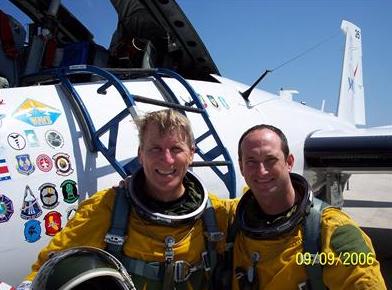
I confess - I was wrong about the photo on the previous post being taken from the ISS, and Al Reynolds proved it (see the discussion thread for details). And from the thread on digg.com that Al Reynolds ferretted out, courtesy of CubicZirconia, these are the guys who took the photograph from their WB-57 reconnaissance plane. They look more like astronauts than astronauts. More links to cool pictures on that site by the way...

Monday, October 30, 2006

Why I Write, Part 12


I pulled this down from one of the message boards where I lurk. I think it came from NASA via Warren Ellis’s site, but I’m not privy to the latter and can’t locate it on the former. Anyway, it’s beautiful: a shuttle launch photographed from the International Space Station.

Revenge of the Dorkofascist Galacticons

Via Jack Womack: Why the right wing fell in and out of love with Battlestar Galactica, or, what’s really wrong with US science fiction right now.

Sunday, October 29, 2006

Down with skool!

Lucy Ellmann, in a review of Elfriede Jelinek’s Greed, starts testifying:

What is killing the novel is people’s growing dependence on feel-good fiction, fantasy and non-fiction. With this comes an inability or unwillingness to tolerate any irregularities of form, a prissy quibbling over capital letters, punctiliousness about punctuation. They act like we’re still at school! Real writing is not about rules. It’s about electrifying prose, it’s about play.

Amen, sister! Amen!

As in mainstream fiction, so in science fiction. Why have we allowed the commissars of correctness to stamp their boot on what should be one of the most vital, playful and imaginatively transgressive genres, turning it into a bland prose factory churning out product by the yard?

Friday, October 27, 2006

Players - 14

Dirk Merrit was sitting at his big desk in the library, his white, angular face steeped in the glow of the computer’s flat screen, his right hand twitching a cordless mouse as he scrolled across a set of architectural plans. On the other side of the dark room, the plasma TV and the bank of smaller screens around it were all showing the same looped clip, sound muted, taken from the local TV station’s evening news: a wasted-looking fellow in black lunging at a much bigger man in an orange jumpsuit, the picture jolting as the camera was caught in the mêlée, showing a confusion of feet, a blur of indistinct motion, settling on a woman in a grey pants suit throwing the man in black against the side of a police cruiser, pinning him there while a sheriff’s deputy handcuffed him. Each time the clip jumped back to its beginning, light and shadow swung across the walls like a flock of birds turning on the wing.

Carl Kelley, walking across the room through television light, knew that Dirk Merrit could hear the ticking of his combat boots on the poured-concrete floor, but the man waited a full minute before dismissing with a click of the mouse the plans he had been scrutinizing -- the plans for the mansion -- and swinging around in his chair. After Carl had explained that he’d overhauled and fuelled up the RV, and packed the ultralight into its trailer, that everything was good to go,

Dirk Merrit said, ‘Tomorrow, at dawn.’

‘It’s your party.’

‘I have the feeling that you’re still angry because I choose to honour the sacrifice rather than give in to expediency.’

Carl didn’t want to get into that again. ‘How’s he doing?’

‘He’s angry, too,’ Dirk Merrit said. ‘He threw his dinner at the wall and stood there in the dark with his fists raised. I believe he was hoping to get into a fight. He’s a feisty boy, Carl. We’re going to have a lot of fun together.’

‘The quiet ones usually run better.’

‘We’ll see.’ Dirk Merrit gestured at the rack of TVs. ‘Do you know what that’s all about?’

‘I imagine the big bloke in orange is the one we framed.’

‘Looks suitably crazy, doesn’t he?’

Carl shrugged.

‘I do hope you’ll be over your sulk tomorrow,’ Dirk Merrit said. He sounded amused.

‘I just came up to report that everything is ready. If there’s nothing else, I’d like to turn in, seeing as how we have an early start.’

‘The fellow in black, he’s the girl’s stepfather. The woman, there . . . ’ Dirk Merrit turned back to his computer, moved the mouse to the menu bar at the bottom of the computer screen, clicked on an icon. Across the room, the action froze on the TVs. ‘She’s a detective from the Portland Police Bureau. Do you think it signifies anything?’

‘She probably brought the stepfather here to ID the girl’s body.’

‘I think so too.’ Dirk Merrit clicked the mouse again and the sequence ran on, the detective shoving the stepfather against the side of the cruiser and pinning his arms while a sheriff’s deputy handcuffed him. Dirk Merrit saying, ‘She’s rather feisty too, don’t you think? I bet I could have a lot of fun with her, in the right circumstances.’

Friday, October 20, 2006

Don't Look Back In Anger

Science fiction is in trouble, no doubt about that, either. It has lost a considerable share of the market it once owned, its audience is growing older because it is having trouble attracting new readers, and it has lost confidence in itself. Reading through the responses to my little rant, and thinking on it some more, I know that I can’t offer a pat solution to this (and hey, if I had a solution, do you think I would share it with you, until I’d written that genre-defining, best-selling novel?). But I think a couple of things have become clearer.

There’s nothing wrong with old skool sf. There isn’t even anything wrong with old-fashioned Star Wars style sf, if that’s what floats your boat. But if that’s all science fiction has to offer, then it will no longer be a vital genre: it will have become a museum of taxonomy. Because retreating from the present into the familiar comfort of the past means giving up on something that makes science fiction distinctive. It means no longer dealing with the shock of the new, no more wild extrapolations or metaphorical constructs ripped from the bleeding edge of science and technology, an end to pushing trends to their limits, and explorations of the limits of what makes us human. Goodbye to all that; hello to a little cell that’s getting smaller by the minute, padded with worn-out tropes from some mythical Golden Age, inhabited by catatonics.

Science fiction isn’t going to win a new and wider audience by turning its back on the world and talking to itself. It has to engage. It has to produce novels that are part of the world’s conversation. Paul Cornell is right. If someone somewhere could write a definitely great populist but finely imagined science fiction novel, it would not only be a lovely thing in its own right; it would, like a supernova, make the science fiction galaxy more visible. But I’d go further. One singular novel, or one lone author, is in danger of being traduced by the too-good-to-be-science-fiction brigade. If we’re going to get our mojo back, we need a shelfload of good books that connect the present with fabulous futures, weird worlds, and even weirder ideas made as real and plausible as any armchair.

So if you’re a writer, write from the heart as well as from the mind. Aim for an audience if you like, but know this: at best you’re going to hit nothing more than a temporary, here-and-gone demographic. Wouldn’t it be better to try to write the book that means more to you than any other book? You’ll probably fail. But you can always try again, and fail better. And, dear reader: buy books. Tell people about the books you like. Spread the word. Behave like you have found the best and finest secret in the world. And who knows? Perhaps you have.

Thursday, October 19, 2006

Players - 13

Denise Childers said, ‘When we talked last night, on the phone, you said you’d be willing to help out.’

Summer said, ‘I’m still willing.’

‘That’s good, because I have a couple of favours to ask,’ Denise said. ‘First off, I’d like to take you up on your offer of finding out whatever you can about this boyfriend, this Billy no-last-name. What he does, who he associates with . . . You know, the usual stuff. If you could track him down and bring him here, I’d love to sit with him and have a long talk about Edie Collier.’

‘Is this an official favour?’

‘If you mean, am I going to get Sheriff Worden to ask your boss if he can give you some time and resources to chase up any leads, then no, it isn’t exactly official. As far as the sheriff’s concerned, the case is down. Nothing to see, time to move on. Otherwise I’d go up to Portland myself.’

‘I guess I can talk to Edie’s probation agent when I get back, and ask around at the place where she worked. But I’ll have to clear it with my sergeant first, and he’s already pissed because I’m taking an extra day down here.’

‘If it’s going to cause problems . . . ’

‘I’ll find a way around it,’ Summer said. ‘I have my own reasons for wanting to help out.’

Denise smiled. ‘Jerry and his little practical joke being one of them, I bet.’

Summer smiled too, relieved that Denise had brought it up. ‘If you mean the dust-up between
Randy Farrell and Joseph Kronenwetter, then yes.’

‘You probably don’t know it, but Jerry is good friends with the TV reporter who just happened to be there when your Mr Farrell and Joe Kronenwetter pitched up at the same time. Right now he’s probably telling his buddies down at the Hanging Drop, the cop bar, all about it.’

‘I already had a pretty good idea that he’d set it up,’ Summer said, and explained about the phone calls Jerry Hill had made at the morgue, his beeper going off on the way back to the Sheriff’s office. ‘It isn’t just about that, though. I want to do right by Edie Collier, and I think there’s a lot more to what happened than your sheriff wants to believe.’

Denise said, with a sad smile, ‘It’s a real heartbreaker, all right.’

There was a silence. Summer saw Edie Collier’s face plain, her serene indifferent calm, and knew that Denise was seeing her too.

Summer said, ‘You said you had a couple of favours to ask. If finding Edie Collier’s boyfriend is one, what’s the other?’

‘I’m going to visit someone who might shed some light on the nature of Joe Kronenwetter’s monster, and the question of why Edie Collier ended up where she did. I was wondering if you wanted to come along.’

Wednesday, October 18, 2006

Why I Write, Part 302

Tuesday, October 17, 2006

Beneath The Valley Of Top Of The Pops

A bunch of top, terrifying and positively weird outsider tunes courtesy of the archived 365 Days Project. My top three so far: the bathos of ‘Love Hurts’ by the Phi Mu Washboard Band (144), the unexpectedly lush arrangement of Barbie and Ken’s ‘Nobody Taught Me’ (151), and the cheerful lunacy of the Reverend Glen Armstrong’s ‘Even Squeaky Fromme Loves Christmas’ (148).

Sunday, October 15, 2006

Don't Fence Me In

I was supposed to get on with my attempt to jump-start the new novel today, having lost much of Friday thanks to an existential hangover caused by too much desperate fun at the launch of The Joke’s Over, Ralph Steadman’s book memorialising his times with Hunter S. Thompson. But after making some notes on the immediate direction of the plot and some local colour Sunday morning, I engaged in a little bit of monging around on the Web, came across Lou Ander’s rant and assorted associated pieces as noted above. So that was half the morning gone, hey ho.

Then, walking to the Farmer’s Market (yeah, I’ve been getting really bourgeois lately), I became more and more enraged by Kristine Kathryn Rusch’s piece in Asimov's, mostly because it exemplifies the lamentably pious, holy-than-thou obsession with definitions that's becoming rife in the science-fiction community. If you really want to kill SF as a genre, go right ahead and tell people what is and what isn’t really SF, and don’t forget to exclude people whose work borrows from and expands on the central themes and tropes of the genre simply because they forgot to include a heroic narrative or some other tick mark that meets the approval of the Guardians of the True Quill.

Listen, here’s the secret. There’s no one right way to write a novel. There’s no one correct style, or tense, or subject, or angle of attack. But the one thing all novelists should be doing is aiming at the Universal nerve. Literary novelists try to hit the Universal by particularising the experiences and inner life of a character. Science-fiction novelists try to hit the Universal by particularising the Universe. And since the Universe contains pretty much everything, SF should be a big, roomy mansion that welcomes all kinds of fantastic fiction. Instead, it’s becoming a shabby little theme park jealously guarded by self-appointed narrow-minded gate-keepers. If you want to save SF, argue right back. Better still, laugh at them. Because their Achilles heel is this: they don’t have any sense of humour.

And while we’re at it, what’s this American obsession with the New Wave? Look, it happened thirty years ago. It shook things up a bit, it added some useful stuff to the common humus of the genre, but the people responsible have moved on. It isn’t around anymore. It’s as dead as a parrot. So why are people still acting as if filthy dirty New Wavers are about to ravish their precious little genre and piss on the furniture afterwards? Get over it, or get out of the way.

True Grit

I guess I should mention this little pearl from the wonderfully passionate Lou Anders, in part grown around a bit of grit I sent to Meme Therapy in answer to a question they asked. Ian McDonald has some good things to say too, especially about Kristine Kathryn Rusch’s unfocused idea that SF is too serious, should get back to the kind of entertainment you find in tie-ins and Star Wars, and Lou Anders follows up here.

Friday, October 13, 2006

Onward

The proofs of Players are finally back with the publishers, margins red-inked with the thorny squiggles used for marking up copy for composition, fixed now in its final form.

While I’ve been reading my book backwards and forwards very very slowly, the Ig-Nobel prizes have been awarded (my favourite is the investigation into why dry spaghetti strands usually break into more than two pieces when flexed, something that briefly engaged the late great Richard Feynman), the Mars rover Opportunity reached Victoria crater, which is where it will probably spent the rest of its unexpectedly long life (Opportunity and Spirit were expected to remain functional for only 90 Martian days; so far they’ve spent an amazing 970 Martian days exploring the surface), and Yahoo is collecting stories and pictures which it plans to laser into space and also archive in a digital time capsule.
Newer Posts Older Posts