Sunday, December 24, 2006

Players - 21

The blonde waitress, Janice, was a tall and big-boned young woman, with acne in the corners of her mouth and too much blue eyeshadow. She said that she’d heard about what happened to Edie on the TV news, just about everyone was cut up about it, and confirmed that Edie had been at work last Thursday but hadn’t turned up on Friday. ‘It’s a fucking shame what happened to her, excuse my French. She was a real darlin’. Everyone but Sneaky Pete liked her.’

‘Sneaky Pete?’

‘Mr Schopf, the manager? I don’t suppose he was much help to you.’

Janice had an accent from someplace three thousand miles south and east of Portland that lifted every other sentence into a question. She wore a candy-striped cotton dress and a white apron with a scalloped trim. Her dirty blonde hair was pulled back in a ponytail fastened with a rubber band, and there was a ballpoint pen tucked behind her ear.

Summer said, ‘Mr Schopf thought you might be able to help me.’

‘I don’t know how I can, but I can try.’

The girl was shifting from foot to foot in her trodden-down flat-heeled shoes, easing the weight on her ankles. Summer suggested that they sit in an empty booth. When they were settled, she said, ‘Did you know Edie socially, or just here at work?’

‘Just at work. We talked when we snuck cigarettes out back? I know she was on probation, and she wanted to go straight. Her big idea, she wanted to go work in one of those big offices downtown. Excuse me.’ Janice pulled a handkerchief from her sleeve and dabbed at the corners of her eyes and said in a pinched voice, ‘I thought she was sweet, y’know?’

Summer said, ‘Did she have a boyfriend that you knew of?’

Janice blew her nose with surprising delicacy. ‘She sure did. Real nice boy, name of Billy.’

Summer felt a quick flare of hope. ‘Did you ever meet this Billy?’

‘Just the once. He came by on Edie’s first day. I think he wanted to see where she was working?’

Garrulous, sharp-eyed Janice, every cop’s idea of a dream witness, gave Summer a description of Edie Collier’s boyfriend: six foot nothing, brown eyes and cheekbones to die for, shoulder-length black hair, rangy, wearing Hi-Top sneakers, blue jeans out at both knees and a raggedy old T-shirt. ‘And he had a couple of fingers missing from one of his hands.’

‘Which hand?’

‘The right.’

‘Can you remember which fingers were missing?’

‘The little finger, and the one next to it.’ Janice wrinkled her nose, remembering. ‘They were cut off at the knuckle? He kept his hand behind him, or in his pocket, like he was ashamed of it, but I saw it when he lit a cigarette.’

‘Did Edie ever tell you how her boyfriend lost his fingers? Was it some kind of industrial accident, for instance?’

‘Uh-uh.’

‘How about his last name?’

Janice looked up at the ceiling for a moment, thinking. ‘I don’t believe it ever came up. Like I said, I only met him that one time.’

‘Did Edie mention what he did for a living?’

‘I believe it was something to do with computers. He played games in competition, something like that? I know when he came in that time he had one of those laptop cases. But whatever he was into, it can’t have earned him much money -- the two of them were living out of his van.’

Thursday, December 21, 2006

Players - 20

The Black Rock Desert, Nevada. The sun a fiery nail hammered high in the wide blue sky; hot wind blowing threads of alkali dust across the playa towards bare mountains rippling behind glassy layers of heat haze.

Carl Kelley was standing in a thin wedge of shade at the rear of the big RV, wearing a baseball cap, an unbuttoned denim shirt and black combat pants, sipping from a bottle of spring water, and watching with edgy and uncharacteristic impatience as Dirk Merrit’s ultralight stooped and turned and climbed a couple of miles away. The buzz of the ultralight’s rear-mounted prop sounded like a bee at a window, rising and falling as Merrit harried the sacrifice to and fro across the dry lake bed, taking his bloody time about it.

The RV, a Coachman Cross Country SE finished with ten coats of hand-rubbed black lacquer and customized from stem to stern, was an ideal way of transporting sacrifices to remote sites where Dirk Merrit could act out his fantasies. The sacrifice could be kept trussed and gagged on the bed in the main sleeping compartment; Dirk Merrit liked to stretch out his unlikely length on the modified recliner behind the big, comfortable driver’s chair. And because people who own RVs often attach all kinds of leisure equipment to them, no one looked twice at the trail bike hung on the rear rack, or the Cumulus motor glider folded on its twenty-foot trailer.

The volume of the walkie-talkie clipped to Carl’s belt was turned right down because he was tired of listening to Dirk Merrit’s breathless whoops of glee, and he didn’t bother to follow the action with the pair of Bushnell field glasses hung around his neck because he knew from all the other times how it would go. If the sacrifice stood its ground, Dirk Merrit would fire shots around it until it ran; when it ran, he chased it and dive-bombed it and took pot shots until it was too tired to run any more, and then he landed and dispatched it with his crossbow.

All in all, it was an expensive, complicated, and dangerous way to get your rocks off, and Carl had lost all patience with it. Also, he felt a squirt of acid in his blood every time the flimsy little aircraft swooped low. Dirk Merrit took unnecessary risks because he thought he was smarter than anyone else and was going to live for ever. Carl would be glad enough to see the back of him, but it wasn’t quite time for him to die. Soon, but not quite yet.

Actuality

I’ve just received advanced copies of Players, and as usual had the strange feeling holding in my hand a physical representation of something that’s been in my head for the past couple of years. I must say the design and layout is striking and quite handsome. But as yet, I haven’t read any of it, being very aware of the Awful Curse of the About-To-Be-Published: an author, on reading in the first copy of his new book a random sentence on a random page will spot a howler that’s entirely his own fault. Unread, the book remains, like Schrodinger’s cat, uncollapsed into its final quantum state.

Wednesday, December 13, 2006

Players - 19

Summer sat at the back of the wood-panelled courtroom and watched things go down pretty much as Mark Kirkpatrick had predicted. A line of shackled prisoners shuffled in, mostly wife-beaters, petty thieves and hung-over drunks, all of them wearing orange jumpsuits with ‘Macabee County Correctional Facility’ stencilled in black letters across their chests and backs. Randy Farrell was hunched between a wincing teenager and a dignified black man with a shaven head. When he noticed that Summer was looking at him, something hardened in his face and he looked away.

The court officer, a balding man wearing an ancient Colt in a worn leather holster under his paunch, ordered everyone to rise, and the judge appeared from a door behind the bench like a figure in a medieval clock. Randy Farrell’s case was first up. Mark Kirkpatrick said that his client wished to plead guilty, and asked to approach the bench. He had a brief whispered conversation with the judge, stepped back. The judge fixed Randy Farrell with a sharp stare and told him that assault on an officer of the law was a serious matter, but given the circumstances and the recent tragic events she was minded to mitigate the sentence to a fine of five hundred dollars and a suspended sentence of a hundred days. The prosecutor made no objection, and the judge banged her gavel and moved on to the next case.

After that, everything moved with the smooth dispatch of a well-rehearsed execution. Randy Farrell was released into Summer’s custody, and after he had changed into his own clothes in a restroom and paid his fine at the cashier’s desk Summer drove him out of the parking lot and through Cedar Falls’s one-way system to the I-5.

Although no one followed them, Summer had the feeling that a hundred years ago they would have been tarred and feathered and ridden out of town on a rail. She let Randy Farrell sit up front next to her, but he hardly said a word on the long trip back to Portland.

Tuesday, December 05, 2006

Players - 18

Joseph Kronenwetter’s neighbour was a widow by the name of Rhonda Cannon, a sensible, sharp-eyed, garrulous old bird in jeans and a man’s shirt. She had no objection to answering Summer’s questions, telling her that she had known Joe Kronenwetter from birth, it was a darn shame he’d turned out the way he did.

‘He was a nice little boy, tow-haired and cute as apple pie. He got into a few scrapes with the law when he was a teenager, but it wasn’t anything serious, and he straightened up after he joined the army. His father, now, he was a drinking man. That’s how they reckon the house burned down, he passed out one evening with a lit cigarette in his hand. It was just after Christmas, in the middle of a snowstorm. My husband -- he was still alive then -- saw a light flickering through the falling snow, and realized the Kronenwetters’ place was on fire. It took the fire trucks more than an hour to arrive, not that it would have made any difference if they had turned up right away: the house was already alight from top to bottom when my husband spotted it. It was one of the strangest sights I’ve ever seen in my life, that house throwing yellow flame and black smoke into the night and snow coming down all the while.’

‘Joseph Kronenwetter was in the army at the time.’

‘Yes, ma’am, getting ready for the First Iraq War. He was given compassionate leave when his parents died in the fire, came back for the funeral, stood straight and tall in his dress uniform by his parents’ grave, and then he went right back to Kuwait to fight Saddam. He’s the only one of his family left. He had an older brother that died in a traffic accident, and there’s a sister who upped and went to live in Los Angeles, no one knows if she’s alive or dead. Anyhow, either the deaths of his parents hit him hard or something happened to him in Kuwait, but when he quit the army and came back here you could see at once that he was a changed man. He’d never been what you could call talkative, but when he came back he didn’t hardly care to pass the time of day. He was drinking heavily, he grew his hair and shambled about in ragged clothes like he was some kind of hobo, and when he did talk to you it was most often to sound off about how people were out to get him.’

‘What kind of people?’

Rhonda Cannon looked away, shrugged. ‘Oh, it was just nonsense. He said that people were hiding in the woods and watching him, nonsense like that. I paid it no heed.’

Summer said, ‘I know you don’t want to speak ill of your neighbour, ma’am. But anything you know about him could help us understand why this happened. It might even help him.’

‘I can’t see how, seeing as you have him locked up.’

‘It might help get him the right treatment.’

Thursday, November 30, 2006

Have A Very Cthulhu ...

...Christmas.

Thursday, November 23, 2006

Players - 17

When his mother came back from work at half past midnight, Daryl Weir was still up, still deep in Trans. A slender, athletic black boy who looked a lot younger than his sixteen years, he was sitting cross-legged on a corduroy beanbag in T-shirt and boxers, hands folded around his customized controller, his face about a foot from the screen of his computer. The screen was the only source of light in the small, stuffy bedroom. It showed a solidly built man in a leather kilt and a harness hung with all kinds of kit marching at a steady pace down a ruined street, cradling an AK-47 in his muscular arms.

The man in the kilt was Daryl’s avatar, a fortune hunter with the handle Seeker8. Daryl was watching him from the usual player’s viewpoint, a few yards behind the back of his head, and steering him with his left thumb. The street stretched away across a parched plain gridded with low ruins and overgrown with a scrub of leafless bushes and a scattering of giant cactuses with crooked arms raised in surrender against a technicolour sunset. When he heard his mother call his name through the closed door of his room, Daryl hunched a fraction of an inch closer to the screen. He really didn’t need any distraction right now, not when Seeker8 was still a long way from the next save point and night was coming on fast.

The front door of the tiny apartment opened directly onto the living room, with the main bedroom and the bathroom off to the left, and the second bedroom, Daryl’s, and the kitchen off to the right. As Seeker8 marched along at an unvarying pace down the middle of the street, past the rusted shells of cars, low mounds of rubble, and street lights leaning at different angles, Daryl heard through the thin plasterboard wall the solid clunk of the refrigerator opening and closing, and knew that his mother was pouring herself a glass of chocolate milk. In a moment the TV would come on; when she got back from her night work, cleaning bank offices in Manhattan, his mother liked to relax in front of the TV with a comforting drink, a White Russian or iced chocolate milk spiked with vodka, before going to bed. But instead of the sudden blare of the TV, the door behind Daryl clicked open, and his mother said, ‘Sweetie, you still up?’

Thursday, November 16, 2006

Quote of the Week

'Very few people would want to have their brain replaced by someone else’s...’

Professor Bruce Lahn, New Scientist

Wednesday, November 15, 2006

Players - 16

Across the room, the rack of TVs flooded with red light. All of them showed the same picture: a man with an unlikely muscular build in leather harness and a kilt jogging through the levelled ruins of a city.

Dirk Merrit said, ‘Remember him?’

Carl was getting a very bad feeling. ‘He’s the partner of your latest sacrifice. The one in Brooklyn. The one you said you weren’t interested in. The one you said would give up after he was left on his own.’

‘Because he was younger and more inexperienced, yes. But he has managed to reach the ruins of Los Angeles after all. He’s been beaten back three times, but he is persistent and clever. He’s a stayer after all. If I don’t do anything, I do believe he’ll reach the oracle soon. And if he has the password that gets him past the oracle, or if he can guess it, he’ll be one step away from the source of those valuable trinkets Mr Hunter Smith likes to sell on eBay.’

‘So put the wolves on him,’ Carl said.

The wolves were a bunch of players in a Romanian click farm, paid by Dirk Merrit to defend the Los Angeles basin from intruders.

On the TV screens, the muscular man jogged past a row of dead palms. Their shrivelled fronds were etched black against a swollen red sun.

Dirk Merrit said, ‘His game profile suggested that he was the junior partner. But now I’ve had to revise my opinion. Not just because of what he has achieved on his own: I’ve read the emails he exchanged with our sacrifice, too. He’s a prodigy.’

‘I thought you’d given up trying to crack that laptop.’

When Carl had kidnapped the latest pilgrim and his girlfriend, he’d brought the guy’s laptop back too.

‘It was quite a clever little bit of encryption. But as it turns out, I’m cleverer,’ Dirk Merrit said complacently. ‘I read every one of this player’s emails, and he’s easily the equal of his partner. Which means that he’s equally worthy of my attentions.’

Sunday, November 12, 2006

Meanwhile . . .

I’ve been pounding away at the first draft of a novel for the past few weeks, getting up to speed, getting inside the beast. And at the same time I’ve been tackling an edit of another novel . . . Which is why I’ve been posting with decreasing frequency, I’m afraid.

Meanwhile, Al Reynold’s marvellous short-story collection, Zima Blue, for which I wrote the introduction, is available in trade and limited edition from Nightshade Books.

Forbidden Planets, edited by Peter Crowter Is Out Right Now, and includes my short story ‘Dust’. About which I said:

The creators of Forbidden Planet made no secret of the fact that they’d borrowed and updated the plot of Shakespeare’s The Tempest. In the same spirit, I hope that no one minds that my little homage to that marvelous film borrows and updates its robots, monsters, and super-technology hidden in an underground alien city.

And Jonathan Strahan has posted the fantabulous listing for the space opera anthology he’s editing with Gardner Dozois. I am not worthy . . .

Wednesday, November 08, 2006

Players -15

Denise and Summer drove down a road that switchbacked between trees and outcrops of rock, a sharp bend suddenly revealing a narrow valley blocked by a tall wedge of white concrete, stark in the floodlights burning along its top. Straight ahead, halfway up the side of the valley, was a broad shelf where three towers stood, also floodlit.

Denise said, ‘That’s the dam, and that’s Merrit’s house -- if you can call it a house.’

It was like a fairy-tale castle, Summer thought, or a trio of old-fashioned rocket ships. The tallest tower was easily a hundred and fifty feet high, with a little glass dome glinting at the top -- yeah, just like a spaceship. The other two towers were shorter; one looked half finished, ending in an uneven crown of rebar. Arrow-slits and round windows shone at different heights in their smooth, tan walls.

Denise parked her Jeep Cherokee behind a black Mercedes SUV at the foot of the tallest tower. She and Summer got out and buckled their bracelets to their wrists. It was very quiet. A steep wooded slope rose on their left towards the black sky. The other two towers were spotlit beyond rocks and stands of bamboo. Although Summer was amused by the obvious theatricality of this spooky setting, she felt a tickle of apprehension as she followed Denise to the smooth flank of the tower, where a castle door swung open silently, a touch straight out of some dumb horror movie. The foyer, pinched between a pair of curving staircases and lit by the lurid flicker of a cluster of TV sets that hung overhead like a chandelier, narrowed to a big steel door that, like the castle door, swung open when Denise and Summer walked towards it, revealing a large room with leather couches and armchairs grouped around an open fireplace in the centre. There were all kinds of objects in niches and behind glass in the adobe walls, clusters of animal heads hung above them, and a tall man stood on the far side, his back to Summer and Denise as he studied or pretended to study a flat-screen TV that was showing some kind of cartoon, a Mad Max-style warrior jogging along a ruined street towards a cluster of broken skyscrapers.

The man’s hands were clasped behind him, dead white against the green silk of his robe -- no, it was a kimono, Summer realized, that big red target on the back was a chrysanthemum. The tall collar of the kimono was turned up, so that she couldn’t see his head; its hem ended just above his knees. His shanks were as pale as his hands, and as hairless as a mannequin’s.

He kept his back to Summer and Denise as they approached. ‘Detective Childers, so nice to see
you again,’ he said. ‘Congratulations on the arrest, by the way. It’s good to know that our police are so efficient. Or should I say so lucky?’

His voice was a light baritone, as engaging as a chat-show host’s.

‘It was a little of both,’ Denise said. ‘This is -- ’

‘Detective Summer Ziegler of the Portland Police Bureau,’ Dirk Merrit said, and turned in a sudden flare of green silk.

Summer’s first thought was that it was a cheesy move that he must have practised a lot. Her second was that he was wearing a mask. Then he smiled at her, and it was as if a red wound had opened in his stiff white face.

Thursday, November 02, 2006

Boy, Is My Face Red


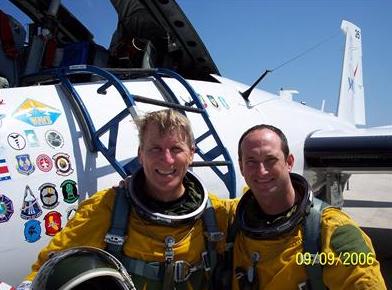
I confess - I was wrong about the photo on the previous post being taken from the ISS, and Al Reynolds proved it (see the discussion thread for details). And from the thread on digg.com that Al Reynolds ferretted out, courtesy of CubicZirconia, these are the guys who took the photograph from their WB-57 reconnaissance plane. They look more like astronauts than astronauts. More links to cool pictures on that site by the way...

Monday, October 30, 2006

Why I Write, Part 12


I pulled this down from one of the message boards where I lurk. I think it came from NASA via Warren Ellis’s site, but I’m not privy to the latter and can’t locate it on the former. Anyway, it’s beautiful: a shuttle launch photographed from the International Space Station.

Revenge of the Dorkofascist Galacticons

Via Jack Womack: Why the right wing fell in and out of love with Battlestar Galactica, or, what’s really wrong with US science fiction right now.

Sunday, October 29, 2006

Down with skool!

Lucy Ellmann, in a review of Elfriede Jelinek’s Greed, starts testifying:

What is killing the novel is people’s growing dependence on feel-good fiction, fantasy and non-fiction. With this comes an inability or unwillingness to tolerate any irregularities of form, a prissy quibbling over capital letters, punctiliousness about punctuation. They act like we’re still at school! Real writing is not about rules. It’s about electrifying prose, it’s about play.

Amen, sister! Amen!

As in mainstream fiction, so in science fiction. Why have we allowed the commissars of correctness to stamp their boot on what should be one of the most vital, playful and imaginatively transgressive genres, turning it into a bland prose factory churning out product by the yard?

Friday, October 27, 2006

Players - 14

Dirk Merrit was sitting at his big desk in the library, his white, angular face steeped in the glow of the computer’s flat screen, his right hand twitching a cordless mouse as he scrolled across a set of architectural plans. On the other side of the dark room, the plasma TV and the bank of smaller screens around it were all showing the same looped clip, sound muted, taken from the local TV station’s evening news: a wasted-looking fellow in black lunging at a much bigger man in an orange jumpsuit, the picture jolting as the camera was caught in the mêlée, showing a confusion of feet, a blur of indistinct motion, settling on a woman in a grey pants suit throwing the man in black against the side of a police cruiser, pinning him there while a sheriff’s deputy handcuffed him. Each time the clip jumped back to its beginning, light and shadow swung across the walls like a flock of birds turning on the wing.

Carl Kelley, walking across the room through television light, knew that Dirk Merrit could hear the ticking of his combat boots on the poured-concrete floor, but the man waited a full minute before dismissing with a click of the mouse the plans he had been scrutinizing -- the plans for the mansion -- and swinging around in his chair. After Carl had explained that he’d overhauled and fuelled up the RV, and packed the ultralight into its trailer, that everything was good to go,

Dirk Merrit said, ‘Tomorrow, at dawn.’

‘It’s your party.’

‘I have the feeling that you’re still angry because I choose to honour the sacrifice rather than give in to expediency.’

Carl didn’t want to get into that again. ‘How’s he doing?’

‘He’s angry, too,’ Dirk Merrit said. ‘He threw his dinner at the wall and stood there in the dark with his fists raised. I believe he was hoping to get into a fight. He’s a feisty boy, Carl. We’re going to have a lot of fun together.’

‘The quiet ones usually run better.’

‘We’ll see.’ Dirk Merrit gestured at the rack of TVs. ‘Do you know what that’s all about?’

‘I imagine the big bloke in orange is the one we framed.’

‘Looks suitably crazy, doesn’t he?’

Carl shrugged.

‘I do hope you’ll be over your sulk tomorrow,’ Dirk Merrit said. He sounded amused.

‘I just came up to report that everything is ready. If there’s nothing else, I’d like to turn in, seeing as how we have an early start.’

‘The fellow in black, he’s the girl’s stepfather. The woman, there . . . ’ Dirk Merrit turned back to his computer, moved the mouse to the menu bar at the bottom of the computer screen, clicked on an icon. Across the room, the action froze on the TVs. ‘She’s a detective from the Portland Police Bureau. Do you think it signifies anything?’

‘She probably brought the stepfather here to ID the girl’s body.’

‘I think so too.’ Dirk Merrit clicked the mouse again and the sequence ran on, the detective shoving the stepfather against the side of the cruiser and pinning his arms while a sheriff’s deputy handcuffed him. Dirk Merrit saying, ‘She’s rather feisty too, don’t you think? I bet I could have a lot of fun with her, in the right circumstances.’

Friday, October 20, 2006

Don't Look Back In Anger

Science fiction is in trouble, no doubt about that, either. It has lost a considerable share of the market it once owned, its audience is growing older because it is having trouble attracting new readers, and it has lost confidence in itself. Reading through the responses to my little rant, and thinking on it some more, I know that I can’t offer a pat solution to this (and hey, if I had a solution, do you think I would share it with you, until I’d written that genre-defining, best-selling novel?). But I think a couple of things have become clearer.

There’s nothing wrong with old skool sf. There isn’t even anything wrong with old-fashioned Star Wars style sf, if that’s what floats your boat. But if that’s all science fiction has to offer, then it will no longer be a vital genre: it will have become a museum of taxonomy. Because retreating from the present into the familiar comfort of the past means giving up on something that makes science fiction distinctive. It means no longer dealing with the shock of the new, no more wild extrapolations or metaphorical constructs ripped from the bleeding edge of science and technology, an end to pushing trends to their limits, and explorations of the limits of what makes us human. Goodbye to all that; hello to a little cell that’s getting smaller by the minute, padded with worn-out tropes from some mythical Golden Age, inhabited by catatonics.

Science fiction isn’t going to win a new and wider audience by turning its back on the world and talking to itself. It has to engage. It has to produce novels that are part of the world’s conversation. Paul Cornell is right. If someone somewhere could write a definitely great populist but finely imagined science fiction novel, it would not only be a lovely thing in its own right; it would, like a supernova, make the science fiction galaxy more visible. But I’d go further. One singular novel, or one lone author, is in danger of being traduced by the too-good-to-be-science-fiction brigade. If we’re going to get our mojo back, we need a shelfload of good books that connect the present with fabulous futures, weird worlds, and even weirder ideas made as real and plausible as any armchair.

So if you’re a writer, write from the heart as well as from the mind. Aim for an audience if you like, but know this: at best you’re going to hit nothing more than a temporary, here-and-gone demographic. Wouldn’t it be better to try to write the book that means more to you than any other book? You’ll probably fail. But you can always try again, and fail better. And, dear reader: buy books. Tell people about the books you like. Spread the word. Behave like you have found the best and finest secret in the world. And who knows? Perhaps you have.

Thursday, October 19, 2006

Players - 13

Denise Childers said, ‘When we talked last night, on the phone, you said you’d be willing to help out.’

Summer said, ‘I’m still willing.’

‘That’s good, because I have a couple of favours to ask,’ Denise said. ‘First off, I’d like to take you up on your offer of finding out whatever you can about this boyfriend, this Billy no-last-name. What he does, who he associates with . . . You know, the usual stuff. If you could track him down and bring him here, I’d love to sit with him and have a long talk about Edie Collier.’

‘Is this an official favour?’

‘If you mean, am I going to get Sheriff Worden to ask your boss if he can give you some time and resources to chase up any leads, then no, it isn’t exactly official. As far as the sheriff’s concerned, the case is down. Nothing to see, time to move on. Otherwise I’d go up to Portland myself.’

‘I guess I can talk to Edie’s probation agent when I get back, and ask around at the place where she worked. But I’ll have to clear it with my sergeant first, and he’s already pissed because I’m taking an extra day down here.’

‘If it’s going to cause problems . . . ’

‘I’ll find a way around it,’ Summer said. ‘I have my own reasons for wanting to help out.’

Denise smiled. ‘Jerry and his little practical joke being one of them, I bet.’

Summer smiled too, relieved that Denise had brought it up. ‘If you mean the dust-up between
Randy Farrell and Joseph Kronenwetter, then yes.’

‘You probably don’t know it, but Jerry is good friends with the TV reporter who just happened to be there when your Mr Farrell and Joe Kronenwetter pitched up at the same time. Right now he’s probably telling his buddies down at the Hanging Drop, the cop bar, all about it.’

‘I already had a pretty good idea that he’d set it up,’ Summer said, and explained about the phone calls Jerry Hill had made at the morgue, his beeper going off on the way back to the Sheriff’s office. ‘It isn’t just about that, though. I want to do right by Edie Collier, and I think there’s a lot more to what happened than your sheriff wants to believe.’

Denise said, with a sad smile, ‘It’s a real heartbreaker, all right.’

There was a silence. Summer saw Edie Collier’s face plain, her serene indifferent calm, and knew that Denise was seeing her too.

Summer said, ‘You said you had a couple of favours to ask. If finding Edie Collier’s boyfriend is one, what’s the other?’

‘I’m going to visit someone who might shed some light on the nature of Joe Kronenwetter’s monster, and the question of why Edie Collier ended up where she did. I was wondering if you wanted to come along.’

Wednesday, October 18, 2006

Why I Write, Part 302

Tuesday, October 17, 2006

Beneath The Valley Of Top Of The Pops

A bunch of top, terrifying and positively weird outsider tunes courtesy of the archived 365 Days Project. My top three so far: the bathos of ‘Love Hurts’ by the Phi Mu Washboard Band (144), the unexpectedly lush arrangement of Barbie and Ken’s ‘Nobody Taught Me’ (151), and the cheerful lunacy of the Reverend Glen Armstrong’s ‘Even Squeaky Fromme Loves Christmas’ (148).
Newer Posts Older Posts