Friday, April 27, 2007

I've Got Your Dilithium Right Here

Remember those crystal-filled caves that featured as alien planet backdrops in so many SF movies and serials in the 1960s and 70s? Here’s the real deal.

Wednesday, April 25, 2007

Double Vision

After reading this, I rubbed my eyes and wondered if the author had seen an advance copy of Cowboy Angels. He even has the obligatory reference to Pottersville.

Gosh Wow

The discovery of an Earth-like planet in the life-zone of another star, just twenty light years away, considerably bumps up the probability of extra-terrestrial life. Although since the planet in question orbits a red dwarf star once every twenty-seven days, it’s not going to be life as we know it . . . but we knew that anyway. 2007 may look nothing like 2001: A Space Odyssey, but what the heck: we’re living in a golden age of space science.

No Big Deal

Oliver Morton sends me details of the Douglas Adams Memorial Debate, hosted by the Institute of Ideas, pointing out that, despite its title, From Star Wars to the Battle of Ideas Is science fiction good for public debate? there aren’t any actual science-fiction authors on the panel.
Given that the publicity puff rehashes ancient left-overs like ‘Do writers and directors have a responsibility to make their science accurate, or even educational?’ and ‘Does sci fi skew our understanding of science?’ we aren’t missing out on much. And besides, an earlier incarnation of the Institute of Ideas sounds rather like a sinister cult from that gnomic TV sci-fi series Sapphire and Steel; I can’t help what Douglas Adams would make of the fact that a debate named in his honour has been taken over by a cadre of humourless, libertarian-loving ex-Marxists.

Meanwhile, here’s a real, solid piece on science fiction and speculation by a science-fiction author, published in today’s Guardian.

Sunday, April 22, 2007

Check It Out

Bobby Lightfoot tells it like it is.

(Thanks to William Gibson for the tip.)

Friday, April 20, 2007

And The Winners Are . . .

Now that Cormac McCarthy’s post-apocalyptic novel The Road has won this year's Pulitzer Prize for fiction and Ray Bradbury is the winner of a special citation, ‘for his distinguished, prolific and deeply influential career as an unmatched author of science fiction and fantasy,’ perhaps the science-fiction community can walk a little taller, and, where appropriate, remove the ‘kick me’ notes from their backs.

Saturday, April 14, 2007

Heroes Of The Write Stuff

An article in the financial section of today’s Guardian pegs a discussion of the current dismal state of highstreet bookshops in Britain on the story of how two heroes have made a success of an independent bookshop, Crockatt & Powell, near Waterloo station. Adam Powell used to work in Waterstones in Islington, one of my local bookshops, and he’s right on the mark when he comments about how depressing this once vibrant branch has become. Like all chain bookshops, its front of house is almost entirely taken up with three-for-two tables, with no sign of any individuality or attempt to cater to what Powell calls the hardcore customers - they people who buy 50-100 books a year.

Although the article is rightly scathing about the damage caused by the craven attitude of most publishers to supermarkets (and if you think Waterstones is dispiriting, check out the book shelves of a big Asda or Tescos), and doesn’t touch on the fact that almost all of the books displayed front-of-house in chains are there because the publishers have paid bungs to put them there. It costs publishers to get recommendations from chains too; it costs them even more to get their book in the window displays. It’s a scam that still doesn’t seem to be general knowledge. It’s almost killed off the midlist because no publisher is going to pay to promote a hardback thatwill probably sell no more than 2000 copies, or a paperback that won’t sell more than 5000 copies. And it’s killing off the chains because people who buy only a few books a year can get their fix at bargain prices at supermarkets, while discerning customers (who buy the most books) are fed up with being told what they should buy, and with shops that don’t stock what they’re looking for. A big hurrah, then, for people like Matthew Crockatt and Adam Powell, and let’s hope that the plan by Waterstone’s chief executive to makeover his shops so that they are able to ‘serve local communities’ succeeds without dumbing down their stocking policy in a vain attempt to match the brute buying power of the supermarkets. And if only there was some way that publishers, who are *losing money* on supermarket deals, would get together and agree to stop giving ridiculous discounts...

My own current reading? I’ve just finished Bryan Talbot’s Alice in Sunderland, a graphic novel that uses Lewis Carroll’s connections with Sunderland as the core of a phantasmagorical exploration of the tangled history of the town and its inhabitants. Provoking and poignant psychogeography that weaves a rich tapestry from individual human stories and lovingly burlesques all kinds of graphic stylings. And I’ve just started Walter Mosley’s Little Scarlet, a sure-footed thriller set in the aftermath of the 1965 Watts riots in Los Angeles, effortlessly carried by the strong and deceptively simple voice of its hero, Easy Rawlins.

Tuesday, April 10, 2007

The End Of The Beginning

It’s no more than a coincidence, but I can’t resist noting that as Cassini makes another pass close to Titan, I’ve finally reached the end of the first draft of the first of two Quiet War novels, with a penultimate scene down on the surface of Saturn’s largest moon, in the caldera of a volcano.
It’s been a long haul. The novel is supposed to be around 150,000 words. I seem to have committed 200,000 so far, with a few scenes missing and a couple truncated. But on the whole it’s better to come out long than short. Now it’s cut, cut, cut, and polish, polish, polish. My favourite part of the writing process, if truth be told. Because now I have a first draft with a beginning and an end, and an endless middle, I know that I have a novel. And hopefully, somewhere in this mass of verbiage, there’s something like the novel I had in mind when I started it, good grief, back in October. (I was interrupted by a rewrite and polish of Cowboy Angels after the editing process, but still: one thing I’ve learnt, it doesn’t get any easier.)

Something like . . . Some writers plan everything with ruthless thoroughness before setting out. Others polish one chapter before starting the next, so that when they reach that last full stop, they have, more or less, the finished object. As far as I’m concerned, the first draft is a kind of exploration of the territory within the boundaries set when I first had the idea for the novel. There are things in that territory that are smaller and far more insignificant than I believed them to be when I started out, and other things that have a far greater significance. And then there are the things, to lapse into a brief Rumsfeldian mode, that I didn’t know I knew, and the characters who somehow managed to rewrite their parts to get a lot more time than I thought they would have, way back when. The discoveries that make the long labour worthwhile.

Sunday, April 08, 2007

The Only Ones

I've been a fan of The Only Ones ever since my flatmate bought their first single ('Lovers of Today'/'Peter and the Pets'), and used to see them regularly in concert because I was living in Bristol back then, in the late 1970s, and their tours always seemed to finish there (I think their lead guitarist, John Perry, came from the area). They broke up in inglorious circumstances involved improbably amounts of drugs in the early 1980s, but now they're back. Truly, nothing is impossible in this strange, wonderful world. Time to dig out my 12 inch disc of 'Another Girl, Another Planet' before returning to Titan and the final haul . . .

Friday, March 30, 2007

Now Hear This

Alan Kaster of AudioText tells me that ‘Second Skin’ has just been released as a Great Science Fiction Stories audio selection. Check out their list.

‘Second Skin’ was the first of the Quiet War stories, and I’m steadily reaching the end of a novel that draws on them, although there’s been some rearrangement of the furniture for the current narrative dance. It’s been, good grief, ten years since ‘Second Skin’ was first published, and the series didn’t so much evolve as grow in various odd and whimsical directions. Rather than try to patch up their common background, I’ve dismantled it and rebuilt it. Only way to get it humming like a turbojet . . .

Wednesday, March 28, 2007

Re:interpretate

Elizabeth Nguyen writes to tell me that she, Mya Dosch, and Dominic Vendell wrote, directed and acted in this interpretation of the science in my novel White Devils as a visual aid for a presentation for their Biotechnology: Health and Society class. She adds: ‘Unfortunately, it is not at its completion - in its live showing each 'biotech' moment was accompanied by a brief description of a biotechnology mentioned in your book. Enjoy!’

I wonder if I convince my publishers that this would be a great way of advertising Cowboy Angels. It would involve rather a lot of guns though. And a cat in a box.

Saturday, March 24, 2007

Tick Tock

Why not submit a story for the clockpunk anthology?

(link via boingboing)

Friday, March 23, 2007

No Future

This is sad: NASA is to close its Institute for Advanced Concepts because of lack of money to keep it going. Apparently, every cent is needed for more immediate projects, including developing the new Orion exploration vehicle, a bigger version of the Apollo capsule, and meeting its goal of returning to the moon, and landing astronauts on Mars. But if even NASA can’t fund blue skies thinking and research into the feasibility of space elevators, novel robot explorers and antimatter space sails, and much more, the future of the future is just a little bit bleaker.

On a happier note, there’s a serious proposal that the new Orion vehicle could be used to land astronauts on a near Earth asteroid.

Sunday, March 11, 2007

Re: renaissance

Apparently, I’ve written a pioneering clockpunk novel. Cool.

Friday, March 09, 2007

As I was saying . . .

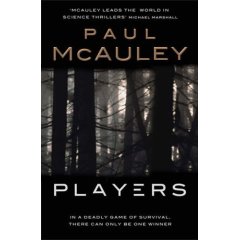
If only I was one of those writers who produce a book every two years - or even less frequently. Right now, I’d be celebrating the publication of Players by taking an extended holiday after having been wafted round an extensive signing tour. Or something. Instead, I’m caught up in a first draft hurtling towards its conclusion, and I’ve just received the copy-edited manuscript of Cowboy Angels, which I have to get back to the publishers so they can get bound proofs ready for the London Book Fair, in the middle of the next month. Busy, busy, busy . . .

On Tuesday, I went up to Leicester to debate with the inestimable Ian Watson whether or not we’re headed for a utopian or dystopian future, in front of a ferociously intelligent and well-informed audience. I travelled by train out of St Pancras, the first time I’ve been there in a few years. In November, it will open fully as the new Eurostar terminal, and from the Midland Mainline platforms you can get a wonderful view of William Henry Barlow’s trainshed roof, the ironwork painted sky blue and the glass sparklingly clean. This, and the huge engineering works to create a new line to the Channel Tunnel, has been progressing more or less invisibly under Londoner’s feet, and is right on schedule. I’m looking forward to being able to take a fifteen minute stroll from my home down to St Pancras where I can catch a train and be whisked to Paris is less than two hours. Now that’s progress.

Just out this week is Future Weapons of War, an anthology edited by Joe Haldeman and Martin Greenburg which features a story of mine. It’s published by Baen Books, famous for their military SF; I haven’t yet seen a copy, but I would guess that the likes of Greg Benford and Kristine Kathryn Rusch may have come up with some neat twists on the eponymous theme.
My story, ‘Rocket Boy’, starts like this:

Rocket Boy lived under the knot of ferroconcrete ribbons where the road from the spaceport joined the beltway that girdled the city. He’d made a kind of nest in a high ledge beneath the slope of an on-ramp, and although traffic rumbled overhead day and night, it was as cozy and safe as anywhere on the street because it could be reached only by squeezing through a kind of picket fence of squat, close-set columns. Even so, Rocket Boy clutched a knife improvised from the neck of a broken bottle while he slept in his nest of packing excelsior, charity blankets and cardboard. The first lesson he’d learned on the street was that you needed to carry a weapon with you at all times.

Saturday, February 17, 2007

Ancient History

This year is the 25th anniversary of Interzone, Britain’s only science fiction magazine. Its present publisher, Andy Cox, asked a bunch of writers for a paragraph about their involvment with Interzone over the years. Here’s my answer.

Summer 1987, Brighton, the World Science Fiction Convention. I'm a new
author with a couple of short stories to my name and a forthcoming novel
that only Malcolm Edwards and I know about. Malcolm is an editor with
Gollancz, Gollancz is hosting the pre-Hugo Award party, and my
unpublished novel gets me a ticket. In the press, a dapper young gent
squints at my name badge. 'Paul McAuley? I thought "King of the Hill"
was pretty good.' 'King of the Hill' was the second story of mine that
Interzone published; that was how I met Kim Newman.* What did
Interzone do for me? It plugged me into the science fiction community,
gentle reader, and turned me on. It was no small thing.

*I like to think that Kim said 'pretty good', but it's possible that he
may have said 'interesting' instead. Kim spent his childhood in
Somerset and that's where 'King of the Hill' is set, so whether or not
he thought it any good, he would have found it of interest.

Tuesday, February 06, 2007

Cracking It

I was trying to understand timelike curves in Einsteinian spacetime today (the things you need to know to write a novel - there’s a cult whose leader believes he is getting messages from his future self from a planet around another star, which means that faster-than-light travel will soon be invented). And while reading about it in Roger Penrose’s The Road to Reality (Chapter 17), I had a sudden lovely little moment of epiphany where the whole thing became utterly transparent. This isn’t exactly world-shattering stuff, and had a lot more to do with Penrose’s lucid explication than my intelligence, as I've always found physics non-intuitive, but like Proust’s madeleine dipped in lime tea, this mental state brought back a few moments from my career in science when I suddenly understood how something worked, and knew that I knew something that no one else in the world knew.

Monday, February 05, 2007

Advertisment For Myself


Players is published today. Here’s what it’s about, according to the blurb on the back:

A teenage girl found naked and fatally injured in mountain forest two hundred miles from her home.

The mutilated corpse of a young man in the Nevada desert, his heart and eyes removed.
The post-apocalyptic world of a role-playing computer game - and the murderous spee of a psychopathic killer driven by delusions of superhuman supremancy.


And rookie detective Summer Ziegler, pitched headlong into her first major case. But even as she tries to unpick the killer’s twisted logic, he lures her into a cat-and-mouse game with a spectacular climax of his own devising . . .

Buy a copy or two, and keep my sponsors happy. Why, I might even be able to afford to keep posting stuff here. American readers might like to note that at present there are no plans for a U.S. edition, so amazon.co.uk is your friend.

Sunday, February 04, 2007

Here Come The Suits

One character in Players scrapes a living by winning virtual weapons and treasures in online Massively Multiplayer games and auctioning them off via eBay. Another runs a business that uses teenage labour to set up virtual characters and do all the boring, repetitive labour of providing them with skill-sets and attributes before selling them to cash-rich, time-poor players who can’t be bothered to do the work for themselves. Luckily, I decided to set the novel in the present of its composition, 2006, rather than in the near future; a week before its publication, eBay announced that it is banning the sale of virtual objects, currency, and characters on its site.

This throws a hefty spanner into the burgeoning virtual economy based on trading of objects and money that exist only in digital form, and undercuts the long-established assumption that this real-money trading is an established part of online gaming. In fact, most companies that run online games prohibit RMT in their terms of service, and eBay seems to be not only clamping down on an area where fraud is rampant, but also anticipating legal arguments about intellectual property rights (it’s still allowing auctions of Second Life property, because Second Life’s publisher, Linden Lab, encourages players to trade goods), as well as the interest by some governments in regulating and taxing RMT. With Sony Online setting up its own 'Station Exchange' service and the rise of third-party trading sites like IGE, it looks like the Wild West days of online gaming’s virtual economy may be coming to an end. The cutting edge of the electronic frontier gets civilized faster than Deadwood: one moment it’s all wild-cat prospectors and gun-slingers; the next it’s banks, mining companies and the feds. Any day now, I expect the Mob to move in.

Monday, January 29, 2007

Altered Ego

According to this, I’m really Stanislav Lem (link via boingboing). Which is nice. After all, it’s about the only way I’m ever going to get within punting distance of a Nobel Prize.
Newer Posts Older Posts