Friday, February 25, 2011

Books Do Furnish A Room

Thursday, February 24, 2011

Rereading

So SFSignal asked me: What books/stories do you feel are just as good now as they were when you first read them?

My answer below; answers from other people here.

Any book worth its salt should be able to withstand a second reading, but there are some that excite and move me at every reencounter. Here are a few:

Concrete Island by J.G. Ballard. A man finds himself stranded on a traffic island after a car crash. At first he can’t escape. And then he doesn’t want to. A powerful, deceptively simple updating of the Robinson Crusoe story.

Dhalgren by Samuel R. Delany. A man comes to a wounded American city, leaves as a hero-poet. After the fall of New Orleans, it’s more relevant than ever.

Libra by Don DeLillo. Oswald as tragic hero.

Neuromancer by William Gibson.  Still fresh and startlingly original, despite a thousand imitators.

The Inheritors by William Golding. Neanderthals encounter modern humans, with fatal results. All of Golding is worth reading and rereading, but this is my favourite.

Climbers by M. John Harrison. A beautifully written, intricately structured memoir/novel about memory, obsession, and the unrelenting reality of the world.

The Dispossessed by Ursula K. LeGuin. Diagrammatic, yes, but the sections set on Anarres are truly powerful and moving, and it’s one of the few SF novels to attempt to portray a genuinely original society from the inside.

Child of God by Cormac McCarthy. America primeval.

Picnic on Paradise by Joanna Russ. Alyx, a barbarian kidnapped by the future, leads a gang of squabbling tourists across an alien wilderness. Alyx is the template for every wisecracking kickass heroine in cyberpunk, the new space opera and much else, but she’s the original and best, tough and funny and tender and wise.

Rabbit, Run, Rabbit Redux, Rabbit is Rich, Rabbit at Rest by John Updike. The detailed life and times of Updike’s American Everyman are, like America itself, inexhaustible.

The Once and Future King
by T.H. White. A marvellously eccentric fantasy about King Arthur, the Round Table, and the Matter of Britain that begins as a juvenile comedy and ends in tragedy and renewal. The death of Beaumont gets me every time. And no one does infodumps like White, who seems to know everything about Medieval Britain, which he remakes into a world that never was but should have been.


Random Acts of Senseless Violence by Jack Womack. The fall of America, as told to her diary by a young girl. The best, and chronologically the first, of Womack’s Ambient sequence.

So, which books do you recommend?

Tuesday, February 22, 2011

City of the Dead


Just up on amazon in both the UK and the US, at as reasonable a price I could manage, the Kindle ebook edition of a recent science-fiction novelette, City of the Dead. My first but by no means last venture in e-publishing.  Cover by Michael Marshall Smith; no DRM. Enjoy!

Monday, February 21, 2011

Imagination

Friday, February 18, 2011

Reality

Thursday, February 17, 2011

Reminder #2

Along with fellow guests of honour Juliet McKenna and Kari Sperring, I'll be at the small but perfectly formed one-day convention Picocon this Saturday.  If you see me, say hello.

Slowly working on the new novel, meanwhile, and thinking about a short story, 'Bruce Springsteen', that jumped into my head the other day.  In the way they do, sometimes.

Monday, February 14, 2011

Reminder #1

...that with Jon Courtenay Grimwood and Ken MacLeod I'll be speaking and taking part in a roundtable discussion at the LSE Thursday 17th. It's a free event (but you need to book tickets) organised by the Department of International Relations as part of the university's Space for Thought Literary Festival.

Friday, February 11, 2011

Book Stack


Here are a few of the books I bought in the past couple of weeks (the paperback pile is about twice as high). From the top:

D.G. Compton, Ascendancies and Farewell, Earth's Bliss. Compton is a highly underrated British SF writer, probably best known for The Continuous Katherine Mortenhoe, which anticipated reality TV and was made into a so-so film, Death Watch, by Bernard Tavernier. Farewell, Earth's Bliss is somewhat atypical - a darkly funny story of redemption set on Mars, used by Earth as a dumping ground for the worst kind of criminal. Ascendancies, like many of Compton's novels, views a near-future society in close-up, through flawed protagonists. Here, a widow and a hapless insurance agent try to out-game each other in a near future transformed by falls of fertilising dust and random disappearances of people via a mysterious process associated with eerie choral music and the scent of roses.

T.M. Disch, The Prisoner. Novelisation of the cult TV series. Disch and The Prisoner are a closer fit than you might at first think.

Stephen Hall, The Raw Shark Texts. Charity shop find, shortlisted for the Clarke Award a couple of years back. Adventures in Un-Space.

Stanislaw Lem, Eden. Secondhand bookshop find. A spaceship crashes on a planet of metaphors.

Jack Womack, Ambient. Womack's first novel, the third, chronologically, in his 'Dryco' series. Uncannily prophetic social satire; opens with one of the best bookshop scenes ever written.

The Ones You Do, Daniel Woodrell. Signed first edition of the third of Woodrell's St Bruno mystery novels (I bought the other two, Under the Bright Lights and Muscle for the Wing, in a sale at the fabulous Powell Books, Portland, Oregon, a few years ago).  Woodrell is one of my favourite writers, a poet of American interstitial lowlife. His second novel, Woe to Live On, was made into a film (Ride With the Devil), as was his last, Winter's Bone.

Wednesday, February 09, 2011

Making It Personal


Simon asks a question that I think is too good to be left under the fold:
Something has been bothering me for sometime about Sci-Fi and you seem the kinda guy to shed some light on it. How come Sci-Fi writers before recent times never mentioned/envisaged personalised settings in technology (you know - screen savers, font, pictures - things that reflect/feedback ones personality in objects). It seems that even the greatest kept faith with the idea of mass homogenised technologies which were no doubt linked to the ideas of societies and objects in the post industrial age. I mean it would have been nice if Rick Deckard would have played around with the personalized settings of his mood organ? I think personalised settings say a lot about notions of liberty, society and people’s interaction with technology – seems an under explored area (you just gonna tell me that I’ve simply just missed all the right books?!!)
 I have not one but three answers. And a question.

First - and I know I've said it before- science fiction really isn't in the prediction business. What it really does is hold up a distorting mirror to the time in which it is written, and takes current directions and preoccupations and speculates wildly about them. It doesn't predict the future, but a rich variety of possible futures.  Sometimes it gets it right. More often it gets it wrong, as in the example at the top of this post - Kelly Freas's terrific painting of a space pirate swarming aboard a rocketship with a slide rule between his teeth.

Second, modern science fiction came of age in the post-war years, when techniques of mass production deployed during the Second World War began to spew all kinds of consumer goods. The growth of the American military-industrial complex in the 1950s and 1960s not only produced the largest and most modern armed force in the world, it also stimulated a huge increase in civilian living standards. SF written at the time reflected that, often in satirical, dehumanised dystopias: Ray Bradbury's Farenheit 451; Fredrick Pohl and Cyril Kornbluth's The Space Merchants; much of Philip K Dick's work. Deckard's mood organ doesn't have personalised settings because that's the point: it's a machine for standardising human emotions in a future where the line between real and artificial human beings is confused.

But has any science fiction explored personalisation of technology? You bet. Much of cyberpunk explores the way in which technology can be subverted and repurposed.  'The street,' William Gibson famously wrote in his short story 'Burning Chrome', 'finds its own uses for things.' My question is this: what's the earliest example of personalised technology in science fiction? In the stories in Larry Niven's future history, published in the 1960s and 1970s, asteroid miners personalised their space suits with paintings (much as vans and motorcycles were customised, back then). But there must be earlier examples . . .

Sunday, February 06, 2011

Palimpsest

Monday, January 31, 2011

Davos In Space

I want to tell you about a few things that inspired the back history of The Quiet War. Let’s start with the World Economic Forum. An annual gathering in the small alpine town of Davos where, inside a ring of steely Swiss security, the mega-rich mingle with world leaders and high-grade chugging teams from humanitarian aid charities:
There's a definite pecking order to the annual jamboree of global leaders. The creme de la creme of the world elite get a chopper in from Zurich airport. Mere chief executives of multinational companies arrive by limo. Meanwhile, charity leaders, religious figures, journalists and hoi polloi trundle up the mountain around icy hairpin bends in complementary shuttle buses.
The 2011 meeting has just ended. But what would happen if the guests never left?

That’s kind of like the scenario in Ayn Rand’s Atlas Shrugged. The novel’s elusive driving force, John Galt, disgusted by the way in the world has turned to socialism, sets up a refuge in the Colorado Rockies where innovators and go-getters hole up and go on strike while all around them, for want of their talent and energy, everything goes to hell in a hand-basket. An unlikely scenario, it seems to me: a fantasy underpinned by the kind of enormous but fragile egotism that prompts little boys to take their ball away when it looks like they’re about to lose the game. More likely to fall apart in all kinds of interestingly savage ways than to hold the line. I much prefer El Rey, the dark mirror-image of Galt’s Gulch in Jim Thompson’s The Getaway: a luxurious Mexican hideout where criminals can enjoy the fruits of their big scores until the money runs out - and that’s where their problems begin, because once you’ve checked in to El Rey, you can never check out . . .

It’s no surprise that something like the World Economic Forum Meeting should be held in Switzerland. Aside from scenery, chocolate and cuckoo clocks, looking after other people’s money is what Switzerland is all about. Protected by the Alps, the Swiss armed forces and secret police (every other person in Geneva looks like a secret police), and centuries of imperturbable omerta, it’s one of the oldest tax havens.  Great Britain isn’t far behind. British citizens able to claim that they are non-domiciled residents can stay at home and pay only a notional amount of tax. Others can shelter their cash in the offshore tax havens of the Channel Islands (more secret-police omerta) and the Isle of Man (Viking omerta). And doors along the streets of the capitals of British overseas territories and former protectorates and colonies in kinder latitudes glitter with brass plates for local firms that are fronts for international banks, businesses and individuals who benefit from low, low local tax rates.

If the rich can’t keep their money close to where they have to live, they like to visit it as often as possible. And because most tax havens are islands, or border the Mediterranean or Caribbean or the Indian Ocean, many of the mega-rich own a yacht. Preferably a really big yacht. Not only because it screams out your status as it jostles amongst its fellows at Cannes, say, or Bermuda’s Hamilton Harbour, but because it can act as a temporary refuge should things go badly pear-shaped: in theory, your creditors can’t touch you on the high seas.

But suppose things go pear-shaped all over the world? Even the biggest floating tax refuge, The World, needs to touch land and resupply. If climate change, economic collapse, popular revolutions and war collide in a perfect storm, the mega-rich will need their own Galt’s Gulch/El Rey.

We’re back to The Quiet War, where the mega-rich flee first find refuge from that perfect storm in New Zealand, a stable Western democracy that’s nicely remote and pretty well placed to ride out the worst effects of rapid climate change.  Then things get worse and the mega-rich up and leave Earth for the Moon, and take over and expand a Japanese colony. (Do you really think Richard Branson is interested in space tourism? It’s really cover for development and manufacture of space yachts for the far-sighted rich.)

But even the Moon isn’t far enough. As the Earth recovers, its new power blocs chase after the mega-rich, who split into two. The more aggressive group heads to Mars, tries to drop an asteroid on Earth, and are blasted to oblivion. The rest, including most of the scientists, engineers and technicians who kept the Moon colony running, flee to the moons of Jupiter, and then spread to the moons of Saturn, where they develop a scientific utopia quarantined by distance. But eventually even that isn’t far enough . . . The taxman has a longer reach than even John Galt could imagine.

UPDATE: Those yachts keep getting bigger. Also, Galt is the elusive mastermind of Atlas Shrugged, not The Fountainhead: corrected (thanks, N.E.).

Saturday, January 29, 2011

Reboot

When people ask me how to write a book, I usually tell them to start at the begining and keep writing until you reach the end. It sounds a little snarky, I know, but it's genuine advice born out of hard experience.  It's easy to start a book; hard to reach the end.  Either because you find something else to do that seems a lot more fun and life-enhancing than sitting at a notebook or a computer day after day, or because you've started in the wrong place and can't get past the opening scenes.  The latter happens to me a lot.  Not every time, but fairly frequently, so that by now I no longer panic when I realise that the 10,000 words I've set down aren't going anywhere because I can't get to where I want to go from the place where I began.

That's what's just happened with the new book, and it's okay.  It's part of the process.  As usual, I've been finding my way into my character's world, and most of what I've set down is backstory and scene-setting that doesn't really advance the plot.  I may use some of it elsewhere; the rest is useful mulch.  Stuff I need to know to tell the story, even if it isn't in the narrative.  It happened with The Quiet War - I was 30,000 words in that time.  Too much background; too much hesitation before plunging in.  It didn't happen with Gardens of the Sun because it picked up The Quiet War's story, and I knew enough about the fictional framework to work out exactly where I needed to start up again.  All good.  But then I had the same problem with one story strand of In The Mouth Of The Whale, and I didn't get that fixed until I realised that the character was a librarian, not a cop.  A small change that made all the difference.

I was diverted from the new novel, in fact, because I had to deal with some useful comments my agent made about In The Mouth Of The Whale.  Fixed those, sent the MSS back to my agent, who's about to send it off to my editor.  Went back to the new book, saw it wasn't right, and inside a day had rebooted with a new beginning.  Starting where the narrative really starts, as far as the character is concerned.  And now that he's in a lot more trouble than he was before, I feel a lot better.

Sunday, January 23, 2011

Inspiration

The cottage in which I grew up was the third in a row of four, with a large shared back garden that ran down to the ruins of a canal lock. A little way beyond was a station on a single-track branch railway line affectionately known as the Dudbridge Donkey.  Before the Beeching Act killed it off, small steam and diesel locomotives hauled goods trains back and forth; my route to primary school crossed the line and on my way back home I'd often see a locomotive rootling about with a few wagons in the truncated goods yard.  I've retained an abiding affection for railways ever since.

Before Lord of the Rings, there was the Chronicles of Narnia, written by Tolkein's fellow Inkling C.S. Lewis.  I read them over again when I was a child.  My favourite was the origin story, The Magician's Nephew.  It featured a wood between worlds where you could, by stepping into one or another of its many shallow pools, access alternate universes.


In the late 1960s, I loved to watch The Time Tunnel, a briefly-lived series created by Irwin Allen in which, as the opening narration of each episode put it:
"Two American scientists are lost in the swirling maze of past and future ages, during the first experiments on America's greatest and most secret project, the Time Tunnel. Tony Newman and Doug Phillips now tumble helplessly toward a new fantastic adventure, somewhere along the infinite corridors of time."
Murray Leinster, widely credited with the invention of parallel universe stories, wrote the tie-in novel.


Where do science-fiction writers get their crazy ideas?

Saturday, January 22, 2011

My Grandmother's Bestiary

A few pages from one of the first books I ever owned, a Victorian volume on natural history given to me by my grandmother when I was a small youngling.  According to its unknown author:
The following pages were commenced solely in the hope of affording such a simple, and, at the same time, such a systematical introduction to the Linnean System of Zoology, as might induce young persons to an earnest pursuit of the study of Natural History . . .  it has, throughout, been his constant endeavour to divert the attention from secondary causes, and to turn it to the Almighty and only Source of Being, Power, and Truth.

As far as I was concerned, the first part worked; the second, not so much. The illustrations strive towards accuracy, but are infused with a certain degree of anthropomorphism.  I especially like the snakes, revelling in their sneaky, snakey nature.


Thursday, January 20, 2011

Kindled, ibooked

While I'm still contemplating bringing out old and new short-story collections as ebooks, Gollancz, my British publishers, have published five of my backlist novels in electronic format.  They include: Four Hundred Billion Stars and Eternal Light, early examples of new space opera that chronicle the adventures of Dorthy Yoshida as she travels to the centre of the galaxy and back again; Red Dust, my Martian ninjapunk novel; Pasquale's Angel, my alternative history Renaissancepunk novel; and Fairyland, my first biopunk novel.  Each for the very reasonable price of £4.49, or $7.33, on Kindle.  They're also available, I'm told, as ibooks, but I'm one of the few authors who haven't converted to Apple, so I haven't been able to check.


Four Hundred Billion Stars, by the way, is my first novel, published by Del Rey as a paperback way back in 1988.  I wrote it on a manual typewriter, and because photocopying was expensive in those days, I typed the final version on a sandwich of bond, carbon, and bank paper (I still have the carbon copy, somewhere).  Now it's out there in the cloud.  Science fiction!

Wednesday, January 19, 2011

In Public

So next month I'll be appearing at not one but two universities in London.  The first gig* is at the London School of Economics, where on February 17 I'll be sharing a platform with Jon Courtenay Grimwood and Ken MacLeod and talking about science fiction and international orders as part of a one-day literary festival.  It's free, but you'll need to get a ticket - details on the web page.

And two days later, on the 19th, I'll be appearing at Imperial College's Picocon 28, with fellow Guests of Honour Juliet McKenna and Kari Sperring.  I'm giving a talk and reading, starting at 11.30, I believe.

EDIT: *apologies for the inappropriate use of 'gig'; I came over all rock and/or roll for a moment

Saturday, January 15, 2011

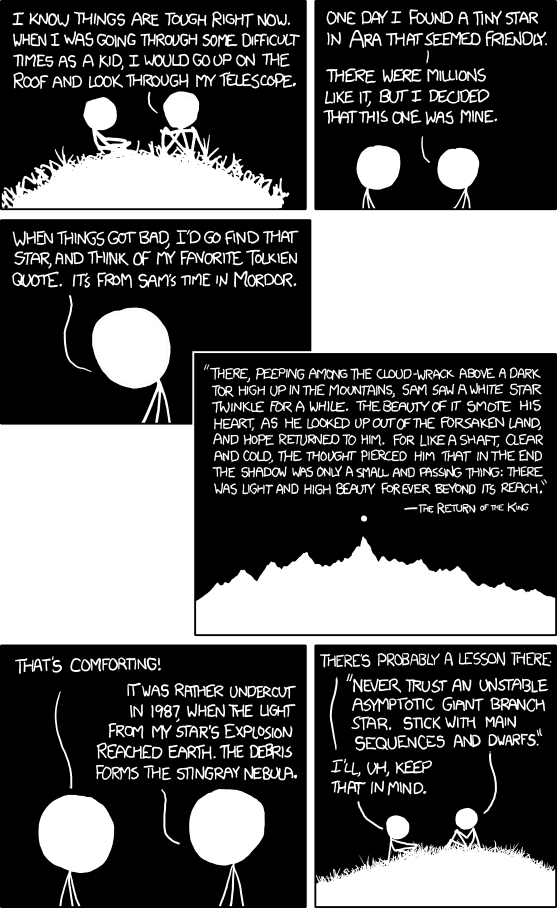
When You Wish Upon A Star, Be Careful To Choose the Right Star

Apropos the mention of star-watching in the last post, XKCD's latest (click to embiggen):

Getting Into Death

Here were Joshie's beginnings. A dystopian upper-class childhood in several elite American suburbs. Total immersion in Isaac Asimov's Science Fiction Magazine. The twelve-year-old's first cognition of mortality, for the true subject of science fiction is death, not life. It will end. The totality of it. The self-love. Not wanting to die. Wanting to live, but not sure why. Looking up at the nighttime sky, at the black eternity of outer space, amazed.
Gary Shteyngart, Super Sad True Love Story
Which set me to thinking about my own long-ago self, when he was at that golden age. Was he really getting into death, back then, when he got hooked into the mainline of SF?  I don't think that he thought that he did.  He was a bright, disorganised kid living in a small town, and like many such he wanted to get out.  SF opened up new worlds to him. America. The future. Easy travel to other planets.  And some of his favourite stories - Theodore Sturgeon's 'The Way Home', Tiptree's 'Beam Me Home' - were about about ways of escape.  When he looked up at the stars in the summer nights sky, he wasn't thinking about eternity. He was wondering if someone like him was up there on a warm wet blue planet circling a yellow star, looking up at their night sky and thinking what  he was thinking.  He was projecting.  He wanted out bad, and SF was balm to that ache.

Well I got out, and I became a scientist, which is what I wanted to be, and then I became an SF writer, which I also wanted to be, and how cool is that?  And now I think, about the SF I read and the SF I write: yeah, in one way or another, it's all about death. I'm just starting in on the editing process of a novel about avoiding the inevitable and the costs this could incur, which is one reason the quote caught my interest.  It's something I've been thinking about.  Also, when I tweeted part of the quote at the head of this, my friend Andrew McKie tweeted back 'I have long maintained the death thing. There's audio somewhere of me droning on to Kincaid about it at a BSFA thing.'  Hard to argue about this with Mr McKie: he once worked for the best bit of the Telegraph - the obits department.  To borrow a line from Michael Connelly, death is his beat.

I used to think SF was all about change, but all change means leaving something behind. I left behind my childhood when I quit that little town for university, and never really came all the way back.  Death is a more permanent kind of change. And if you avoid it somehow, that will change you too.  You won't be some eternal extropian twentysomething, planning to turn a galaxy into beer and pizza.  You'll be something so deeply weird the future equivalent of all the world's armies would try to take you down if you ever returned to Earth.

But we're not just talking about childhood's end, or the all-too-brief span of human life, in SF. We're talking about the end of everything. The end of the universe, maybe flattening out forever, maybe crunching back down into the Singularity of a new universe, maybe giving birth to hundreds of new universes. We're talking about the end of reality.  We're talking about hard, important questions. If everything is in flux, what is useful and what isn't? What do we do with our knowledge about the immensity of the universe and the seemingly microscopic size of our place within it? How can we make sense of that, and learn to live with it? Is it really possible to develop strategies to avoid the heatdeath of the Universe or surfing the wave of a new Big Bang? And what then? And what then...

Tuesday, January 11, 2011

E-Bookery

Thanks to everyone who took the trouble to comment here or on Twitter.  All very useful, especially as there was reasonably general agreement about the price range.  It seems to me that if I go ahead with this crazy idea I should price the OOP collections at around £4.20 (which includes the VAT eBooks attract), or possibly a little lower.  That would come in at a little under $7 at the current exchange rate, which might be a bit high for US readers, but perhaps not too high (Would they have to pay VAT?  I realise that I have no idea.  If not, the price would be well under $6.)  That's somewhat less than the price my UK publishers are charging for a couple of OOP novels that have sneaked out as eBooks.  I wouldn't charge much more for the new collection, to be honest.  All of three would consist of reprinted stories after all.

A couple of other points, if you can bear it (authors do tend to go on and on about eBooks, so forgive me).  The price of printing a book is only a small part of the cover price.  Editing, production design, maintaining offices and warehousing and distribution add a bit more.  A large chunk goes to the end seller; much smaller chunks go to the publisher and author.  So the idea that eBooks are much cheaper to produce because they aren't physical objects isn't exactly right; although they are somewhat cheaper, new books still have to be edited, given cover art and so on.  As for the price difference between hardback and paperbacks, at the moment, some people are still willing to pay extra for the latest book by their favourite authors, just as they're willing to pay extra to see a film in a first-run cinema.  That will change, I think.  (it would also be nice if hardbacks in the UK were all printed on acid-free paper, to give them the kind of permanence of US editions.)  At any rate, OOP titles revived as eBooks should definitely be cheaper.  Some are very cheap indeed - presumably in the hope that what's lost per unit will be made up in greater volumes of sales.  Not sure I want to go there quite yet.

One commentator raised the point that people below a certain age expect books to be free. As I'm well above that certain age, and still earn my living from writing and selling fiction: I don't.  And I still buy books at full price, when I have to.  But if it's free fiction you want, then look here.  There's a small anthology's worth of free stuff.  And you're welcome to distribute under the terms of the Creative Commons License.  Think of it as a gift, or as a taster for stuff you can buy.  Whatever.

PS Chris asks why the Confluence trilogy isn't back in print.  Good question!  I'm trying to persuade my UK publishers to do just that.  Hopefully in one nice fat volume.  And failing that option, I do have the eBook rights...

UPDATE: Again, thanks for commenting; thought I'd reply here rather than under the fold.  Various people have given me cogent reasons not to simply stick with Amazon/Kindle.  My plan now, such as it is and if I go forward with my idea to self-publish those OOP collections, would be to use Kindle as an experiment, and then go to the more open format ePub format, which appeals to me because it is supported on all kinds of platforms (including Stanza, which I use), and I think gets around the licensing problem . . . but it looks like it'll be a steep learning curve.  RFYork - thanks for the link to Charlie Stross's blog post on why books aren't cheap and to talkie_tim and Blue Tyson for supporting arguments : exactly.  And here are a couple of good posts on why pirating books hurt the author rather than sticks it to the 'greedy publisher'.  I especially like Saundra Mitchell's suggestions for ways that the problem can be turned around to help the reader and the author.   More news, when I have it.  Don't hold your breath, though; I have one book to edit, and another to write, and I'm seriously short on the kind of Victorian can-do energy that enabled Charles Dickens to be a novelist, a magazine publisher, and a smash-hit performer (and killed him, in the end...).

Thursday, January 06, 2011

A Question

So I'm giving some serious thought to republishing, as ebooks, two out-of-print short-story collections,  The Invisible Country and Little Machines.  Also, to compiling and publishing in ebook form a substantial new collection featuring the 'Quiet War' stories and some other space-opera stories.  How much would people be prepared to pay for ebook versions of a previously-published but OOP short story collection?  And how much for a new collection?  ('Nothing' isn't an answer, by the way.  I have meet the costs of publishing (new covers, formatting and so on); also, I have to eat.)
Newer Posts Older Posts