Monday, September 19, 2011

A Transect

When I get stuck on a plot point or find myself typing instead of writing, a walk usually clears my head and gets me thinking again. This is one of my longer walks, more or less due south to the Thames.


Friday, September 16, 2011

Under A Double Star


Into town today to talk for a couple of minutes on the BBC World Service about the recent discovery of a planet orbiting the Kepler-16 binary system. Both stars are smaller than the sun, one an orange K-type star, the other a red dwarf; the orbit of the planet, Kepler-16b, is similar to that of Venus; comparisons have been made to Star Wars' Tatooine (the hook on which so many news stories have been hung).  But Kepler-16b is about the size of Saturn, although with a higher density, suggesting that it possesses a core of ice or rock about half its diameter, enveloped in deep atmosphere at a chilly -100° C.  Not much chance for any carbon-based life like ours to see those double sunsets and sunrises, then, although it's possible that the planet's core might retain some heat and warm lower layers of its atmosphere, or that there might be a moon with an atmosphere that's both thick enough and with the right composition to generate a greenhouse effect.

Given that the Kepler spacecraft has discovered one planet around a stable binary star system, it's pretty likely that there are plenty more out there, and that some will be much more Earth-like than Kepler-16b. Perhaps there are even planets around triple-star systems; maybe even a planet or two orbiting a system with six suns, as in Isaac Asimov's short story 'Nightfall', where night is a rare and frightening event . . .

Well, it's nice to know that there are real-life equivalents of science-fictional scenarios.  Even better, we're beginning to understand that the universe is stranger than we can imagine.  Kepler-16b isn't the first explanet to be discovered orbiting a binary system.  There are two planets bigger than Jupiter orbiting the eclipsing binary NN Serpentis, 1700 light years away.  The stars, a red dwarf and a white dwarf, are believed to be a cataclysmic variable system, with the material drawn off from the red dwarf forming an accretion disc around the white dwarf.  When material from the disc falls on to the white dwarf, it triggers nuclear fusion and a cataclysmic outburst.  If enough material falls on to the white dwarf it could increase the interior density of the white dwarf, ignite runaway carbon fusion, and trigger a supernova. Imagine the view from a moon of one of those gas giants if that happens . . .

Thursday, September 15, 2011

O Superman

Tuesday, September 13, 2011

On Mars

Found in PC World magazine during research:
"Probably the most special day I've had as a rover [driver] was the day I built my first drive solo on Mars," [Ashley] Stroupe said. "We were on the plateau on Husband Hill, and we were driving along the edge to get imagery of the valley below. I parked us right on the edge and got a spectacular view."

"I remember looking at those tracks and realizing what they meant -- my first tracks on Mars, and the first tracks actually made by a woman driving on another planet," she said. "I am proud of it every time I see that panorama from the very top looking down at those tracks."
It's an especially powerful piece of empathy or projection because driving a rover is more like one of those ancient text-based computer games than Gran Turismo or Second Life.  The Mars rover team at JPL keep in contact with their machine viaNASA's Deep Space Network, and because their time on the network is limited and the round-trip for signals between Earth and Mars takes between 8 and 42 minutes, driving by direct law isn't possible. Instead, while the rover rests during the Martian night, its team of drivers and scientists plan out the next day's moves, code them, and test and retest them before uploading them. The rover then executes those moves the next day. Yet note how by the second sentence of Stroupe's description, the pronoun has changed from I to we.   Identification is complete. "We were on the plateau on Husband Hill..." We were on Mars...

Friday, September 09, 2011

Cover Me


Hey, here's the cover for In The Mouth of the Whale.  It's by Sidonie Beresford-Browne, and I like it a lot. There's a lot going on in the novel, but quite a bit of it involves spaceships (I know they have wings: they're on their way down into the atmosphere) and chunky worldlets and a gas giant.

Wednesday, September 07, 2011

The Hippity-Hop Theory of Writing

"Because I don’t work with an outline, writing a story is like crossing a stream, now I’m on this rock, now I’m on this rock, now I’m on this rock."

Ann Beattie (from The Paris Review)

Friday, September 02, 2011

Snark Hunting

I was away - a short break in Bruges.  Lovely, thanks.  And now I'm busy with the copy edit of In The Mouth of the Whale, dealing with queries and corrections raised by a fantastically sharp-eyed editor with a good and solidly old-fashioned (in the best sense of the world) grounding in grammar who has not only read every word and noted every punctuation mark of the MS, but has queried the correctness and value of each and every one too. It's the first time I've done this kind of thing entirely on screen.  For every other novel and story of mine, I transferred marks made on a printed MS to an electronic file; this time, I'm hunting for overstrikes and red-lined corrections with the help of the search-and-replace function, and recalling a little of the performance anxiety I felt when I transferred from typewriter to word processor. But I get to read the whole thing again, this time in physical form, when the proofs are delivered, and the thing moves another step closer to actuality.

Tuesday, August 23, 2011

Some Remarks on In The Mouth of the Whale


It’s a stand-alone novel that’s set 1500 years after The Quiet War and Gardens of the Sun and picks up the story of one of the players in the old drama: Sri Hong-Owen, a gene wizard who is her own greatest experimental subject.

Sri wants to live forever.  After a treatment that went badly wrong left her confined to a vat, she created a strange family from her own flesh and set off for the star Fomalhaut, to found her own empire in its great planetary ring. But history has overtaken her, as history always overtakes people who live too long. Her starship was damaged; she died; those of her children who survived have rebooted her by recreating her childhood.

Meanwhile, a posthuman group, the Quick, has reached Fomalhaut ahead of Sri and founded a new civilisation which fell to another group, the fierce and largely unmodified True, who enslaved the Quick and set up their own empire.  And now, as Sri’s starship approaches Fomalhaut, the True are fighting interlopers from another interstellar colony for control of the gas giant Cthuga, whose core may be the home of a vast strange intellect.

What else? There’s an outcast librarian who, with the help of his Quick servant, fights demons in fragments of a vast data base. The disappearance of one of the scions of a powerful family. Thistledown cities and an archipelago of engineered worldlets. A big dumb object floating in atmosphere of a gas giant planet, probing for signs of life. War in the air. A vivid dream of childhood that begins to unravel. A secret hidden in the cityscapes of a virtual library. The termitarial mindset of a cult that’s lasted 1500 years. Visions of cul-de-sacs in human evolution. The utility of intelligence. The cost of longevity, and that perennial problem of what to do for the rest of your life after you die . . .

Coming soon, as they say.

Wednesday, August 17, 2011

Sense/Memory

Today's walking break took me along the Regents Canal to St Pancras, then back up through a scrappy neighbourhood north of Euston Road's hurricane of tin and carbon monoxide. Very quiet there, only a few cars parked up and the air heavy with sultry August heat, pavements dusty and brick walls radiating warmth, this specific combination twitching a vivid and vertiginous memory almost fifty years old of walking aimlessly along a half-remembered summer street close to the bungalow in Portchester my family rented for a year.

Writing a novel, someone wrote, is an act of memory. I'm halfway through the second draft of the ongoing, although much of it, so far, seems to be new stuff.

Some links:

A shooting star seen from orbit
An arrow-shaped cloud the size of Texas on Saturn's moon Titan.
Odyssey crater, Mars.
Vesta's wacky craters.

Tuesday, August 16, 2011

Spaceships That Aren't Really Spaceships (1)

Monday, August 15, 2011

Retromania


Just received in the post, a copy of a spiffy little hardback edition of Philip K. Dick's Do Androids Dream of Electric Sheep? done up in early 1960s Gollancz yellow-jacket style (inducing in me vertiginous nostalgia for the SF novels in like livery that I read way back when, when I first started reading SF), with a short introduction what I wrote.*  An honour to be asked; a joy to reread the novel, and rediscover how swift, and sad, and funny it is.

It's due out on the 1st of September, part of the 50th birthday celebrations of Gollancz's science-fiction and fantasy line.  Four other SF novels and five fantasy novels will be published in the same format at the same time.  They were chosen by readers from a short list of eligible** titles.  You can find the listings and other details here.

*readers old enough to remember searching out Gollancz yellowbacks in their local libraries will get the reference at once
**that is, titles to which Gollancz have the hardback rights

Thursday, August 11, 2011

Red Remembered Hills

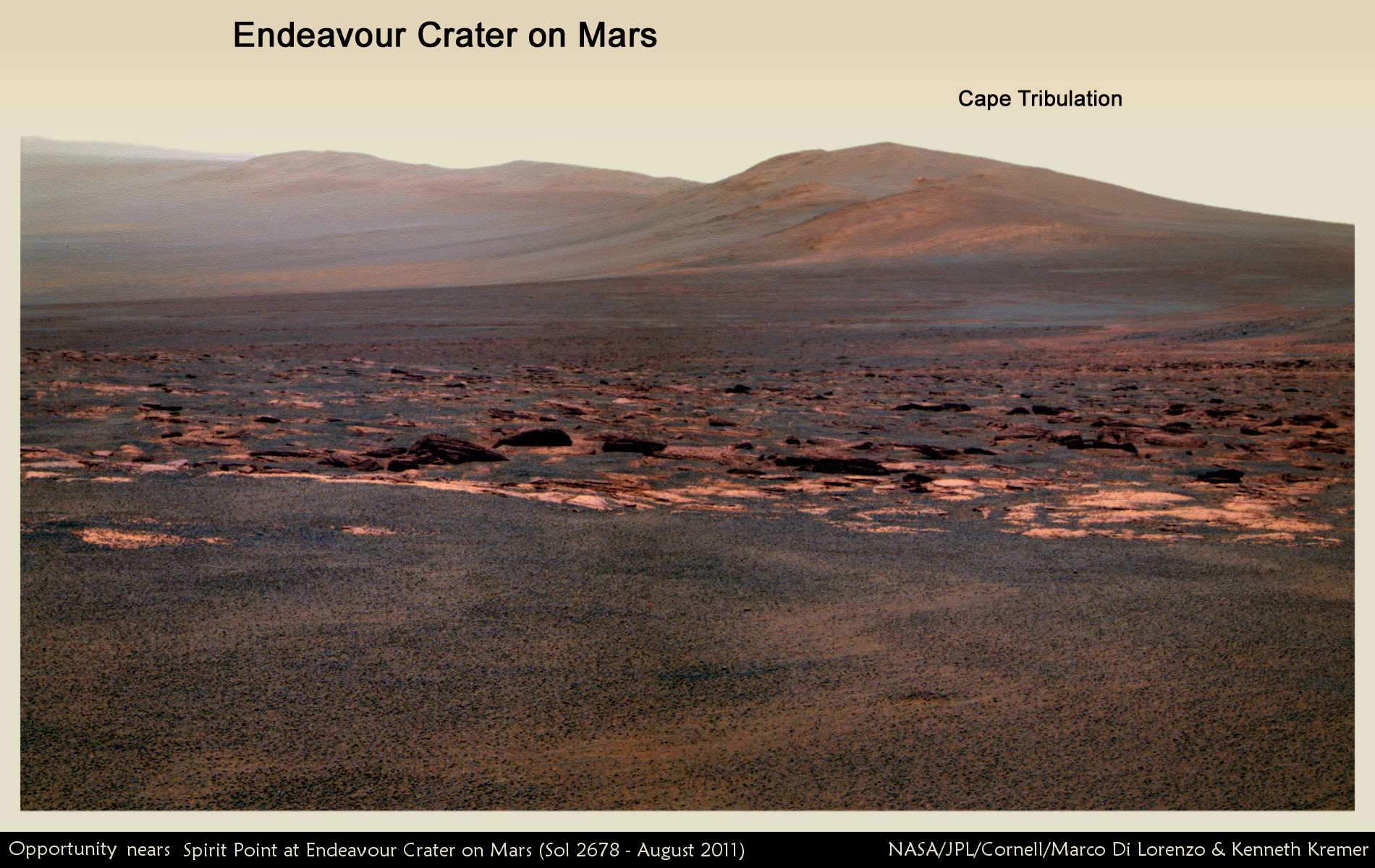
Credit: NASA / JPL / Cornell / Damien Bouic

The two rovers, Spirit and Opportunity, have taken many panoramic pictures of the Martian landscapes they've traversed, but I think that this is one of the loveliest.  (To see it full-size, check out the entry in the Planetary Society's blog, where I found it; a variation on the same scene can be found here.)  It's a view taken by Opportunity two days ago, looking across the western foothills of the rim of Endeavour Crater, and it's lovely for two reasons.

The first, for those who have been following the progress of the rovers since they landed on Mars more than seven years ago, is that this is the end of a small but epic journey of some 21 kilometres that began in 2008, after Opportunity left Victoria Crater.  All that time, driving backwards because one of her front wheels is jammed, the rover has traversed a landscape of rippled sand and exposed plates of rock, interrupted by the occasional smashed dish of a small crater.  Twenty-one kilometres - 13 miles - doesn't sound much.  A good afternoon's ramble.  But Opportunity is no bigger than a golf cart, is long past her warranty date (she was supposed to operate for only 90 Martian days, or sols), is being steered by remote control by operators on Earth, and the terrain, while it has been mapped and photographed by orbiting spacecraft, contains unknown perils and traps. While Opportunity was travelling, her sister rover, Spirit, became inextricably stuck in a patch of loose sand, and succumbed to the Martian winter after operating as a stationary science platform for more than a year.  Opportunity ploughed on, backwards.  At sol 2681 she finally reached Spirit Point, named after her sister rover and at the edge of a ridge known as Cape York.  Now she's ready to begin the science part of her fifth mission extension.  Endeavour Crater is some 22 kilometres across, much bigger than Victoria Crater.  The rock layers exposed by the impact that created it are deeper and older, and there are signs that some of the layers are clay-bearing phyllosilicates formed in the presence of water.

But the other reason it's an especially lovely view is that it is in many ways quite Earth-like.  The ridges may mark the edge of an impact crater (and the rocks in the foreground were thrown from another much small impact crater beyond the right-hand side of the photomosaic), but they have been eroded into soft shapes by millions of years of wind-blown sand, and they are also softened by the hazy atmosphere, giving a very familiar effect of a landscape fading into the distance.  Alien and familiar, they wouldn't look out of place in an Earthly desert. It's very easy to imagine standing there, and walking forward into the unknown.

Friday, July 29, 2011

Drive, He Said

'All you need to know about American society can be gleaned from an anthropology of its driving behaviour. That behaviour tells you much more than you could ever learn from its political ideas. Drive ten thousand miles across America and you will know more about the country than all the institutes of sociology and political science put together.'
Jean Baudrillard, America

Thursday, July 28, 2011

More Soviet SF

To the BFI Southbank last night, to see two more films in the BFI's excellent Kosmos: A Soviet Space Odyssey.  The first, Mars (1968), was the last major film made by director Pavel Klushantsev (Road to the Stars) before his contract with Odessa Studios was terminated in 1972, and he was forced into retirement.  I was looking forward to seeing Mars because a couple of clips in the documentary that accompanied the screening of Road to the Stars showed a wonderfully gonzo alien scenario complete with cosmonaut dog in a dog-shaped spacesuit.  Well, the dog didn't disappoint, but the bulk of the film is a lively but badly dated educational documentary showing that you can prove anything by analogy -- even, in 1968, after Mariner 4 showed Mars to be a battered hostile world lacking any of the romance implied by Percival Lowell's 'canals', the presence of higher forms of Martian life.  Klushantsev's depictions of possible variations of life on Mars are marvellous, however, and the brief portrayal of a lifeless Mars is startlingly close to close-up images beamed back by the Viking landers and other American robots.

Toward Meeting A Dream, from 1963, is a more conventional science-fiction film in which aliens from a nearby star are attracted to Earth by the broadcast of a particular piece of music, crashland on Mars, and are rescued by hero cosmonauts.  The special effects (re-used by American director Curtis Harrington in his SF potboiler Queen of Blood) depicting both Mars and the alien world and its advanced technology are state-of-the-art, as good as anything in Forbidden Planet, and the Russian space facilities on the Earth and Moon are equipped with all kinds of realistic hardware, but as for the story and characters . . . well, let's just say Soviet SF cinema operated on conventions at a slant to Western expectations.  During a conversation afterwards, Kim Newman (who has seen most of the films in the BFI's season) and I identified the following Rules for Successful Soviet SF:

(1) There must be a stirring song, repeated at intervals, and written by one of the characters.
(2) There is no real plot beyond depictions of the selfless heroism of the characters, but a narrator will fill in any holes in the story.
(3) There is no plot because there must be no conflict or violence: problems are solved by application of idealism and logic rather than fists and rayguns.  In Toward Meeting A Dream, an American scientist argues that aliens approaching Earth may be hostile and bent on conquering the human race, and is, at the end, very publicly humiliated.
(4) Characters are differentiated by random tags, and there must be no character development (because that would imply that the Soviet heroes possessed flaws which must be corrected).  So if you're, say, a chess-playing joker at the beginning of the film, for the rest of the story you'll be carrying a chessboard and, when your comrades refuse to play you because they know you're the best chess-playing cosmonaut in the universe, you'll make a joke about it.
(5) As in American SF of the period, the only female character on the ship operates the switchboard.
(6) If a character dies, it will turn out that the whole story was not only a dream, but it was his dream.  And at the very end, some element of it will come true.
(7) Pack all this into a film less than an hour long, either to make room for the main feature, or for a two-hour documentary on pig-iron production in Kazakhstan.

Wednesday, July 20, 2011

Ongoing

Most writers are interested in how other writers write. In their environments; in their habits; in their productivity. Not because they’re neurotics, worried that they’re doing it right, or working hard enough (or not only because they’re neurotics), but because writing is a private process, and a mysterious one, too. In a piece for last Saturday’s The Week In Books feature in the Guardian (which the Guardian doesn’t seem to archive online, any more, so I can’t provide a link), Philip Hensher noted that his friend Alan Hollinghurst ‘is a devotee of Ishiguro’s “crash” method. After a long period of planning and thinking, the author retreats into a cell and writes furiously for up to 12 hours a day.’ Hensher’s method, on the other hand, is slow and steady:
Writing my latest novel, King of the Badgers, I got up at 6:30, five to six days a week, and wrote until 10. I reckon to produce between 400 and 1,500 words a day, and then do a lot of crossing out.
There are other methods, of course - Vladimir Nabokov wrote sentences and paragraphs on index cards, and then assembled them into the finished work. But it seems to me that the Crash and Slow and Steady methods are at either end of a spectrum that encompasses most common variants of writing methodology. I’m of the slow and steady school, although I don’t write within a set time but try instead to produce a fixed amount each day. I’m working on a second draft at the moment - rewriting, crossing out, inserting new material - and attempting to make a quota of around 2000 words a day. Yesterday I was writing so slowly that I could have used the blood sweated from my forehead for ink. Today I finished inside two hours. So it goes. I do have a plan before I start the first draft, but it isn't in any way detailed, and I certainly don't spend months thinking about the book before I start. As far as I’m concerned writing is a process of discovery. The trick is to keep moving forward.

Tuesday, July 19, 2011

New World


An image of Vesta taken by the Dawn spacecraft two days ago from a distance of 15,000 kilometres, when (as you probably know) it went into orbit around the asteroid. Dawn will slowly spiral inward, and will take many more images at closer range, but this is a great early look at the ravaged worldlet, the second largest body in the asteroid belt (bigger version here).  We're looking down at the south pole, which about a billion years ago was hit by a large body.  Some debris spalled off by the impact resurfaced Vesta; the rest, about 1% of Vesta's original mass, went into orbit around the sun. HED meteorites are part of this debris, so we already have samples of Vesta's crust.  The big whack left behind a big crater.  It's about 500 kilometres across, almost as wide as Vesta's mean diameter.  The lump in the centre is an uplifted central peak; there are also huge cliffs, and ridges forming chevron-like features. Over at the Planetary Society blog, Emily Lakdawalla has posted a nice analysis, comparing the chevron features inside Vesta's south pole crater with those of Uranus's moon Miranda.  Miranda's chevrons were probably formed by diapirs or plumes of upwelling warm ice; if the chevrons sit at the top of the plumes, those ridges may be the edges of uptilted blocks.  Since we know that Vesta was once geologically active and almost certainly has an iron core that was once molten (all the HED meteorites are igneous material), it's tempting to speculate that big whack may have triggered some kind of residual geological activity.  Could there be ancient volcanoes, on the opposite side?

Monday, July 11, 2011

Road to the Stars

Last Friday, the day of the launch of the last space shuttle, and the end until who knows when of the United State’s capability to send human beings into space, I went the British Film Intitute to watch a marvellous old Russian film about space travel, Pavel Klushantsev’s Road to the Stars -- shown with a documentary, The Star Dreamer, that provided useful historical context and a nice overview of Klushantsev’s career.


Klushantsev began to make Road to the Stars in 1954. He’d started his career in a Leningrad studio making documentaries, and The Road to the Stars begins in straight-forward documentary style, with a dramatised biography of the father of astronautics, Konstantin Tsiolkovsky, and a sequence on early experiments in rocketry that establishes the basic physics of spaceflight. Then, without changing style (or the portentious narrator), the film jumps into the future. Ingenious special effects, with meticulously detailed models and sets, and realistic depictions of cosmonauts manoeuvring in free fall (amongst other tricks, Klushantsev shot actors hung on wires from below, and used a revolving set), are deployed to show the launch of the first three cosmonauts into space, the construction and operation of a space station in low Earth orbit, mapping the Moon’s surface by a robotic surveyor, and the first manned flight to the Moon. Some of the scenes allegedly influenced Stanley Kubrick’s 2001: A Space Odyssey.


Just before Road to the Stars was finished, in 1957, Sputnik 1 went into orbit. The Russian authorities insisted that Klushantsev insert material about Earth’s first artificial moon, and gave his film a wide release. Space was the next big thing; the Soviet red star was in the ascendent; Road to the Stars was, as far as the authorities were concerned, a prime piece of propaganda. More than a million people saw it in Russia; it was screened in twenty- two other countries. Segments shown by Walter Cronkite on the CBS evening news allegedly galvanised the American participants in the space race. Road to the Stars seemed like a blueprint for the Soviet conquest of space: space travel as an inevitable step in the evolution of Russia’s socialistic scientific utopia, proceeding by logical steps to the Moon, with journeys to other planets soon to follow.

It’s a future we didn’t get, of course. America won the race to the Moon; Nixon cancelled a programme to build rockets that would send astronauts to Mars; after the last Apollo mission, no human being has ventured beyond low Earth orbit. Klushantsev went on to make a full-length feature film about the first expedition to Venus, Planet of the Storms, that showcased more marvellous special effects, but ran into trouble when a commissar objected to the tears of a female cosmonaut (‘No Soviet cosmonaut would cry’). His film was given a restricted release; the script for the next, about a race to the Moon involving Russian, American and German spacecraft that ended in peace and harmony, was rejected. He made further documentary-style films about space travel (scenes from one about Mars, with giant animated flowers and a dog in a dog-shaped spacesuit, look wonderful) but retired a disappointed man, more or less forgotten until American special-effects artist Robert Skotak tracked him down, just before his death in 1999.

Unsurprisingly, some of scenes in the film seem quaint (nothing dates like the future), but it’s infused with warmth and charm, and its cheery optimism about the benefits of space exploration and colonisation outshines the occasional passages of naked propaganda. At the end of Road to the Stars, two cosmonauts descend a spacecraft’s ladder to the Moon’s surface. There’s a close-up of the first tentative step, and the bootprint it leaves.


But there’s no solemnity; no tick-box of tasks to be performed. The cosmonauts dance out across the surface, and when they see the Earth floating above the Moon’s mountains, they embrace each other with glee, overwhelmed with amazement and happiness at being on the Moon. It’s a wonderfully touching moment, reminding us that although robot spacecraft have and still are sending back amazing pictures and reams of data, the old-fashioned notion of human exploration, while perhaps foolishly and unrealistically romantic, still stirs emotions no robot can reach.

 (You can watch the whole film, without subtitles, here.)

J.G. Ballard's House


...is for sale.

Friday, July 08, 2011

Free Entry to British Library Event

I'm appearing on a panel at the British Library Tuesday 12th July, talking with Pat Cadigan, Toby Litt and Kim Newman (and a virtual Margaret Atwood) about our favourite items in the Out of the World exhibition.

I have not one but two free entries up for grabs. If you want to come along, email me at PJCMcAuley at gmail dot com and I'll add your name to the list on the door.  First to email wins!

EDIT: They're gone!

Tuesday, July 05, 2011

The Secret of My Success

Harold Pinter on his plays, 1963 (pinched from Dangerous Minds):

I’m not a theorist. I’m not an authoritative or reliable commentator on the dramatic scene, the social scene, any scene. I write plays, when I can manage it, and that’s all. That’s the sum of it.
I’ve had two full-length plays produced in London. The first ran a week, and the second ran a year. Of course, there are differences between the two plays. In The Birthday Party I employed a certain amount of dashes in the text, between phrases. In The Caretaker I cut out the dashes and used dots instead. So that instead of, say, “Look, dash, who, dash, I, dash, dash, dash,” the text would read, “Look, dot, dot, dot, who, dot, dot, dot, I, dot, dot, dot, dot.” So it’s possible to deduce from this that dots are more popular than dashes, and that’s why The Caretaker had a longer run than The Birthday Party. The fact that in neither case could you hear the dots and dashes in performance is beside the point. You can’t fool the critics for long. They can tell a dot from a dash a mile off, even if they can hear neither.
Newer Posts Older Posts