Wednesday, November 08, 2006

Players -15

Denise and Summer drove down a road that switchbacked between trees and outcrops of rock, a sharp bend suddenly revealing a narrow valley blocked by a tall wedge of white concrete, stark in the floodlights burning along its top. Straight ahead, halfway up the side of the valley, was a broad shelf where three towers stood, also floodlit.

Denise said, ‘That’s the dam, and that’s Merrit’s house -- if you can call it a house.’

It was like a fairy-tale castle, Summer thought, or a trio of old-fashioned rocket ships. The tallest tower was easily a hundred and fifty feet high, with a little glass dome glinting at the top -- yeah, just like a spaceship. The other two towers were shorter; one looked half finished, ending in an uneven crown of rebar. Arrow-slits and round windows shone at different heights in their smooth, tan walls.

Denise parked her Jeep Cherokee behind a black Mercedes SUV at the foot of the tallest tower. She and Summer got out and buckled their bracelets to their wrists. It was very quiet. A steep wooded slope rose on their left towards the black sky. The other two towers were spotlit beyond rocks and stands of bamboo. Although Summer was amused by the obvious theatricality of this spooky setting, she felt a tickle of apprehension as she followed Denise to the smooth flank of the tower, where a castle door swung open silently, a touch straight out of some dumb horror movie. The foyer, pinched between a pair of curving staircases and lit by the lurid flicker of a cluster of TV sets that hung overhead like a chandelier, narrowed to a big steel door that, like the castle door, swung open when Denise and Summer walked towards it, revealing a large room with leather couches and armchairs grouped around an open fireplace in the centre. There were all kinds of objects in niches and behind glass in the adobe walls, clusters of animal heads hung above them, and a tall man stood on the far side, his back to Summer and Denise as he studied or pretended to study a flat-screen TV that was showing some kind of cartoon, a Mad Max-style warrior jogging along a ruined street towards a cluster of broken skyscrapers.

The man’s hands were clasped behind him, dead white against the green silk of his robe -- no, it was a kimono, Summer realized, that big red target on the back was a chrysanthemum. The tall collar of the kimono was turned up, so that she couldn’t see his head; its hem ended just above his knees. His shanks were as pale as his hands, and as hairless as a mannequin’s.

He kept his back to Summer and Denise as they approached. ‘Detective Childers, so nice to see
you again,’ he said. ‘Congratulations on the arrest, by the way. It’s good to know that our police are so efficient. Or should I say so lucky?’

His voice was a light baritone, as engaging as a chat-show host’s.

‘It was a little of both,’ Denise said. ‘This is -- ’

‘Detective Summer Ziegler of the Portland Police Bureau,’ Dirk Merrit said, and turned in a sudden flare of green silk.

Summer’s first thought was that it was a cheesy move that he must have practised a lot. Her second was that he was wearing a mask. Then he smiled at her, and it was as if a red wound had opened in his stiff white face.

Thursday, November 02, 2006

Boy, Is My Face Red


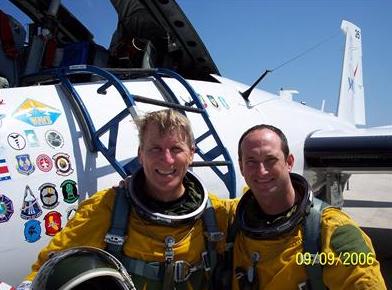
I confess - I was wrong about the photo on the previous post being taken from the ISS, and Al Reynolds proved it (see the discussion thread for details). And from the thread on digg.com that Al Reynolds ferretted out, courtesy of CubicZirconia, these are the guys who took the photograph from their WB-57 reconnaissance plane. They look more like astronauts than astronauts. More links to cool pictures on that site by the way...

Monday, October 30, 2006

Why I Write, Part 12


I pulled this down from one of the message boards where I lurk. I think it came from NASA via Warren Ellis’s site, but I’m not privy to the latter and can’t locate it on the former. Anyway, it’s beautiful: a shuttle launch photographed from the International Space Station.

Revenge of the Dorkofascist Galacticons

Via Jack Womack: Why the right wing fell in and out of love with Battlestar Galactica, or, what’s really wrong with US science fiction right now.

Sunday, October 29, 2006

Down with skool!

Lucy Ellmann, in a review of Elfriede Jelinek’s Greed, starts testifying:

What is killing the novel is people’s growing dependence on feel-good fiction, fantasy and non-fiction. With this comes an inability or unwillingness to tolerate any irregularities of form, a prissy quibbling over capital letters, punctiliousness about punctuation. They act like we’re still at school! Real writing is not about rules. It’s about electrifying prose, it’s about play.

Amen, sister! Amen!

As in mainstream fiction, so in science fiction. Why have we allowed the commissars of correctness to stamp their boot on what should be one of the most vital, playful and imaginatively transgressive genres, turning it into a bland prose factory churning out product by the yard?

Friday, October 27, 2006

Players - 14

Dirk Merrit was sitting at his big desk in the library, his white, angular face steeped in the glow of the computer’s flat screen, his right hand twitching a cordless mouse as he scrolled across a set of architectural plans. On the other side of the dark room, the plasma TV and the bank of smaller screens around it were all showing the same looped clip, sound muted, taken from the local TV station’s evening news: a wasted-looking fellow in black lunging at a much bigger man in an orange jumpsuit, the picture jolting as the camera was caught in the mêlée, showing a confusion of feet, a blur of indistinct motion, settling on a woman in a grey pants suit throwing the man in black against the side of a police cruiser, pinning him there while a sheriff’s deputy handcuffed him. Each time the clip jumped back to its beginning, light and shadow swung across the walls like a flock of birds turning on the wing.

Carl Kelley, walking across the room through television light, knew that Dirk Merrit could hear the ticking of his combat boots on the poured-concrete floor, but the man waited a full minute before dismissing with a click of the mouse the plans he had been scrutinizing -- the plans for the mansion -- and swinging around in his chair. After Carl had explained that he’d overhauled and fuelled up the RV, and packed the ultralight into its trailer, that everything was good to go,

Dirk Merrit said, ‘Tomorrow, at dawn.’

‘It’s your party.’

‘I have the feeling that you’re still angry because I choose to honour the sacrifice rather than give in to expediency.’

Carl didn’t want to get into that again. ‘How’s he doing?’

‘He’s angry, too,’ Dirk Merrit said. ‘He threw his dinner at the wall and stood there in the dark with his fists raised. I believe he was hoping to get into a fight. He’s a feisty boy, Carl. We’re going to have a lot of fun together.’

‘The quiet ones usually run better.’

‘We’ll see.’ Dirk Merrit gestured at the rack of TVs. ‘Do you know what that’s all about?’

‘I imagine the big bloke in orange is the one we framed.’

‘Looks suitably crazy, doesn’t he?’

Carl shrugged.

‘I do hope you’ll be over your sulk tomorrow,’ Dirk Merrit said. He sounded amused.

‘I just came up to report that everything is ready. If there’s nothing else, I’d like to turn in, seeing as how we have an early start.’

‘The fellow in black, he’s the girl’s stepfather. The woman, there . . . ’ Dirk Merrit turned back to his computer, moved the mouse to the menu bar at the bottom of the computer screen, clicked on an icon. Across the room, the action froze on the TVs. ‘She’s a detective from the Portland Police Bureau. Do you think it signifies anything?’

‘She probably brought the stepfather here to ID the girl’s body.’

‘I think so too.’ Dirk Merrit clicked the mouse again and the sequence ran on, the detective shoving the stepfather against the side of the cruiser and pinning his arms while a sheriff’s deputy handcuffed him. Dirk Merrit saying, ‘She’s rather feisty too, don’t you think? I bet I could have a lot of fun with her, in the right circumstances.’

Friday, October 20, 2006

Don't Look Back In Anger

Science fiction is in trouble, no doubt about that, either. It has lost a considerable share of the market it once owned, its audience is growing older because it is having trouble attracting new readers, and it has lost confidence in itself. Reading through the responses to my little rant, and thinking on it some more, I know that I can’t offer a pat solution to this (and hey, if I had a solution, do you think I would share it with you, until I’d written that genre-defining, best-selling novel?). But I think a couple of things have become clearer.

There’s nothing wrong with old skool sf. There isn’t even anything wrong with old-fashioned Star Wars style sf, if that’s what floats your boat. But if that’s all science fiction has to offer, then it will no longer be a vital genre: it will have become a museum of taxonomy. Because retreating from the present into the familiar comfort of the past means giving up on something that makes science fiction distinctive. It means no longer dealing with the shock of the new, no more wild extrapolations or metaphorical constructs ripped from the bleeding edge of science and technology, an end to pushing trends to their limits, and explorations of the limits of what makes us human. Goodbye to all that; hello to a little cell that’s getting smaller by the minute, padded with worn-out tropes from some mythical Golden Age, inhabited by catatonics.

Science fiction isn’t going to win a new and wider audience by turning its back on the world and talking to itself. It has to engage. It has to produce novels that are part of the world’s conversation. Paul Cornell is right. If someone somewhere could write a definitely great populist but finely imagined science fiction novel, it would not only be a lovely thing in its own right; it would, like a supernova, make the science fiction galaxy more visible. But I’d go further. One singular novel, or one lone author, is in danger of being traduced by the too-good-to-be-science-fiction brigade. If we’re going to get our mojo back, we need a shelfload of good books that connect the present with fabulous futures, weird worlds, and even weirder ideas made as real and plausible as any armchair.

So if you’re a writer, write from the heart as well as from the mind. Aim for an audience if you like, but know this: at best you’re going to hit nothing more than a temporary, here-and-gone demographic. Wouldn’t it be better to try to write the book that means more to you than any other book? You’ll probably fail. But you can always try again, and fail better. And, dear reader: buy books. Tell people about the books you like. Spread the word. Behave like you have found the best and finest secret in the world. And who knows? Perhaps you have.

Thursday, October 19, 2006

Players - 13

Denise Childers said, ‘When we talked last night, on the phone, you said you’d be willing to help out.’

Summer said, ‘I’m still willing.’

‘That’s good, because I have a couple of favours to ask,’ Denise said. ‘First off, I’d like to take you up on your offer of finding out whatever you can about this boyfriend, this Billy no-last-name. What he does, who he associates with . . . You know, the usual stuff. If you could track him down and bring him here, I’d love to sit with him and have a long talk about Edie Collier.’

‘Is this an official favour?’

‘If you mean, am I going to get Sheriff Worden to ask your boss if he can give you some time and resources to chase up any leads, then no, it isn’t exactly official. As far as the sheriff’s concerned, the case is down. Nothing to see, time to move on. Otherwise I’d go up to Portland myself.’

‘I guess I can talk to Edie’s probation agent when I get back, and ask around at the place where she worked. But I’ll have to clear it with my sergeant first, and he’s already pissed because I’m taking an extra day down here.’

‘If it’s going to cause problems . . . ’

‘I’ll find a way around it,’ Summer said. ‘I have my own reasons for wanting to help out.’

Denise smiled. ‘Jerry and his little practical joke being one of them, I bet.’

Summer smiled too, relieved that Denise had brought it up. ‘If you mean the dust-up between
Randy Farrell and Joseph Kronenwetter, then yes.’

‘You probably don’t know it, but Jerry is good friends with the TV reporter who just happened to be there when your Mr Farrell and Joe Kronenwetter pitched up at the same time. Right now he’s probably telling his buddies down at the Hanging Drop, the cop bar, all about it.’

‘I already had a pretty good idea that he’d set it up,’ Summer said, and explained about the phone calls Jerry Hill had made at the morgue, his beeper going off on the way back to the Sheriff’s office. ‘It isn’t just about that, though. I want to do right by Edie Collier, and I think there’s a lot more to what happened than your sheriff wants to believe.’

Denise said, with a sad smile, ‘It’s a real heartbreaker, all right.’

There was a silence. Summer saw Edie Collier’s face plain, her serene indifferent calm, and knew that Denise was seeing her too.

Summer said, ‘You said you had a couple of favours to ask. If finding Edie Collier’s boyfriend is one, what’s the other?’

‘I’m going to visit someone who might shed some light on the nature of Joe Kronenwetter’s monster, and the question of why Edie Collier ended up where she did. I was wondering if you wanted to come along.’

Wednesday, October 18, 2006

Why I Write, Part 302

Tuesday, October 17, 2006

Beneath The Valley Of Top Of The Pops

A bunch of top, terrifying and positively weird outsider tunes courtesy of the archived 365 Days Project. My top three so far: the bathos of ‘Love Hurts’ by the Phi Mu Washboard Band (144), the unexpectedly lush arrangement of Barbie and Ken’s ‘Nobody Taught Me’ (151), and the cheerful lunacy of the Reverend Glen Armstrong’s ‘Even Squeaky Fromme Loves Christmas’ (148).

Sunday, October 15, 2006

Don't Fence Me In

I was supposed to get on with my attempt to jump-start the new novel today, having lost much of Friday thanks to an existential hangover caused by too much desperate fun at the launch of The Joke’s Over, Ralph Steadman’s book memorialising his times with Hunter S. Thompson. But after making some notes on the immediate direction of the plot and some local colour Sunday morning, I engaged in a little bit of monging around on the Web, came across Lou Ander’s rant and assorted associated pieces as noted above. So that was half the morning gone, hey ho.

Then, walking to the Farmer’s Market (yeah, I’ve been getting really bourgeois lately), I became more and more enraged by Kristine Kathryn Rusch’s piece in Asimov's, mostly because it exemplifies the lamentably pious, holy-than-thou obsession with definitions that's becoming rife in the science-fiction community. If you really want to kill SF as a genre, go right ahead and tell people what is and what isn’t really SF, and don’t forget to exclude people whose work borrows from and expands on the central themes and tropes of the genre simply because they forgot to include a heroic narrative or some other tick mark that meets the approval of the Guardians of the True Quill.

Listen, here’s the secret. There’s no one right way to write a novel. There’s no one correct style, or tense, or subject, or angle of attack. But the one thing all novelists should be doing is aiming at the Universal nerve. Literary novelists try to hit the Universal by particularising the experiences and inner life of a character. Science-fiction novelists try to hit the Universal by particularising the Universe. And since the Universe contains pretty much everything, SF should be a big, roomy mansion that welcomes all kinds of fantastic fiction. Instead, it’s becoming a shabby little theme park jealously guarded by self-appointed narrow-minded gate-keepers. If you want to save SF, argue right back. Better still, laugh at them. Because their Achilles heel is this: they don’t have any sense of humour.

And while we’re at it, what’s this American obsession with the New Wave? Look, it happened thirty years ago. It shook things up a bit, it added some useful stuff to the common humus of the genre, but the people responsible have moved on. It isn’t around anymore. It’s as dead as a parrot. So why are people still acting as if filthy dirty New Wavers are about to ravish their precious little genre and piss on the furniture afterwards? Get over it, or get out of the way.

True Grit

I guess I should mention this little pearl from the wonderfully passionate Lou Anders, in part grown around a bit of grit I sent to Meme Therapy in answer to a question they asked. Ian McDonald has some good things to say too, especially about Kristine Kathryn Rusch’s unfocused idea that SF is too serious, should get back to the kind of entertainment you find in tie-ins and Star Wars, and Lou Anders follows up here.

Friday, October 13, 2006

Onward

The proofs of Players are finally back with the publishers, margins red-inked with the thorny squiggles used for marking up copy for composition, fixed now in its final form.

While I’ve been reading my book backwards and forwards very very slowly, the Ig-Nobel prizes have been awarded (my favourite is the investigation into why dry spaghetti strands usually break into more than two pieces when flexed, something that briefly engaged the late great Richard Feynman), the Mars rover Opportunity reached Victoria crater, which is where it will probably spent the rest of its unexpectedly long life (Opportunity and Spirit were expected to remain functional for only 90 Martian days; so far they’ve spent an amazing 970 Martian days exploring the surface), and Yahoo is collecting stories and pictures which it plans to laser into space and also archive in a digital time capsule.

Thursday, October 05, 2006

Kinetica

Dancing robots? Right this way.

Monday, October 02, 2006

The Kids Are Alright

Philip Reeve’s A Darkling Plain, the final volume of a quartet of children’s science fiction novels set in mobile cities that tour a post-apocalypse landscape, has just won the 2006 Guardian’s children’s fiction prize. An interview with him was published in Saturday’s Guardian review section, and very enjoyable it is too. Although the interviewer, Julia Ecclestone, can’t help noting that it reads more like an alternative history than science fiction", as if, y’know, it would be really embarrassing to think that an honest to God SF novel ever won a literary prize, so let’s pretend that it isn’t really SF at all. And as if no alternative history was ever SF.

Anyway, Reeve’s quartet, begun with Mortal Engines, which he describes as the kind of "’big and rambling book’ he would have enjoyed as a teenager" sounds like the pure quill to me. And I bet that I would have loved to have come across it back when I was a teenager, and reading anything that was even remotely associated with the special spine-tingling mind-expanding strangeness I had discovered in SF - adult SF, that is, for there was precious little children’s SF back then. What happens, I wonder, to all the fans of Reeve’s novels (and to fans of all the other SF and fantasy children’s novels) when they grow a little older? Do they move away from SF and fantasy, and if so, why? And why do so many people stop reading as they grow up? Are SF and fantasy publishers trying to capture the attention of this large and avid audience? And have SF conventions any ideas about attracting younger readers? It seems to me that the average age of convention-goers increases at a rate of about a year per year, which given my advanced years is a bit worrying. If the genre is to stay vital, it needs to find answers to these questions.

Sunday, October 01, 2006

Players - 12

Jerry Hill said, ‘Here’s how I see it, Joe. I’ll lay it out for you, and any time you think I got something wrong, you just jump right in and tell me. Okay? Way I see it, you’re driving along, and you see this pretty young girl standing by the side of the road, holding out her thumb, looking for a lift. She’s wearing nothing but a flimsy dress and she’s a young, good-looking girl, you can see the shape of her body through that thin material. So you do what any red-blooded man would do. You stop your truck and you tell her to hop in. So far, you haven’t done anything wrong, but now she’s sitting right beside you in that thin dress, you can smell her, and she smells so good you want to eat her up. You live by yourself out in the country, I bet a week might go by without you talking to anyone, much less a delectable peachy-fresh girl like this. She got into your truck of her own accord, in that thin little dress, she’s talking away, maybe she’s leaning at the window letting the wind blow her hair back and you can smell her and you want her. You ache for her, don’t you? Any man would, right?’

Watching this on the little TV, Summer realized that Jerry Hill wasn’t interested in getting Kronenwetter to confirm or deny the story. No, the son of a bitch was making sure that he got his version of events on record.

Look at him now, smiling up at the camera, saying, ‘So you make a move. And then she’s screaming, and you panic and somehow or other you knock her out. And when you’ve done that, you’ve crossed the line. And crossing the line frees you up. You can do anything you like. So you take her back to your cabin -- or no, maybe first of all you pull off the road and drag her out of the truck into the ditch and you have her right there, don’t you, Joe? Because you can’t wait. Because she’s so young and fresh.

‘And afterward, you know you can’t let her go,’ Jerry Hill said, his voice getting louder. ‘So you take her back to your cabin, you drag her down into your cellar. You rip off that thin little dress and those black panties, and you chain her up. You keep her down there, naked and chained like an animal. We know you did, Joe, because we found the leg-irons you used. And you know what? Those leg-irons have her blood on them. The very same blood we found on her dress and on her panties.’

Kronenwetter shook his head violently, hair whipping from side to side, his teeth bared in a
grimace, his eyes squeezed shut.

The noise he made was shrill and raw, like razor-wire ripped from his throat.

Summer felt as if someone had dropped an ice cube down her back. One of the detectives said, ‘Jesus.’

On the TV, Denise Childers said, ‘Maybe we should take a break.’

Jerry Hill caught hold of a handful of Kronenwetter’s hair, winding it around his fist, pulling back the big man’s head, leaning down to speak in his ear. ‘You picked up that little girl from the side of the road. You kidnapped her and you held her prisoner and you raped her. How many times? Five? Ten? Twenty? You did all that, and then she got away and what did you do? Nothing. Because you just didn’t care. Because you thought you were so fucking powerful there was no way you would get caught. Or wait, maybe you wanted to get caught. Is that it? Is that why you left her dress and her driver’s licence and her library card and her panties down there in your cellar? Is that why you left the fucking leg-irons there? Is that why you’re blubbering now, you piece of shit?’

Kronenwetter’s mouth worked inside his beard and he gave a wordless cry, so loud that everyone around Summer jumped. On the TV, Jerry Hill had let go of Kronenwetter’s hair, and the man was shaking his head, shouting.

‘It wasn’t me! It wasn’t me! It was the monster!’

Saturday, September 30, 2006

Whoops Apocalypse

I’ve been back from two weeks of desperate fun in New York and adventures in Vermont, New Hampshire and Massachusetts for a few days, but almost all of that time has been taken up with checking the proofs of Players and trying to comb out as many goofs, inconsistencies, spelling mistakes, word-processing errors (a whole bestiary of horrors made possible by sloppy cutting-and-pasting and on-the-spot editing) and syntactical errors as possible. Amazing what survives four drafts, editing, and copy-editing...

Arriving in the post while I was away were copies of Gregory Maguire’s Wicked and Susanna Clarke’s The Ladies of Grace Adieu, both with embossed jackets sans dustjackets. Is this a new trend for literary fantasy?

Wednesday, September 13, 2006

Limited

It turns out that Players will have a limited hardback edition as well as the trade paperback edition that, hopefully, will be all over the bookshops in February. The hardback is for the library trade, but I may be able to persuade a friendly specialist bookseller to order up a few.

Meanwhile, unless I stumble across an internet café in the New England woods, I’m out of here for a while...

Players - 11

Jerry Hill took his time on the drive back to the Justice Building. Keeping well under the speed limit, stopping at intersections to let other vehicles go through ahead of him, stopping at a drive-through coffee shop and spending five minutes bantering with the waitress before placing his order. He told Summer that Cedar Falls was a fine little town -- if she was considering staying overnight he could show her a barbecue place that served the best steak in the county, plus he knew of a motel he could recommend. It was basic but comfortable, and cops got a discount there, if she knew what he meant.

Treating her to his shit-eating grin, relaxed and confident, an alpha male on his home turf. She wondered how many women he’d managed to talk into taking a room at this motel of his. She saw him turning up an hour or so after she’d checked in, saw him standing in the doorway with a bottle of something or other and a couple of glasses, saying he thought she might want some company . . . And told him she planned to be back in Portland by the evening.

‘I wouldn’t count on it,’ Jerry Hill said. ‘I’m gonna need to talk to Randy again.’

‘I’ve already told you everything I know,’ Randy Farrell said.

‘We’ll see about that,’ Jerry Hill said. His beeper went off and he checked it and put on a little speed, sounding his horn as he sped through an intersection, saying, ‘Unless you want to leave Randy behind, Detective Ziegler, it very much looks like you might not be getting back to Portland tonight. Think about that motel, why don’t you? I’ll be happy to fix you up.’

‘I bet this is a fun town,’ Summer said, ‘but I really do have to get back to Portland. I think we should ask your partner if she thinks it’s necessary to talk with Mr Farrell again.’

‘She’s welcome to sit in on the conversation. You too,’ Jerry Hill said, swinging his big pickup into the parking lot behind the Justice Building. Saying with mock innocence, ‘Oh my, what do we have here?’

A TV van was parked among the black and white cruisers and civilian vehicles, and there was a small commotion at the rear entrance of the building. Two deputies were arguing with a smartly dressed woman and a man with a video camera up on his shoulder, while two more deputies helped a big shaggy-haired man in shackles and an orange jumpsuit clamber out of the back of a cruiser. Summer realized that the prisoner must be Joseph Kronenwetter, and turned in her seat to tell Randy Farrell to stay right where he was. But he was already clawing at the handle of his door, and Jerry Hill caught Summer’s arm when she reached for him, saying, ‘Let the poor guy have some fun.’

‘Get your hands off me,’ Summer said, and jumped down and chased Randy Farrell across the parking lot.

He was running flat out. When one of the deputies, a woman, got in his way and tried to grab hold of him, they whirled around in an awkward tangle. He smacked her in the eye with an elbow, she lost her footing and sat down hard, and he dodged around her, throwing wild punches and kicks at the prisoner, yelling that he was going to kill the fucking son of a bitch. Then Summer slammed into him and drove him against the side of the cruiser, grabbing hold of one of his wrists and wrenching it up behind his back, pinning him there while a burly deputy handcuffed him and two more deputies hustled the prisoner away, the reporter shouting questions, and the video camera sucking it all in.

Tuesday, September 12, 2006

Players - 10

The morgue was in an annexe behind the medical centre, connected to the main building by a short corridor with wide double doors at each end. In Portland, relatives and friends identified bodies at one remove, via a TV screen. In Cedar Falls they did it the old-fashioned way, in a small white-tiled room with the body lying on a gurney and covered from head to feet in a stiff blue sheet. When the attendant folded back the top portion of the sheet from the dead face, Randy Farrell said at once, ‘That’s her.’

Summer recognized Edie Collier too, remembered driving past Meier and Frank in her cruiser and spotting the department store’s detective, an ex-cop by the name of Tom McMahon, chasing the girl through crowds of Christmas shoppers. Summer had cut in front of her at an intersection, had been handcuffing her when Tom McMahon had come puffing up. In a drab little office in the basement of the store, Edie Collier had watched with calm indifference as Summer went through her shoulder bag; Summer remembered finding a paperback of Billy Collins’s Nine Horses among the usual debris, the pages much underlined and annotated, remembered asking Edie Collier if she was a poetry fan, trying to make some contact. But the girl had barely shrugged, her gaze as luminously untroubled as a Madonna’s when Tom McMahon had told her that the store would be pressing charges. In court, she’d pled guilty with the same serenity, lost in some private world while the judge told her that her priors and the fact that she’d been arrested for shoplifting while on probation for the same offence suggested to him that she should spend Christmas in jail -- it would be her chance to think about the course her life was taking and get straightened out.

Randy Farrell, sitting right behind his stepdaughter in the courtroom, had leaned forward to whisper something to her before she was led away; she’d smiled and touched his hand as if to reassure him that she would be all right. Now he brushed back stray strands of hair from her dead face, and with the tender gesture of a parent tucking in a sleeping child adjusted the sheet to hide the beginnings of the crudely stitched Y-shaped autopsy incision. There was a rose tattooed on the ball of her right shoulder, a banner lettered Billy in Gothic script curled around its stem.

After five years of policing the streets of Portland, Summer had developed calluses on her soul; most of the time, she did her work with the tough-minded pragmatism of a doctor triaging battlefield casualties. She had good days, she had bad days, and while she hoped the good outweighed the bad, she’d learned that keeping a tally brought nothing but grief, and she tried her best not to bring home what she saw on the streets. But she’d also learned that some cases hooked the heart. Edie Collier, raised in a chaotic household with a violent drunk for a mother and a stepfather in and out of jail, was exactly the type who would end up as a victim on a mortuary gurney; Summer had encountered dozens like her down and out on the streets of Portland. But now, looking at the girl’s dead face, turned a delicate shade of green by the fluorescent light of the viewing room, Summer felt a hook dig deep, and knew that this was one of the cases she would never forget.

‘You have to see this.’ Jerry Hill lifted up the other end of the sheet, exposing the dead girl’s legs to mid-thigh, and pointed to the two parallel welts above the knuckle of her right ankle. ‘This is how we figured out she’d been chained up someplace.’

Size Isn't Everything

A couple of weeks after the reclassification of Pluto, there’s a new twist in the debate about planetary taxonomy. A team of researchers have discovered that a red dwarf star has a companion body with just twelve times the mass of Jupiter, but orbiting so far out that it almost certainly didn’t form by accretion within its primary’s circumstellar disk, like a planet, but by collapse of clouds of hydrogen gas, like a star. It’s a zoo out there.

Saturday, September 09, 2006

Players - 9

Denise Childers was patient and meticulous, drawing out Randy Farrell on every point, making notes in a rounded hand. Summer prompted him to tell the story about how he had spotted Edie and her boyfriend in the shopping mall. Jerry Hill, leaning by the door with his arms folded across his chest, watched impassively. It took half an hour. At last Denise Childers closed her notebook and thanked Randy Farrell again, told him that the information he had given would greatly help the investigation.

She added casually, ‘By the way, is the name Joseph Kronenwetter familiar to you?’

‘Is he the guy that killed Edie?’

‘Have you ever heard the name before?’

Randy Farrell shook his head.

‘Did Edie ever mention it to you?’

Randy Farrell shook his head again. ‘She never mentioned this place, either. I don’t know what she was doing here.’

‘That’s something we’d very much like to find out too,’ Denise Childers said.

From his sentry position by the door, Jerry Hill said that he would take Summer and Randy Farrell to the hospital, get the chore of identifying the body out of the way. That was the word he used: chore. When Denise Childers gave him a sharp look, he said amiably, ‘You go ahead and write this up. I promise to take good care of them.’

As he drove Randy Farrell and Summer through the town in his cherry-red Dodge Ramcharger, Jerry Hill explained that Denise Childers was a good detective who liked to do things by the book, but sometimes the book got in the way of ordinary human decency. He, on the other hand, didn’t have a problem with letting them know about the latest developments in the case; in fact, he said, he considered it to be his Christian duty to enlighten them.

‘Denise spotted what she thought were marks made by some kind of shackle on one of the girl’s legs. When the ME confirmed her guess, all of a sudden we were looking at a potential kidnap/homicide. We started canvassing the area yesterday afternoon, and that’s when I had my lucky break,’ Jerry Hill said, smiling at Summer.

Randy Farrell said, ‘You found this guy. Kronenwetter.’

‘It’s better than that,’ Jerry Hill said. ‘Yesterday evening, I paid him a visit to ask him the questions we were asking everyone in the area. Mr Kronenwetter is known to us from various incidents involving trespass and poaching, and he’s done jail for assaulting a police officer. When I banged on the door of his shack, you can bet I had my pistol drawn and a couple of deputies at my back. The guy comes out reeking of whiskey, he’s shouting all kinds of wild nonsense, and he has a handgun stuck down the front of his pants. I arrested him for threatening a police officer, brought him in, booked him. When he went up before the judge for arraignment this morning, he was sent to the county jail for psychiatric evaluation, and around the same time we get a phone call telling us to take a look in his cellar. Which is where we found a set of leg-irons, the girl’s driver’s licence, her social security and library cards, her dress, and panties with blood on them that we’re gonna send off to Eugene for DNA typing.’

‘Son of a bitch,’ Randy Farrell said.

Summer, riding shotgun beside Jerry Hill, turned to Randy Farrell and said, ‘Are you all right hearing this?’

Randy Farrell ignored her, asked Jerry Hill who had made the phone call that fingered this creep, he’d like to shake their hand.

‘Some guy who didn’t leave his name,’ Jerry Hill said. ‘We figure a neighbour. Joe Kronenwetter pissed off just about everyone unfortunate enough to live close by him. We went straight to the county jail and explained to him exactly how much trouble he was in, asked him if he had anything to say for himself. He didn’t say a word, just kept shaking his head and moaning. He wouldn’t even talk to the public defender. We left him there to be evaluated by the shrink, and to think about just how much trouble he’s in. When the District Attorney has finished the paperwork we’ll bring him in and charge him and go around it again.’

‘Son of a bitch,’ Randy Farrell said again.

‘Don’t you worry, Randy, even if he keeps up the crazy-man act we have enough to put him away for a very long time.’ Jerry Hill aimed his grin at Summer. ‘So tell me, detective, you ever get this much excitement up in Portland?’

Monday, September 04, 2006

On Infodumping

Anonymous asks (regarding my post about novels as a vehicle for learning about stuff):

Why a minimum of infodumping? The infodumping is often quite enjoyable. (And on rare occasions from writers we won't name, the best part).

Well, liking most infodumps is certainly nothing to be ashamed - so unless you’re a character from an Italo Calvino novel, Anonymous, you don’t need to hide behind a pseudonym.

The only kind of infodump that’s rightly despised is the infamous dialogue form (‘As you know, Professor,’ a character will begin, and then tell the Professor what they both know). Other than that, the three main types of infodump that I recognise are all perfectly fine. There’s the catch-up or historical infodump, which summarises compresses events outside the main narrative (It was ten years before she saw her husband again - a time of immense change...). There’s the interiorised travelogue, which uses the character’s response to events or landscape to smuggle in information. And there’s the straight-no chaser unabashed infodump - a sentence, a paragraph, a page, that nakedly and often rhapsodically explains something.

I’ve used all three kinds of infodump in just about every novel I’ve written, and don’t intend to stop now, but I’m going to have to show some restraint this time around, for otherwise the whole damned book will be a kind of prose-poem landscape rapture about Saturn’s moons. And while they are as wonderful and wild and strange than anything ever imagined, I want to bring them to life by having my characters inhabit them, and then there’s the small matter of this big sprawling plot I have to fit in...

Sunday, September 03, 2006

Farewell...

...Smart-1.

Players - 8

Cedar Falls was a sprawling town cut east to west by the Umpqua River and north to south by the cantilevered lanes of the I-5. Summer Ziegler followed the long curve of the freeway exit down to a four-lane boulevard lined with motels and gas stations, drove across a concrete bridge that spanned the sluggish river, and bumped over a single-track railroad that ran along the western edge of the town centre. The train station had been converted to a bank. There were several blocks of shops and restaurants and small businesses; houses straggled up the steep side of the river valley towards a bare crest crowned by radio, TV and microwave antennae.

The Macabee County Sheriff’s office occupied two floors of the town’s Justice Building, a four-storey slab of concrete and tinted glass that shared a block with the Macabee County Juvenile Correctional Facility, the city hall, and an imposing Greek Revival courthouse. The detectives’ bullpen was on the third floor, a long room cluttered with pairs of back-to-back desks and rows of filing cabinets. On one side, offices, interview rooms and holding cells; on the other, tall windows and a nice view across the town towards the river. This was where Summer Ziegler and Randy Farrell met Denise Childers, the detective in charge of the investigation into Edie Collier’s death. Denise Childers introduced them to her partner, Jerry Hill, told Randy Farrell that she was very sorry for his loss, and started to explain that although the Sheriff’s office in Macabee County didn’t have the resources of a big city like Portland, on the whole they managed pretty well.

Jerry Hill said, ‘What Denise is trying to tell you is that we turned this case from an accidental death to a kidnap/homicide and brought in the doer, all inside of twenty-four hours.’

Summer said, ‘Wait a minute. Someone kidnapped Edie Collier?’

Randy Farrell said, ‘You know who this guy is? You arrested him?’

He spoke so loudly that a woman working at a nearby photocopier turned to look at him.

‘Hold on there, Mr Farrell,’ Denise Childers said, shooting an annoyed look at Jerry Hill. ‘Let’s not get ahead of ourselves.’

‘If you arrested some creep for this, I think I have the right to know about it,’ Randy Farrell said.

‘All I can tell you is that we’ve arrested a man, but we haven’t charged him yet,’ Denise Childers said.

She was slightly built and in her early forties, wearing blue jeans and a suede jacket, shoulder-length auburne hair clipped back from her pale face. It was the kind of face, Summer thought, that looked out at you from Depression-era photographs of migrant workers, from earlier photographs of pioneer families posed in the doorways of their sod cabins. Careworn but tough. Determined and forthright.

Jerry Hill said, ‘The guy we like for this is a local boy. I arrested him yesterday over another matter, and this morning we came across some stuff that ties him to Edie Collier.’

A burly man in his forties, with a cap of dry blond hair and the hectic complexion of a dedicated drinker, Jerry Hill was wearing blue jeans too, with a blue short-sleeved shirt, and a burgundy-knit tie spotted with old grease stains. A Sig-Sauer .38 rode on his right hip. Summer felt overdressed in her grey pants suit, and her good black purse slung over her shoulder.

Randy Farrell said, ‘What kind of stuff?’

Denise Childers said, ‘I’m sorry, Mr Farrell, but we can’t go into that at this stage.’

Jerry Hill said, ‘We haven’t questioned him yet, which is why Denise is being so cautious, but believe you me, he’s square in the frame. He’s going down.’

Randy Farrell was bewildered and angry. Blood flushed his sallow cheeks at the hinges of his jaw. He said, ‘You knew that Edie was killed, you found the fucker that did it, and you didn’t tell me?’

‘I’m telling you now, aren’t I? And watch your language, sport,’ Jerry Hill said, smiling at Summer. ‘There are ladies present.’

‘How did you expect him to react?’ Summer said.

She’d taken an instant dislike to Denise Childers’s partner. Jerry Hill appeared to be the perfect example of the kind of macho old-school cop who made a lot of noise about having no time for political correctness or snotty-nosed college kids who believed they were better than police who’d learned their trade on the street, the kind who made sure that suspects banged their heads when they were put in the back of a car, who believed it was a fine joke to ask a female colleague how they were hanging.

Denise Childers said, ‘It was my call, Mr Farrell. I thought it would be better to speak to you about this in person. We’re just as anxious as you are to get at the truth, and I promise you that we are going to do our best by Edie. That’s why we’d appreciate it if we could talk to you about her.’

Jerry Hill said, ‘Just a little Q&A. A man like you, I’m sure you know the drill.’

‘Oh yeah,’ Randy Farrell said bitterly. ‘I know the drill.’

Summer said, ‘Remember that you’re here for Edie, Mr Farrell.’

Randy Farrell turned on her. ‘You knew that all along that she’d been murdered, didn’t you?’
‘I know as much about this as you.’

Summer had offered to help the investigation into Edie Collier’s death when she had talked to Denise Childers on the phone last night, suggested that she could try to track down the girl’s boyfriend, ask him what he thought she might have been doing in Cedar Falls. She’d been hoping that she could turn Ryland Nelsen’s errand into something meaty, something that would prove to the other detectives in the Robbery Unit that she had the right stuff, prove that she could do her job without someone looking over her shoulder, give her career a nice push. But that was blown out of the water now.

Saturday, September 02, 2006

Learning The World

In another of his short essays about the novel, John Sutherland meditates on the role of the novel as a vehicle for instruction and ‘clueing-up’ in the ways of the world. He’s pretty sympathetic to science fiction, pointing out that it ‘has done as much for the factual scientific education of the average reader as all the educational reforms introduced since CP Snow’s 1959 polemic The Two Cultures lamented his fellow Britons’ epidemic ignorance of the second law of thermodynamics.’ And while I at first bridled at Sutherland’s suggestion that because a high proportion of Americans believe in X-File alien probings (how quickly SF authors get tired of being asked about UFOs), SF may have been responsible for ‘dumbing down the citizenry’, on reflection, he has a good point; after all, although SF writers aren’t responsible for the finer flights of fancy of flying saucer afficiendos, they did after all invent and propogate tropes about aliens and alien invasions. And worse than flying saucer fever, SF has produced a clutch of post-catastrophe novels that mendaciously suggest that plague, nuclear war or asteroid impact may be a beneficial winnowing of the dumb and undeserving, and that clever and resourceful people will flourish and bring in a Utopia. As if. (On the plus side, SF in the 1950s and 1960s definitely boosted interest in space travel; many people working for NASA were hooked by SF at an impressionable age.)

Whether or not novels instruct and enlighten the reader and make her a ‘better, or at least, better informed’ citizen (a lovely notion), they certainly allow the authors to indulge in their interests and obsessions. I had a lot of fun researching paleolithic art and theories of consciousness for Mind’s Eye, and delving into police procedures and the economies of massively multiplayer online role-playing games for Players. And right now I’m deeply immersed in the landscapes of Saturn’s moons, trying to figure out how to convey their strange and wonderful beauty with a minimum of infodumping.

Tuesday, August 29, 2006

Players - 7

Carl Kelley braced Pat Metcalf Wednesday lunchtime, when the security company manager arrived at the estate for his weekly inspection. Walking straight up to him, saying, ‘I want a word.’

'Make it quick. I’m running late.’

They were standing beside Metcalf’s black Range Rover in the parking lot by the gatehouse, with a view down the valley to the tall narrow vee of the dam and the lake spread behind it, the ruins of the old lodge and holiday cabins on one side, forest on the other. It was a warm, sunny day. A hawk was circling in the stark blue sky.

Carl said, ‘I’ll come straight to the point. I found one of your guys in the mansion last night, wandering around the trophy room.’

‘Yeah, Frank Wilson told me about that,’ Metcalf said. ‘He also told me you threatened him.’

‘He was pricing Mr Merrit’s possessions like an auctioneer. What are you going to do about it?’

‘He found the door open and checked it out. Why should I do anything?’

Pat Metcalf was a heavy-set man with an untidy mop of hair dyed blond, wearing a sport jacket over a white shirt and bolo tie. He’d been a senior detective in LAPD’s Vice Unit until he ended up on the wrong side of an assault charge after beating up a working girl and putting her in a coma because she wouldn’t give him a freebie. That had been ten years ago, but he still possessed a cop’s bullish arrogance and made it clear that he considered Carl to be some kind of untrustworthy freeloading lowlife. Saying in passing, ‘I’ve got your number, buddy.’ Or, ‘Don’t think I don’t know.’ Or, ‘You and me, anywhere, any time.’ Eye-fucking him with belligerent contempt. Daring him to try something.

Metcalf was giving Carl that look now. Carl gave it right back, saying, ‘Did you know that Frank Wilson has done time? I don’t suppose you do, or you wouldn’t have hired him.’

‘I interview a guy for a job, I can’t ask him was he ever arrested. That’s a straight violation of Federal law -- invasion of privacy. I can’t ask him if he’s ever been a mental patient either, or if he’s gay or has HIV.’

‘Frank Wilson is sporting a prison tattoo on his hand. He was definitely convicted for something,’ Carl said.

‘So?’

‘So that story about finding the door open was a load of bullshit.’

‘I told you, the guy got lost.’

‘Which reminds me of the other thing that bothers me. Here’s a bloke wandering around the trophy room, claiming to have wandered in through an open door. But why was the door open in the first place?’

‘Maybe there’s a problem with your system. If I were you, I’d get it fixed,’ Metcalf said, and made a move to go past Carl.

Carl said, ‘Either the system was broken, or Mr Frank Wilson got hold of a bracelet that allowed him entry into a part of the mansion where he had no business being. Maybe I should look into that.’

‘What do you want me to do? Fire his ass?’

‘That’s what I’d do.’

‘Yeah, but you don’t have to find halfway decent guards who’ll take wages that’re less than they can earn flipping burgers. And you know what? I’d rather employ someone who’s done jail than some crazy queer dripping with the virus.’

‘If all your employees are like him, maybe we’d better find another security company.’

‘If you’re not happy with the service my company provides, why don’t you raise the matter with Mr Merrit? Oh, but I bet you already ran to him with your paranoid little story, and he told you to forget about it. Is that why you’re sore?’

‘I’m pissed off because there’s been a breach in security and you aren’t taking it seriously.’

‘There hasn’t been any breach in security,’ Metcalf said with exaggerated patience, ‘so quit bothering me with this weak shit about conspiracy to rob or whatever. Stick to your own job, whatever the fuck it is, and keep your nose out of my business.’

Carl let the man walk past, then said to his back, ‘Who mentioned anything about a conspiracy?’

Sunday, August 27, 2006

Unsurprisingly...

...Kim Newman and I didn’t win a Hugo for our little performance piece at last year’s Hugo award ceremony in Glasgow, but at least we lost out to one of the best episodes from the terrific first series Doctor Who; it’s been a while since a British TV show has been nominated for, let alone won, a Hugo, and the revived Doctor Who has been British TV at its best. Good to see, too, that Robert Charles Wilson won a Hugo for his novel Spin - a well-deserved tick mark for a fine, thoughtful and imaginative writer.

I wasn’t at Anaheim, and thanks to the time difference between the UK and California, I slept through the award ceremony. But I’ve been to enough of the things to know how it goes. The only sensible and sane reaction to having your work put on the short list for an award is to think how nice to be noticed, but of course I won’t win, not when when I’m up against relentless self-promotor X, the tremendously popular Y, or the unfairly talented Z. But if you attend the ceremony, you can’t help feeling, as the moment approaches, that perhaps you really do have a chance of winning - why else would you have put yourself through all this? Not that you tell anyone that you fancy your chances of course, knowing full well that hubris is a lightning conductor for fate, but despite the fact that the sensible part of your brain continues to list the cold hard reasons why you aren’t going to win, your serene self-belief continues to persist right up to the moment that the grinning envelope-opener announces that the award has gone to someone else. In fact, for a split-second, as X, Y, or Z leaps up and lopes for the stage, you exist in a parallel universe where you have won, but then applause for the winner collapses that still-born reality, and it’s time to congratulate the winner and find a stiff consolatory drink to calm your nerves. Having spared myself that ordeal, all I have to do is thank everyone who nominated and voted for us.

Friday, August 25, 2006

Exterminate!

Spare cash burning a hole in your pocket? Why not bid on this home-made robot with more than a passing resemblance to the croak-voiced enemies of Doctor Who?

Monday, August 21, 2006

Point And Click

Suggest a target for the Mars Orbiter Camera on board Mars Global Surveyor.


And here’s one of my favourite of all of the pictures beamed back from the still-functioning pair of Mars rovers. Not only because it was taken on my birthday last year, but also because sunset on Mars really makes you realise that it’s so very different from Earth.

(Note - the direct link to the picture turned out to be broken, but you can get to it via the NASA homepage by clicking on Larger Image.)

Sunday, August 20, 2006

Players - 6

After they had set off again, Randy Farrell explained that he’d been diagnosed with liver cancer three years ago, the doctors had cut a tumour as big as a goose egg out of him. He’d gotten better, but four months ago the cancer had come back worse than ever, had spread to his bones and his pancreas. He didn’t have long to live, which was why he wanted to do right by Edie. Also, he said, he loved the girl as if she was one of his own. He’d been a son of a bitch when he was younger, beating up on his girlfriends, even beating his mother once, but marriage and helping to raise his stepdaughter had grounded him. He’d even quit drinking after his last stretch in the joint, but not before the damage had been done.

His confession was well rehearsed and laced with jargon he’d probably learned at Alcoholics Anonymous meetings and cancer support groups. But he seemed sincere, telling Summer that Edie had loved to read, English had been her best subject at school and she would have studied it in college if she hadn’t grown wild and gotten into trouble with the police. Telling her that Edie had loved a little black cat she called Edgar Allan Poe, that Edie had sewn her own clothes from patterns, and she had been a pretty good artist, too. Edie and her mother had never gotten along, Randy Farrell said, but he hoped he had been some help to her. When he’d seen her that one time after she ran off, she had been full of plans; he’d given her money to buy something smart so she could try to get back to school, train for an office job. Meanwhile, she’d been waitressing in a short-order place. The manager took a kickback straight from her basic pay because she’d been on probation and he could violate her back to jail any time he wanted, but she had been making that up on tips.

‘Everything was going right for her, except for that no-good boyfriend.’

‘Have you remembered anything more about him?’

Before driving to the Farrells’ house Summer had phoned around Portland’s five precincts in case Edie Collier’s boyfriend had reported her missing, but she’d had no luck.

Randy Farrell said, ‘I saw them together once, by accident. I was on the floor above them in the Lloyd Center, looking to buy something for Lucinda’s birthday. I saw Edie with some young guy outside the multiplex there.’

‘Did you get a good look at him?’

‘When I spotted them, like I said, I was on the floor above. By the time I had ridden down on the escalator, they’d split. Went to see a movie, I guess.’ Randy Farrell was quiet for a moment. Summer glanced at him in the rear-view mirror. He was looking at something inside his head and the corners of his mouth were turned down. Saying at last, ‘I just realized that was the last time I saw her.’

‘When was this?’

‘Two weeks ago to the day. I got Lucinda a crystal dolphin. She loves shit like that. Edie didn’t even send a card, I’m sorry to say.’

‘That was the only time you saw Edie’s boyfriend?’

‘If the guy she was with was her boyfriend, yeah.’

‘What did he look like?’

‘I didn’t really get to look at him.’

‘Well, was he white or black?’

‘White.’

‘How old would you say?’

‘I guess about Edie’s age. Maybe a little older, it’s hard to say.’

‘Edie was eighteen.’

‘Nineteen next month.’

‘So this boyfriend, Billy no-last-name, was eighteen or nineteen.’

‘Maybe a little older. I didn’t get a real good look.’

‘How tall was he?’

‘I was pretty far away.’

‘Taller than Edie? Shorter?’

‘Maybe a head taller. He had black hair, too, shoulder length.’

‘What he was wearing?’

‘Jeans, I think. Blue jeans. And a big plaid shirt, some kids wear them like a coat over their T-shirt? Like that. And he had a briefcase too. Apart from that, he looked like any of those kids who hang around Pioneer Square.’

‘What kind of briefcase?’

‘What do you mean?’

‘Was it metal or leather?’

Randy Farrell thought for a moment. ‘I guess it was more like one of those cases you carry those small computers in. You know, with a shoulder strap.’

‘A laptop computer case.’

‘I guess.’

‘Did you get a look at his face?’

‘I only saw him from behind.’

‘Shoulder-length black hair, blue jeans, a plaid shirt. And a computer case.’ It wasn’t much, but it was something. There couldn’t be too many street kids who lugged around a laptop computer - or, at least, its case.

Randy Farrell said, ‘Edie told me they were in love. She showed me this cheap ring he bought her. Way she talked you could see she thought he was Mr Wonderful, but don’t you guys say that in a murder case the first suspect is the one nearest the victim?’

‘I don’t have an opinion one way or another, Mr Farrell. It isn’t my case.’

Friday, August 18, 2006

Snakes On A Plane

Kim Newman has to see it on the day of release because there are no press shows; how could I resist the invitation to tag along? Along with the usual ads and trailers the presage the main feature, there’s one of those short films for Orange mobiles in which a star makes a pitch that’s derided by a committee of movie execs interested only in product placement. This time the star is Steven Seagal, and the piece is snappily directed and packed with sharp one-liners and neat parodies on action movie tropes. In short, it’s everything that the main feature aspires to be. The set-up is famously simple. Brutal Hawaiian gangster Eddie Kim wants to get rid of a witness (Wolf Creek’s Nathan Phillips) to his slaying of a public defender, and arranges for a big crate full of venomous snakes and equipped with a timer release to be placed on the 747 in which the witness, under the protection of Samuel L. Jackson’s FBI agent, is flying to Los Angeles. The snakes are released and people start dying as the 747 lumbers into a tropical storm. The mayhem on the plane is fine, there are some good jokes and shocks, air stewardess Julianna Margulies is a nice foil to Samuel L. Jackson’s cool, and of course there’s the famous line added after the webstorm of publicity. But the movie can’t make up its mind whether it’s a spam-in-a-cabin slasher or an Airplane!, the snakes, mostly very obviously CGI’d, are a pretty monotonous multi-headed enemy that doesn’t do much but snap and lunge, a promising sub-plot with a rogue snake farmer is dismissed too quickly, and the action sags for about twenty minutes before picking up for a slum-dunk ending. Snakes On A Plane doesn’t live up to its hype (what movie could?), but it could have been a lot worse than it is, and at ninety minutes it definitely doesn't outstay its welcome.

Here's Kim's pithier review.

Thursday, August 17, 2006

Players - 5

It was a straight shot down the I-5, through the Willamette Valley to the beginning of Oregon’s banana belt. It started to rain soon after they set out, but forty miles south of Portland the sun broke through, lighting up a ragged chasm in the clouds, probing farmland on either side of the freeway with slanting fingers of light. Randy Farrell spent the first part of the trip zoned out in the back seat of the Police Bureau Taurus, waking only when Summer turned off the I-5 at Springfield for a pit stop at a Wendy’s. After picking over his plain burger and fries, he disappeared into the men’s room. Ten minutes later, Summer went to look for him and found him out back by a Dumpster, sucking on the last half-inch of a tightly rolled joint.

‘I’m licensed to use it,’ he said, giving her a defiant look. ‘It helps control the nausea I get after I eat. You don’t believe me, I have a registration card my doctor gave me.’

‘I don’t need to see your card, Mr Farrell. I’ll wait by the car until you’ve finished, but don’t be too long.’

After they had set off again, Randy Farrell explained that he’d been diagnosed with liver cancer three years ago, the doctors had cut a tumour as big as a goose egg out of him. He’d gotten better, but four months ago the cancer had come back worse than ever, had spread to his bones and his pancreas. He didn’t have long to live, which was why he wanted to do right by Edie. Also, he said, he loved the girl as if she was one of his own. He’d been a son of a bitch when he was younger, beating up on his girlfriends, even beating his mother once, but marriage and helping to raise his stepdaughter had grounded him. He’d even quit drinking after his last stretch in the joint, but not before the damage had been done.

His confession was well rehearsed and laced with jargon he’d probably learned at Alcoholics Anonymous meetings and cancer support groups. But he seemed sincere, telling Summer that Edie had loved to read, English had been her best subject at school and she would have studied it in college if she hadn’t grown wild and gotten into trouble with the police. Telling her that Edie had loved a little black cat she called Edgar Allan Poe, that Edie had sewn her own clothes from patterns, and she had been a pretty good artist, too. Edie and her mother had never gotten along, Randy Farrell said, but he hoped he had been some help to her. When he’d seen her that one time after she ran off, she had been full of plans; he’d given her money to buy something smart so she could try to get back to school, train for an office job. Meanwhile, she’d been waitressing in a short-order place. The manager took a kickback straight from her basic pay because she’d been on probation and he could violate her back to jail any time he wanted, but she had been making that up on tips.

‘Everything was going right for her, except for that no-good boyfriend.’

Monday, August 14, 2006

The Hearts of Conspiracy Theorists Everywhere Quicken

According to Sky News, NASA has lost the original footage of man's first steps on the moon.

Sunday, August 13, 2006

Playlist

After seeing the picture of my office that I posted here, Fred Kiesche asked me about the CDs lined up above my computer - what are they, and do I listen to them while I work? Mostly, like the fat wedge of Steely Dan, they’re the overspill from the groaning shelves downstairs in the living room, leavened with a bunch of recent arrivals - stuff by The Handsome Family, Richmond Fontaine, Drive-By Truckers, Ali Farka Toure, Roy Harper, Lokua Kanza, reggae compilations... Pretty mainstream stuff, really (the racks of 1920s and 1930s American music are all downstairs).

I don’t listen to much music when I’m doing the first draft, but having familiar stuff on random play on the computer helps rhythm and flow of the endless redrafting (it has to be familiar stuff, so it works mostly on my back brain). The older I get, the less distraction I can tolerate.

Some of my novels have a soundtrack; some don’t. Players doesn’t, because I think that using musical preferences as a short-hand for characterization in thrillers is a bit of a tired cliche - and too often it’s a form of showing-off by the author too.* I suspect that if Summer Ziegler listens to anything, it would be jazz-lite solo singer stuff; she certainly doesn’t slump down in an easy chair at the end of the day and sip bonded bourbon while listening to Dock Boggs.

*I know, I know: I'm guilty of it in Whole Wide World, but the punk thing is supposed to be part of John's voice rather than a quirky character tic. Honest.

On the other hand, Cowboy Angels, which was partly inspired by the idea of the lost, weird America Greil Marcus wrote about in Lost Republic does have a soundtrack. Here it is (the songs on it are either name-checked or hinted at in the text, and appear in narrative order):

Man Gave Names To All The Animals - Bob Dylan
Hook And Line - Hatton Brothers
Acony Bell - Gillian Welch
Kentucky Avenue - Tom Waits
Who Knows Where the Time Goes - Fairport Convention
Wolf Among Wolves - Bonnie ‘Prince’ Billy
America - Simon & Garfunkel
Romance in Durango - Bob Dylan
Cold Cold Cold - The Handsome Family
Lost in the Flood - Bruce Springsteen
I See A Darkness - Johnny Cash
Slow Train Coming - Bob Dylan
I Dream A Highway - Gillian Welch
Train Song - Tom Waits

Saturday, August 12, 2006

The McLuhan Test

Professor John Sutherland, in an article in the Guardian Review, passes on Marshall McLuhan’s simple but sage advice on how to decide whether or not a novel is worth buying. All you have to do is open the book at page 69 and read it; if you like that page, you’ll like the book.

In that spirit, here’s page 69 from the paperback edition of Mind’s Eye. I hope you like it. (More extracts from Players are in the pipeline, by the way, but I can't guarantee which will contain the material that will appear on page 69 of the finished book. )

5.

Harriet’s instructions took her to the edge of the London A-Z, to Enfield and a small café in the middle of a short row of shops hunched in the thunder and diesel wind of the A10's busy dual carriageway. Her handler, Jack Nicholl, had arranged the meeting with an MI5 agent, Susan Blackmore, and an informer in the Kurdish community. ‘She’ll be very protective of the guy,’ Jack Nicholl had said. ‘If anything looks funny to her, she’ll blow the meet and I won’t be able to fix you up with another. So be cool, and do everything she asks.’

Harriet allowed Susan Blackmore to pat her down in the café’s toilet. The MI5 agent searched Harriet’s handbag and confiscated her mobile phone for the duration.

‘If I see any sign that my man is going to be followed, I’ll call this off at once,’ she said.
‘I understand.’

‘And I’ll also call it off if I think someone is eavesdropping, using a video camera, or taking photographs.’

‘You don’t have to worry -- ’

‘And I will sit in while you talk with him. That’s not negotiable.’

‘Of course.’

Harriet bought two coffees and followed Susan Blackmore to a table outside the café. The MI5 agent was in her late twenties, only a year or two older than Harriet. She wore her mouse-brown hair in a ponytail pulled back

That Was Then, This Is Now

In these troubled times, when even toothpaste is a suspect substance, it’s far harder to practice do-it-your-self rocketry. How innocent we were, back then, in the Cold War, how innocent.

Thursday, August 10, 2006

Rocket Boy

A little while after my tunnelling exploits, I discovered chemistry. One of my chemistry teachers had worked in an explosives research laboratory during the Second World War, and showed us how to make thermite, what happened when you dropped potassium metal into water, and why it isn’t a good idea to hit lead azide with a hammer. And in those days (back when there was still a space race), you could go to a chemist’s shop and buy strips of magnesium, hydrochloric and sulphuric acids, aluminium powder, both kinds of iron oxide . . .

And then there was the mix of a certain weedkiller (now outlawed) and sugar that formed a junior but potent version of thermite. With a length of guttering as a Fireball XL5 style launch pad, lightly modified plastic bottles, and my weedkiller/sugar mix, I was in the rocket business. Some of the rocket bottles flew a surprising distance; one certainly surprised me by shooting about a hundred feet into the air in a graceful arc that carried it over the brook into a trash pile in the yard of the blast furnace. Like Wernher von Braun, I had aimed for the stars, but hit a civilian target instead. Luckily the small fire that the burning rocket bottle started went out before I had to wade across the brook to deal with it. Even more luckily, I still have all my fingers and thumbs; the only souvenir of my rocketry experiments is a small oval scar at the base of my right thumb.

Wednesday, August 09, 2006

Talk Is Free

I had to turn off comments for a while because a spambot fell in love with this blog. I think it has gone somewhere else now, so comments are back on. If you're interested, that is.

Dig This

The story of the tunnelling exploits of the Hackney Mole reminds me of my brief childhood career of making trenches and tunnels that invariably collapsed after only a couple of feet. Although I was inspired by stories of British soldiers digging their way out of German prisoner-of-war camps, I failed to pay sufficient attention to the technical details of props and linings. Besides, it was easier to carve mazes out of the abundant stands of stinging nettles that grew under the apple and pear trees of our little orchard, or to build camps from sticks and willow branches on the tiny island in the wide shallow pond at the bottom of the disused lock.

I grew up in the third of a row of four Elizabethan cottages in the little community of Dudbridge, a couple of miles from the Cotswold town of Stroud. To the front we had a view of a factory; to one side was the factory’s sports ground and to the other, across a brook, a small blast furnace; and at the rear was the pond where the brook ran into the old disused canal, and the prospect of countryside beyond. The cottages were each no more than three rooms stacked one on the other with a kitchen and bathroom tacked onto the back, but the acre of gardens behind them were a generous playground, and at a very early age I was allowed to roam farther afield, and expend my considerable energy in the tracks and hollows and abandoned quarries of Selsley Common.

Children are natural guerrillas, and the many of the books I read as a child - Just William books, the adventures of the Swallows and Amazons, Wind in the Willows, and Lord of the Flies - acknowledged this. I hope there are equivalent adventures in contemporary children’s books, but the few I have read were either examples of urban realism dealing with ‘issues’, or full-blown fantasy. Are there any that treat children as creatures whose natural behaviour is much more like that of Ratty and Mole and Badger (there is no better example of a den than Badger’s home in the Wild Wood) than the contemporary idea of children as miniature, unfallen, unformed adults?

Tuesday, August 08, 2006

Going Underground

I moved to London ten years ago, and very nearly bought a ground-floor flat opposite a derelict house that was owned by the famous Hackney Mole. Oddly, the estate agent didn’t mention at the time that with only a little excavation I could have had access to the Mole’s underground empire.

Players 3

On the way to confront his boss, to find out just how badly the man had screwed up while he’d been away, Carl Kelley came across one of the security guards in the trophy room. The guy had no right or reason to be there. A computerized system allowed or denied residents, guests, visitors and employees access to different parts of the mansion’s towers and outbuildings according to codes in the electronic bracelets everyone had to wear. The security guards who manned the main gate and patrolled the perimeter of the estate were allowed into the gatehouse, the kitchens and the staff dining room, that was it, but here was the new guy who’d started work just last week, Frank Wilson, wandering around a room reserved only for those with the highest privilege rating.

The trophy room took up much of the ground floor of the main tower: adobe walls hung with the heads of cougars and antelope and pronghorn deer; leather armchairs, low tables and zebra-skin rugs scattered around the central open-hearth fireplace, with its platform of rough stone and its copper hood that was as big as the vent of a Moon rocket. Carl stood just beyond the open door, a wiry middle-aged man wearing a short-sleeved white shirt and black cargo pants, an athletic bag slung over one shoulder. The security guard, Wilson, was bending to look at things in low alcoves, leaning close to things on shelves, turning now as Carl walked across the room towards him

‘This is some place, huh?’ Wilson said, with a quick, false smile.

‘I hope you didn’t touch anything,’ Carl said. ‘It takes for ever to reset the system.’

Each collectable and piece of art was tagged with an RFID chip, a little printed circuit that sent out a coded signal when pulsed with a specific radio frequency. It was possible to bring up a virtual schematic of any room in the mansion and see the pieces standing in place like chess pieces on a board. If anything was moved by so much as an inch, its icon would turn red and started blinking; if it was carried off, the computer would lock down doors and trigger the alarms.

‘I was just looking, is all,’ Wilson said. He was a good six inches taller than Carl, and wore a light blue shirt with black epaulettes that matched his pants. A nightstick, a radio and a five-cell flashlight were hooked to his belt.

Carl said, giving it right back to him, ‘Did you see anything that took your fancy?’

‘I bet you’re wondering how I got in here. What happened, I was checking the lights along the driveway,’ Wilson said. He pulled a voltage tester from the back pocket of his pants and showed it to Carl. A pair of eights was tattooed on the knuckles of the middle and ring fingers of his right hand. ‘Maybe you noticed some of them haven’t been coming on when they should. Anyhow, I saw the main door was open, I thought I should check it out, and I found the door to this room open too.’

Carl said, ‘It’s a funny thing, but the main door wasn’t open just now.’

‘I guess I must have shut it when I came in,’ Wilson said.

The man was still smiling, but something had hardened in his gaze. It took Carl back to the army, and to the orphanage before that. Two guys sizing each other up, neither ready to back down.

He said, ‘That door won’t open for anyone who isn’t supposed to be here. I got to be somewhere, but first I’ll have to let you out.’

He let Frank Wilson walk ahead of him, across the trophy room and through the doorway into the double-height foyer beyond, the man looking left and right, checking out the stuff in glass-fronted steel cabinets, in niches cut into the pink adobe. Pieces of Japanese armour mixed up with scratch-built fantasy pieces. Cases of knives and knuckledusters. Human skulls modified with sagittal crests, fangs, bony spines or frills. Stairs curved to the left and right, and high above hung a kind of chandelier of welded steel and a couple of dozen TVs, old-fashioned cathode-ray tubes without casings, circuit boards and bundles of wires open to the air, the TVs facing in different directions, showing different scenes from Trans, the computer game that had paid for all this.

Wilson said, ‘He sure has a lot of stuff. Like a museum, uh?’

‘This is my favourite piece,’ Carl said, stepping over to a niche under the sweep of the left-hand staircase, where a ceremonial sword rested on two pieces of black oak, its curved blade pulled halfway out of its red lacquered scabbard, a red tassel hanging at the end of its pommel. ‘It’s Korean, three centuries old.’

‘It’s nice,’ Wilson said without any enthusiasm, clearly wanting to get out of there now.

Carl said, ‘They used it for executions. I tried it out myself once, on a dog. Sliced through the neck-bones like they were butter.’

Monday, August 07, 2006

Players 2

Before driving over to the Southeast Precinct, Summer had checked out Edie’s stepfather, Randy Farrell, on the computer, and confirmed her suspicion that he had a record. White male, black hair, brown eyes. Five foot seven, one hundred forty pounds -- not a big guy, but he had thirty pounds and a couple of inches on her. His D.O.B. made him fifty-four years old. No scars or other identifying marks, no FBI number . . . Most of his crimes were minor -- housebreaking, receiving or attempting to sell stolen goods -- and he’d been given plenty of second chances or through plea agreements had received probation instead of jail time, which made Summer suspect that he was some detective’s confidential informant. But he’d served time in the gladiatorial arena of state prison at Salem after having been convicted of conspiracy to rob, and with no less than three charges of assault to his name it looked as if he was quick to use his fists. She remembered that he’d sat right behind his stepdaughter in the courtroom, arms folded across the front of his denim jacket, hair lacquered back from his temples, sucking on a permanently sour expression; remembered how he’d bulled up to her in the busy corridor outside the courtroom after Edie Collier had been sentenced, asking her how she liked sending a young girl to jail, turning on his heel and stomping off after she’d advised him to take it up with the judge. Randy Farrell’s wife, Edie Collier’s mother, had a record of violence, too: threatening behaviour and several charges of assault, including one on a high-school teacher that had gotten her a year’s probation, plus one charge of public drunkenness and three DUIs; her driver’s licence had been suspended after the last, two months ago.

Anticipating trouble, Summer was happy to have Laura at her back as she walked up to the bungalow. It was dusk now. Lights were burning in a couple of the bungalow’s windows, but Summer had to lean on the doorbell for more than a minute before she saw movement behind the three stepped panes of frosted glass in the front door. When it opened, Summer straightened her back and held up her badge, saw from the corner of her eye Laura move her right hand towards the Glock holstered on her hip. But the man who stood in the doorway was a skinny scarecrow, barefoot in a dressing gown that hung open over a T-shirt and boxer shorts, his face sallow and sunken and sporting the makings of a black eye. It took Summer a long moment to recognize in this ruin the man she’d faced down outside the courtroom just six months ago.

He stared at Summer without seeming to recognize her, stared at Laura, and said, ‘Whatever you’re selling, I don’t need it.’

Summer asked if she could speak with his wife.

‘What kind of trouble has she gotten herself into now?’

‘She isn’t in any trouble that I know of, Mr Farrell. Could you have her come to the door?’

‘Lucinda ain’t in any fit state to talk to the police. Why don’t you come back tomorrow?’
‘It’s about her daughter, Mr Farrell. If she can’t come to the door, you should let us in. We need to talk with her.’

The man’s attitude, a junkyard dog defending its turf, evaporated. ‘This is about Edie? What happened? Is she hurt, in hospital somewhere?’

‘Let us in, Mr Farrell. We need to talk to your wife.’

‘Oh Jesus,’ Randy Farrell said, and closed his eyes for a moment.

Laura said, ‘We don’t want to talk about this out here, Mr Farrell, in full view of your neighbours, and I’m sure you don’t want to either. So why don’t we go inside?’

‘I guess,’ Randy Farrell said, standing aside. ‘But I should warn you, Lucinda’s more than half in the bag, and she ain’t taking prisoners.’

Summer and Laura followed him down a narrow hall stacked with cardboard cartons. The air was hot and close, and stank of cigarette smoke and greasy cooking.

‘In there,’ Randy Farrell said, with a wave of a hand towards an archway filled with the flicker of TV light.

Lucinda Farrell slumped on a plastic-covered couch, a blown-up bear of a woman in a pink sweatshirt and grey sweatpants, clutching a tall glass half-full of icecubes to her bosom as she watched Oprah on the big TV across the room. A fifth of vodka, a gallon jug of orange juice, a washing-up bowl heaped with popcorn, and an ashtray full of cigarette stubs crowded a bamboo coffee table. When Summer stepped into the room, Lucinda Farrell looked at her and said with shrill but forceful scorn that cut through the laughter and applause of Oprah’s audience, ‘I got nothing to say to any cops, so why don’t the both of you march straight on out of here.’

Randy Farrell said from the archway, ‘Take it easy, why don’t you? They got something to tell you. About Edie.’

‘Edie? Fuck her. Fuck you too, for letting in these fuckers.’

Summer switched on the ceiling lights and in the sudden glare crossed the room and punched off the TV and took a position directly in front of the woman on the couch. Laura was standing just inside the archway, ready to block Randy Farrell if he tried to cause trouble. Summer said, ‘How about we start over, Mrs Farrell?’

The woman stared at Summer. Bleached hair dry as straw stuck out around her pugnacious face. ‘My daughter ran out on me four months back. Anything she did, it isn’t my problem, she’s over eighteen now. So how about you say what you got to say and get out.’

Summer waited a beat, making it clear that she was doing this in her own time. ‘Mrs Farrell, your daughter was found badly injured this morning, in woods near a town by the name of Cedar Falls. I’m very sorry to have to tell you that she died on the way to hospital.’

‘Jesus Christ,’ Randy Farrell said softly.

Lucinda Farrell leaned forwards and with the frowning concentration of a small child sloshed a good three fingers of vodka into her glass. She added a splash of orange juice, sucked down half the drink, and said to no one in particular, ‘So that’s that.’

‘Mrs Farrell, the Sheriff’s office in Cedar Falls would like you to make a formal identification -- ’

The woman flapped a hand. ‘She was dead to me when she left this house. I told her so, she said she didn’t give a fuck, and she hasn’t been back since. So why should I give a fuck now?’

‘You need to do the right thing by your daughter,’ Summer said.

‘I already done all I could by her,’ Lucinda Farrell said flatly, and drained the rest of her drink.

Summer tried to talk her around, but the woman retreated into stubborn silence, clutching her glass in her swollen paws and glaring at a spot somewhere beyond Summer’s left shoulder. At last, Summer said, ‘I’ll come back tomorrow. We’ll talk about this again.’

‘Switch on the fucking TV on your way out. I wanna see Oprah ask Demi Moore about her toyboy.’

Summer ignored her request, and in the hallway asked Randy Farrell if Edie’s biological father lived in Portland.

‘He died in a car accident way before I met Lucinda. Edie kept his name, but if she has a father -- Jesus, had one -- it would be me.’

Summer said, ‘I’ll have to come back tomorrow, Mr Farrell. I have to talk to your wife again.’

‘Won’t do any good.’

‘The local police need her to ID her daughter. It’s a formality, but it has to be done before they can release the body. And at some point your wife will have to think about funeral arrangements.’

Randy Farrell shook his head. ‘Lucinda meant what she said about Edie being dead to her. She never once tried to find her after she ran off, never once visited her when she was in jail . . . ’

‘Talk to her, Mr Farrell. Tell her that she needs to do the right thing by Edie. I’ll come by
tomorrow morning, talk to her again.’

‘She sets her mind to something, that’s it. Edie was the same way.’ Randy Farrell looked at Summer and said, ‘How she ended up, out there in the woods. You have any idea how she got there?’

‘I’m sorry, Mr Farrell. It isn’t my case.’

Before setting out for the Southeast Precinct, Summer had called the Cedar Falls Sheriff’s office and talked briefly with Denise Childers, the detective in charge of the case. The woman had been friendly enough, but hadn’t given anything away.

Randy Farrell said, ‘She didn’t have any reason to leave Portland I knew of. You should ask her boyfriend what she was doing out there.’

When Summer had been given this job, she’d believed that she wouldn’t get much out of it. If she messed up, she would confirm Ryland Nelsen’s unvoiced suspicion that she was a hotshot promoted beyond her experience and capability. And if she did okay she’d probably be landed with every next-of-kin notification the Robbery Unit had to deal with: it was the kind of dirty, thankless task that male cops liked to pass on to their female colleagues because, according to them, women had better people skills. Now, though, she felt a twinge of interest and said, ‘Do you have a name and address for this boyfriend?’

Randy Farrell stared past her for a moment, then said, ‘I think it was Billy something.’

‘Do you have a last name? An address?’

Randy Farrell shook his head. ‘I never met the guy, and I only talked to Edie one time after she took up with him. She told me she and him were living out of his van. I wasn’t too happy, hearing that, but she said she was doing fine.’

‘When did she leave home?’

‘First week in February, just after her birthday. She and her mother had a big bust-up.’

‘And she ran off to be with her boyfriend?’

Randy Farrell shrugged.

‘How long had she known him?’

‘Let’s put it this way, I’d never heard of him before she ran off.’

‘Does he have a job?’

‘I wouldn’t know.’

‘They were living in his van. Where did they park at night?’

‘Somewhere over near the airport I think.’

Laura said, ‘I’ll ask the guys in the Northeast Precinct to keep a look out. Mr Farrell, do you know if they had a regular spot where they parked at night? Up in Piedmont, maybe? Maywood Park?’

‘Somewhere near the airport, that’s all I know.’

‘How about you tell me something about this van,’ Laura said. ‘Make, colour -- anything at all.’
‘Like I said, I never met him, and I never saw his van either.’

Summer said, ‘Take your time, Mr Farrell. Anything you can remember could be a big help.’

‘I remember that she was happy, when I saw her. She had plans, she was thinking of going back to school . . . What will happen to her if no one looks after her? To her body, I mean?’

Summer said, ‘If no one claims her, the state will serve as sponsor.’

‘Yeah, that’s what I thought. And the state will bury her in a cardboard coffin without a marker. She doesn’t deserve that.’ Randy Farrell paused, then told Summer, ‘I know who you are. You’re the one arrested Edie just before Christmas. You were in uniform then, but I don’t forget a face. Listen, it’s okay, I’m not blaming you for what happened to her, but how about cutting me a break?’

‘If you want to help Edie, Mr Farrell, you should persuade your wife to go make the ID.’

‘You need someone to make the ID? How about you take me to Cedar Falls,’ Randy Farrell said.

‘I’ll take care of whatever arrangements need to be made, too. I have money.’

‘Perhaps I should come by tomorrow and talk to your wife again.’

‘It won’t make no difference. But I want to do right by Edie, even if Lucinda doesn’t.’

Summer saw that the man was genuinely upset. ‘I’ll tell the police in Cedar Falls about your offer, Mr Farrell. That’s the best I can do right now.’

‘I was like a father to her, you understand? I helped raise her for more than ten years, I want to do right by her now . . . You tell them that. Also, you should explain that I have cancer of the liver and I can’t drive on account of my medication, the side effects. I get these blackouts. So you tell them, if they want someone to ID her, either you take me, or they’ll have to come get me.’

Summer took out one of her cards and handed it to him. ‘If you remember anything you think might be useful, anything at all, give me a call and I’ll pass it on to the detective in charge of the case. But right now, Mr Farrell, maybe you should go look after your wife. I think she’s more shaken up than she lets on.’

Outside, Laura Killinger hitched up her Garrison belt and said, ‘Edie Collier was brought up by those two, and all she had on her sheet was shoplifting? She must have been some kind of saint.’

Friday, August 04, 2006

Players 1

Late Tuesday afternoon, the Robbery Unit of the Portland Police Bureau, Detective Sergeant Ryland Nelsen called Summer Ziegler into his office. He didn’t ask her to sit down, so she stood in front of his desk, straight-backed in a cream blouse and black skirt, waiting for him to finish studying a custody report. She’d dressed for a court appearance that had eaten up most of the day, and she’d been working late, finishing paperwork. She wished now that she’d gone straight home at the end of the shift, because she was dead certain that her boss was about to hand her yet another petty errand.

He took his own sweet time with the report, reading both sides, saying at last, ‘Do you believe in karma, Detective Ziegler?’

‘As in fate?’

‘As in be sure your sins will catch up with you.’

‘I believe it would make our work a lot easier if karma caught up with all the bad guys.’
Ryland Nelsen dropped the report on his desk, leaned back in his chair and laced his hands behind his grey buzz cut. ‘Cast your mind back to last December. You arrested a young woman name of Edie Collier.’

Summer thought for a moment. ‘She tried to boost a couple of cashmere sweaters from Meier and Frank, the store detective challenged her, she made a run for it. I was cruising the area, helped chase her down. She got thirty days’ county time plus two years’ probation.’

‘She got county time for shoplifting? All my arrests should go up before that judge.’

‘She was already on probation for another shoplifting offence, plus she had a bunch of priors. She pled guilty at arraignment and the judge told her he was going to give her a short, sharp shock, stick her in jail over Christmas in the hope it would straighten her out. But I guess it didn’t.’
Summer also guessed that Edie Collier must have gotten into something much more serious than shoplifting if she had come to the attention of the Robbery Unit, which investigated thefts involving use of a weapon or threats implying the presence of a weapon; mundane property crimes like shoplifting were handled by uniformed police and precinct detectives.

‘I don’t know if it straightened her out or not,’ Ryland Nelsen said. ‘I do know that a couple of fishermen stumbled across her in woods way the hell south of here, near Cedar Falls. Know where it is?’

‘I’ve driven past it.’

‘On the I-5. Me too, but I never stopped. Anyhow, she was badly injured from some kind of fall, and she died before the paramedics could get her to hospital. The local police are treating it as a suspicious death. They identified her from fingerprints and found out that her last known address was in Portland, and their Sheriff put in a call to the Chief’s office, asked if someone in the Bureau could inform Edie Collier’s parents and persuade them to make the trip to Cedar Falls for formal ID and disposition of the body. And, well, the request bounced down the chain of command to the officer who last arrested her.’

‘Me,’ Summer said, with a falling sensation.

‘You,’ Ryland Nelsen said, pointing his forefinger at her and cocking his thumb gunwise. ‘During your time in uniform, were you ever asked to do a next-of-kin notification?’

‘No, sir. We left that kind of thing to detectives.’

‘And just three weeks ago you got your detective’s badge . . . See what I mean about karma?’

Thursday, August 03, 2006

Blue World

The films of M. Night Shyamalan more often have their roots in literature rather than in other films. His latest, Lady in the Water, is no exception: like many of the novels of Gene Wolfe, Peter S. Beagle and Jonathan Carroll, its plot turns on the realisation by its hero that he is an archetype inhabiting a mythic story he can survive only by coming to terms with his true nature.

Lady in the Water’s premise, that the root of human sin is due to a break with the wise inhabitants of the Blue World of water, is rather silly and made sillier by a sententious voice-over that explains it, but its story is simple enough. A water nymph named, er, Story (played by the ethereal Bryce Dallas Howard), has been sent to find the writer she’s destined to inspire, so that he can finish the book that will, eventually, save the world (I’m not giving anything away by noting that the world-saving writer is played by none other than the film’s director). She’s helped by Cleveland Heap (Paul Giamatti), who finds her in the swimming pool of the apartment building where he works as superintendent. With the help of Korean student Young-Soon Choi and her mother, Heap must unriddle the bedtime story into which he’s been plunged, and locate the writer and the other people needed to help Story complete her quest and protect her from her enemy, the hyena-like Scrunt that haunts the apartment building’s grounds.

Most of the plot twists are derived either from the deus ex machina rules of Story’s quest, or from cases of mistaken identity as Heap tries to find amongst the apartment building’s tenants those predestined to help Story. And there’s the rub. M. Night Shyamalan’s best films are driven by conflict between vividly-drawn counterpart characters - ghost and ghost-whisperer in The Sixth Sense; hero and villain in Unbreakable. But since a football team of people are needed to protect and help Story, and there are at least two candidates for every place on the team, there are so many named characters packed into the movie’s 90-odd minutes that there’s little space to develop most of them beyond stock types.

The central characters fare little better. After a strong introduction, Story does little but huddle in the shower and refuse to divulge vital information, and even Cleveland Heap fails to stir the audience’s empathy when he finally realises his true nature and comes to terms with the Hero’s Wound that drove him to hide away from the world in a modest job in a modest apartment building. The Scrunt provides several good shock moments, there’s plenty of typically crisp dialogue and clever ideas, and there’s fine comedy relief from Young-Soon’s obtuse mother and an acidulous film critic (a nice cameo by Bob Balaban). But Shyamalan’s failure to develop strong central characters leaves the mechanics of his plot and the paint-by-numbers symbolism of his story overly exposed. For a movie that promises world-changing events, Lady in the Water ultimately feels as hermetic as the bubble of water in a snow-globe.

Tuesday, August 01, 2006

Where I Get My Ideas From - Part 40581 Of An Endless Series

Down to the West End last night to catch a preview of M. Night Shayamalan’s Lady in the Water (I’ll post a review in a couple of days). Sitting outside the Bar Italia in Soho, we were engaged in conversation by an eccentric fiftysomething fellow in a kilt who was treating his old Italian mother to dinner (she was the very picture of an old Italian mother, complete with cloche hat and shawl, somewhat in her dotage and addressed by her doting son with affectionate exasperation; if you put the pair of them in a novel you’d be accused of stereotyping). In short order, we learned that he was a cellist and had been down to Sussex on some kind of camping holiday (don’t go there) that seemed to have involved country dancing. Then his attention wandered to a young couple sitting down with their baby and after a little to and fro the father (also Italian) brought the baby over so that the old Italian mother could not only admire it, but also give it a wee cuddle - something British parents would almost never do. Meanwhile, the restless and voluble kilt-wearing son had wandered over the café across the road to make more friends. I love this crazy town.

Players: The Cover


Here’s a rough of the cover for Players. I very much like the menacing glow burning through the trees (much of the novel is set in the woods of South-west Oregon, where I spent some time last year; they are both lovely and spooky - especially spooky when there’s a lull in the ambient insect- and bird-song, and you think: bear).

I’ve just finished the copy edit, and now I have to work up notes about the changes I made, and key in all the changes in the hard copy to the electronic version of the text. I’ll start putting up some chunks from it soon.
Newer Posts Older Posts