Tuesday, August 08, 2006

Players 3

On the way to confront his boss, to find out just how badly the man had screwed up while he’d been away, Carl Kelley came across one of the security guards in the trophy room. The guy had no right or reason to be there. A computerized system allowed or denied residents, guests, visitors and employees access to different parts of the mansion’s towers and outbuildings according to codes in the electronic bracelets everyone had to wear. The security guards who manned the main gate and patrolled the perimeter of the estate were allowed into the gatehouse, the kitchens and the staff dining room, that was it, but here was the new guy who’d started work just last week, Frank Wilson, wandering around a room reserved only for those with the highest privilege rating.

The trophy room took up much of the ground floor of the main tower: adobe walls hung with the heads of cougars and antelope and pronghorn deer; leather armchairs, low tables and zebra-skin rugs scattered around the central open-hearth fireplace, with its platform of rough stone and its copper hood that was as big as the vent of a Moon rocket. Carl stood just beyond the open door, a wiry middle-aged man wearing a short-sleeved white shirt and black cargo pants, an athletic bag slung over one shoulder. The security guard, Wilson, was bending to look at things in low alcoves, leaning close to things on shelves, turning now as Carl walked across the room towards him

‘This is some place, huh?’ Wilson said, with a quick, false smile.

‘I hope you didn’t touch anything,’ Carl said. ‘It takes for ever to reset the system.’

Each collectable and piece of art was tagged with an RFID chip, a little printed circuit that sent out a coded signal when pulsed with a specific radio frequency. It was possible to bring up a virtual schematic of any room in the mansion and see the pieces standing in place like chess pieces on a board. If anything was moved by so much as an inch, its icon would turn red and started blinking; if it was carried off, the computer would lock down doors and trigger the alarms.

‘I was just looking, is all,’ Wilson said. He was a good six inches taller than Carl, and wore a light blue shirt with black epaulettes that matched his pants. A nightstick, a radio and a five-cell flashlight were hooked to his belt.

Carl said, giving it right back to him, ‘Did you see anything that took your fancy?’

‘I bet you’re wondering how I got in here. What happened, I was checking the lights along the driveway,’ Wilson said. He pulled a voltage tester from the back pocket of his pants and showed it to Carl. A pair of eights was tattooed on the knuckles of the middle and ring fingers of his right hand. ‘Maybe you noticed some of them haven’t been coming on when they should. Anyhow, I saw the main door was open, I thought I should check it out, and I found the door to this room open too.’

Carl said, ‘It’s a funny thing, but the main door wasn’t open just now.’

‘I guess I must have shut it when I came in,’ Wilson said.

The man was still smiling, but something had hardened in his gaze. It took Carl back to the army, and to the orphanage before that. Two guys sizing each other up, neither ready to back down.

He said, ‘That door won’t open for anyone who isn’t supposed to be here. I got to be somewhere, but first I’ll have to let you out.’

He let Frank Wilson walk ahead of him, across the trophy room and through the doorway into the double-height foyer beyond, the man looking left and right, checking out the stuff in glass-fronted steel cabinets, in niches cut into the pink adobe. Pieces of Japanese armour mixed up with scratch-built fantasy pieces. Cases of knives and knuckledusters. Human skulls modified with sagittal crests, fangs, bony spines or frills. Stairs curved to the left and right, and high above hung a kind of chandelier of welded steel and a couple of dozen TVs, old-fashioned cathode-ray tubes without casings, circuit boards and bundles of wires open to the air, the TVs facing in different directions, showing different scenes from Trans, the computer game that had paid for all this.

Wilson said, ‘He sure has a lot of stuff. Like a museum, uh?’

‘This is my favourite piece,’ Carl said, stepping over to a niche under the sweep of the left-hand staircase, where a ceremonial sword rested on two pieces of black oak, its curved blade pulled halfway out of its red lacquered scabbard, a red tassel hanging at the end of its pommel. ‘It’s Korean, three centuries old.’

‘It’s nice,’ Wilson said without any enthusiasm, clearly wanting to get out of there now.

Carl said, ‘They used it for executions. I tried it out myself once, on a dog. Sliced through the neck-bones like they were butter.’

Monday, August 07, 2006

Players 2

Before driving over to the Southeast Precinct, Summer had checked out Edie’s stepfather, Randy Farrell, on the computer, and confirmed her suspicion that he had a record. White male, black hair, brown eyes. Five foot seven, one hundred forty pounds -- not a big guy, but he had thirty pounds and a couple of inches on her. His D.O.B. made him fifty-four years old. No scars or other identifying marks, no FBI number . . . Most of his crimes were minor -- housebreaking, receiving or attempting to sell stolen goods -- and he’d been given plenty of second chances or through plea agreements had received probation instead of jail time, which made Summer suspect that he was some detective’s confidential informant. But he’d served time in the gladiatorial arena of state prison at Salem after having been convicted of conspiracy to rob, and with no less than three charges of assault to his name it looked as if he was quick to use his fists. She remembered that he’d sat right behind his stepdaughter in the courtroom, arms folded across the front of his denim jacket, hair lacquered back from his temples, sucking on a permanently sour expression; remembered how he’d bulled up to her in the busy corridor outside the courtroom after Edie Collier had been sentenced, asking her how she liked sending a young girl to jail, turning on his heel and stomping off after she’d advised him to take it up with the judge. Randy Farrell’s wife, Edie Collier’s mother, had a record of violence, too: threatening behaviour and several charges of assault, including one on a high-school teacher that had gotten her a year’s probation, plus one charge of public drunkenness and three DUIs; her driver’s licence had been suspended after the last, two months ago.

Anticipating trouble, Summer was happy to have Laura at her back as she walked up to the bungalow. It was dusk now. Lights were burning in a couple of the bungalow’s windows, but Summer had to lean on the doorbell for more than a minute before she saw movement behind the three stepped panes of frosted glass in the front door. When it opened, Summer straightened her back and held up her badge, saw from the corner of her eye Laura move her right hand towards the Glock holstered on her hip. But the man who stood in the doorway was a skinny scarecrow, barefoot in a dressing gown that hung open over a T-shirt and boxer shorts, his face sallow and sunken and sporting the makings of a black eye. It took Summer a long moment to recognize in this ruin the man she’d faced down outside the courtroom just six months ago.

He stared at Summer without seeming to recognize her, stared at Laura, and said, ‘Whatever you’re selling, I don’t need it.’

Summer asked if she could speak with his wife.

‘What kind of trouble has she gotten herself into now?’

‘She isn’t in any trouble that I know of, Mr Farrell. Could you have her come to the door?’

‘Lucinda ain’t in any fit state to talk to the police. Why don’t you come back tomorrow?’
‘It’s about her daughter, Mr Farrell. If she can’t come to the door, you should let us in. We need to talk with her.’

The man’s attitude, a junkyard dog defending its turf, evaporated. ‘This is about Edie? What happened? Is she hurt, in hospital somewhere?’

‘Let us in, Mr Farrell. We need to talk to your wife.’

‘Oh Jesus,’ Randy Farrell said, and closed his eyes for a moment.

Laura said, ‘We don’t want to talk about this out here, Mr Farrell, in full view of your neighbours, and I’m sure you don’t want to either. So why don’t we go inside?’

‘I guess,’ Randy Farrell said, standing aside. ‘But I should warn you, Lucinda’s more than half in the bag, and she ain’t taking prisoners.’

Summer and Laura followed him down a narrow hall stacked with cardboard cartons. The air was hot and close, and stank of cigarette smoke and greasy cooking.

‘In there,’ Randy Farrell said, with a wave of a hand towards an archway filled with the flicker of TV light.

Lucinda Farrell slumped on a plastic-covered couch, a blown-up bear of a woman in a pink sweatshirt and grey sweatpants, clutching a tall glass half-full of icecubes to her bosom as she watched Oprah on the big TV across the room. A fifth of vodka, a gallon jug of orange juice, a washing-up bowl heaped with popcorn, and an ashtray full of cigarette stubs crowded a bamboo coffee table. When Summer stepped into the room, Lucinda Farrell looked at her and said with shrill but forceful scorn that cut through the laughter and applause of Oprah’s audience, ‘I got nothing to say to any cops, so why don’t the both of you march straight on out of here.’

Randy Farrell said from the archway, ‘Take it easy, why don’t you? They got something to tell you. About Edie.’

‘Edie? Fuck her. Fuck you too, for letting in these fuckers.’

Summer switched on the ceiling lights and in the sudden glare crossed the room and punched off the TV and took a position directly in front of the woman on the couch. Laura was standing just inside the archway, ready to block Randy Farrell if he tried to cause trouble. Summer said, ‘How about we start over, Mrs Farrell?’

The woman stared at Summer. Bleached hair dry as straw stuck out around her pugnacious face. ‘My daughter ran out on me four months back. Anything she did, it isn’t my problem, she’s over eighteen now. So how about you say what you got to say and get out.’

Summer waited a beat, making it clear that she was doing this in her own time. ‘Mrs Farrell, your daughter was found badly injured this morning, in woods near a town by the name of Cedar Falls. I’m very sorry to have to tell you that she died on the way to hospital.’

‘Jesus Christ,’ Randy Farrell said softly.

Lucinda Farrell leaned forwards and with the frowning concentration of a small child sloshed a good three fingers of vodka into her glass. She added a splash of orange juice, sucked down half the drink, and said to no one in particular, ‘So that’s that.’

‘Mrs Farrell, the Sheriff’s office in Cedar Falls would like you to make a formal identification -- ’

The woman flapped a hand. ‘She was dead to me when she left this house. I told her so, she said she didn’t give a fuck, and she hasn’t been back since. So why should I give a fuck now?’

‘You need to do the right thing by your daughter,’ Summer said.

‘I already done all I could by her,’ Lucinda Farrell said flatly, and drained the rest of her drink.

Summer tried to talk her around, but the woman retreated into stubborn silence, clutching her glass in her swollen paws and glaring at a spot somewhere beyond Summer’s left shoulder. At last, Summer said, ‘I’ll come back tomorrow. We’ll talk about this again.’

‘Switch on the fucking TV on your way out. I wanna see Oprah ask Demi Moore about her toyboy.’

Summer ignored her request, and in the hallway asked Randy Farrell if Edie’s biological father lived in Portland.

‘He died in a car accident way before I met Lucinda. Edie kept his name, but if she has a father -- Jesus, had one -- it would be me.’

Summer said, ‘I’ll have to come back tomorrow, Mr Farrell. I have to talk to your wife again.’

‘Won’t do any good.’

‘The local police need her to ID her daughter. It’s a formality, but it has to be done before they can release the body. And at some point your wife will have to think about funeral arrangements.’

Randy Farrell shook his head. ‘Lucinda meant what she said about Edie being dead to her. She never once tried to find her after she ran off, never once visited her when she was in jail . . . ’

‘Talk to her, Mr Farrell. Tell her that she needs to do the right thing by Edie. I’ll come by
tomorrow morning, talk to her again.’

‘She sets her mind to something, that’s it. Edie was the same way.’ Randy Farrell looked at Summer and said, ‘How she ended up, out there in the woods. You have any idea how she got there?’

‘I’m sorry, Mr Farrell. It isn’t my case.’

Before setting out for the Southeast Precinct, Summer had called the Cedar Falls Sheriff’s office and talked briefly with Denise Childers, the detective in charge of the case. The woman had been friendly enough, but hadn’t given anything away.

Randy Farrell said, ‘She didn’t have any reason to leave Portland I knew of. You should ask her boyfriend what she was doing out there.’

When Summer had been given this job, she’d believed that she wouldn’t get much out of it. If she messed up, she would confirm Ryland Nelsen’s unvoiced suspicion that she was a hotshot promoted beyond her experience and capability. And if she did okay she’d probably be landed with every next-of-kin notification the Robbery Unit had to deal with: it was the kind of dirty, thankless task that male cops liked to pass on to their female colleagues because, according to them, women had better people skills. Now, though, she felt a twinge of interest and said, ‘Do you have a name and address for this boyfriend?’

Randy Farrell stared past her for a moment, then said, ‘I think it was Billy something.’

‘Do you have a last name? An address?’

Randy Farrell shook his head. ‘I never met the guy, and I only talked to Edie one time after she took up with him. She told me she and him were living out of his van. I wasn’t too happy, hearing that, but she said she was doing fine.’

‘When did she leave home?’

‘First week in February, just after her birthday. She and her mother had a big bust-up.’

‘And she ran off to be with her boyfriend?’

Randy Farrell shrugged.

‘How long had she known him?’

‘Let’s put it this way, I’d never heard of him before she ran off.’

‘Does he have a job?’

‘I wouldn’t know.’

‘They were living in his van. Where did they park at night?’

‘Somewhere over near the airport I think.’

Laura said, ‘I’ll ask the guys in the Northeast Precinct to keep a look out. Mr Farrell, do you know if they had a regular spot where they parked at night? Up in Piedmont, maybe? Maywood Park?’

‘Somewhere near the airport, that’s all I know.’

‘How about you tell me something about this van,’ Laura said. ‘Make, colour -- anything at all.’
‘Like I said, I never met him, and I never saw his van either.’

Summer said, ‘Take your time, Mr Farrell. Anything you can remember could be a big help.’

‘I remember that she was happy, when I saw her. She had plans, she was thinking of going back to school . . . What will happen to her if no one looks after her? To her body, I mean?’

Summer said, ‘If no one claims her, the state will serve as sponsor.’

‘Yeah, that’s what I thought. And the state will bury her in a cardboard coffin without a marker. She doesn’t deserve that.’ Randy Farrell paused, then told Summer, ‘I know who you are. You’re the one arrested Edie just before Christmas. You were in uniform then, but I don’t forget a face. Listen, it’s okay, I’m not blaming you for what happened to her, but how about cutting me a break?’

‘If you want to help Edie, Mr Farrell, you should persuade your wife to go make the ID.’

‘You need someone to make the ID? How about you take me to Cedar Falls,’ Randy Farrell said.

‘I’ll take care of whatever arrangements need to be made, too. I have money.’

‘Perhaps I should come by tomorrow and talk to your wife again.’

‘It won’t make no difference. But I want to do right by Edie, even if Lucinda doesn’t.’

Summer saw that the man was genuinely upset. ‘I’ll tell the police in Cedar Falls about your offer, Mr Farrell. That’s the best I can do right now.’

‘I was like a father to her, you understand? I helped raise her for more than ten years, I want to do right by her now . . . You tell them that. Also, you should explain that I have cancer of the liver and I can’t drive on account of my medication, the side effects. I get these blackouts. So you tell them, if they want someone to ID her, either you take me, or they’ll have to come get me.’

Summer took out one of her cards and handed it to him. ‘If you remember anything you think might be useful, anything at all, give me a call and I’ll pass it on to the detective in charge of the case. But right now, Mr Farrell, maybe you should go look after your wife. I think she’s more shaken up than she lets on.’

Outside, Laura Killinger hitched up her Garrison belt and said, ‘Edie Collier was brought up by those two, and all she had on her sheet was shoplifting? She must have been some kind of saint.’

Friday, August 04, 2006

Players 1

Late Tuesday afternoon, the Robbery Unit of the Portland Police Bureau, Detective Sergeant Ryland Nelsen called Summer Ziegler into his office. He didn’t ask her to sit down, so she stood in front of his desk, straight-backed in a cream blouse and black skirt, waiting for him to finish studying a custody report. She’d dressed for a court appearance that had eaten up most of the day, and she’d been working late, finishing paperwork. She wished now that she’d gone straight home at the end of the shift, because she was dead certain that her boss was about to hand her yet another petty errand.

He took his own sweet time with the report, reading both sides, saying at last, ‘Do you believe in karma, Detective Ziegler?’

‘As in fate?’

‘As in be sure your sins will catch up with you.’

‘I believe it would make our work a lot easier if karma caught up with all the bad guys.’
Ryland Nelsen dropped the report on his desk, leaned back in his chair and laced his hands behind his grey buzz cut. ‘Cast your mind back to last December. You arrested a young woman name of Edie Collier.’

Summer thought for a moment. ‘She tried to boost a couple of cashmere sweaters from Meier and Frank, the store detective challenged her, she made a run for it. I was cruising the area, helped chase her down. She got thirty days’ county time plus two years’ probation.’

‘She got county time for shoplifting? All my arrests should go up before that judge.’

‘She was already on probation for another shoplifting offence, plus she had a bunch of priors. She pled guilty at arraignment and the judge told her he was going to give her a short, sharp shock, stick her in jail over Christmas in the hope it would straighten her out. But I guess it didn’t.’
Summer also guessed that Edie Collier must have gotten into something much more serious than shoplifting if she had come to the attention of the Robbery Unit, which investigated thefts involving use of a weapon or threats implying the presence of a weapon; mundane property crimes like shoplifting were handled by uniformed police and precinct detectives.

‘I don’t know if it straightened her out or not,’ Ryland Nelsen said. ‘I do know that a couple of fishermen stumbled across her in woods way the hell south of here, near Cedar Falls. Know where it is?’

‘I’ve driven past it.’

‘On the I-5. Me too, but I never stopped. Anyhow, she was badly injured from some kind of fall, and she died before the paramedics could get her to hospital. The local police are treating it as a suspicious death. They identified her from fingerprints and found out that her last known address was in Portland, and their Sheriff put in a call to the Chief’s office, asked if someone in the Bureau could inform Edie Collier’s parents and persuade them to make the trip to Cedar Falls for formal ID and disposition of the body. And, well, the request bounced down the chain of command to the officer who last arrested her.’

‘Me,’ Summer said, with a falling sensation.

‘You,’ Ryland Nelsen said, pointing his forefinger at her and cocking his thumb gunwise. ‘During your time in uniform, were you ever asked to do a next-of-kin notification?’

‘No, sir. We left that kind of thing to detectives.’

‘And just three weeks ago you got your detective’s badge . . . See what I mean about karma?’

Thursday, August 03, 2006

Blue World

The films of M. Night Shyamalan more often have their roots in literature rather than in other films. His latest, Lady in the Water, is no exception: like many of the novels of Gene Wolfe, Peter S. Beagle and Jonathan Carroll, its plot turns on the realisation by its hero that he is an archetype inhabiting a mythic story he can survive only by coming to terms with his true nature.

Lady in the Water’s premise, that the root of human sin is due to a break with the wise inhabitants of the Blue World of water, is rather silly and made sillier by a sententious voice-over that explains it, but its story is simple enough. A water nymph named, er, Story (played by the ethereal Bryce Dallas Howard), has been sent to find the writer she’s destined to inspire, so that he can finish the book that will, eventually, save the world (I’m not giving anything away by noting that the world-saving writer is played by none other than the film’s director). She’s helped by Cleveland Heap (Paul Giamatti), who finds her in the swimming pool of the apartment building where he works as superintendent. With the help of Korean student Young-Soon Choi and her mother, Heap must unriddle the bedtime story into which he’s been plunged, and locate the writer and the other people needed to help Story complete her quest and protect her from her enemy, the hyena-like Scrunt that haunts the apartment building’s grounds.

Most of the plot twists are derived either from the deus ex machina rules of Story’s quest, or from cases of mistaken identity as Heap tries to find amongst the apartment building’s tenants those predestined to help Story. And there’s the rub. M. Night Shyamalan’s best films are driven by conflict between vividly-drawn counterpart characters - ghost and ghost-whisperer in The Sixth Sense; hero and villain in Unbreakable. But since a football team of people are needed to protect and help Story, and there are at least two candidates for every place on the team, there are so many named characters packed into the movie’s 90-odd minutes that there’s little space to develop most of them beyond stock types.

The central characters fare little better. After a strong introduction, Story does little but huddle in the shower and refuse to divulge vital information, and even Cleveland Heap fails to stir the audience’s empathy when he finally realises his true nature and comes to terms with the Hero’s Wound that drove him to hide away from the world in a modest job in a modest apartment building. The Scrunt provides several good shock moments, there’s plenty of typically crisp dialogue and clever ideas, and there’s fine comedy relief from Young-Soon’s obtuse mother and an acidulous film critic (a nice cameo by Bob Balaban). But Shyamalan’s failure to develop strong central characters leaves the mechanics of his plot and the paint-by-numbers symbolism of his story overly exposed. For a movie that promises world-changing events, Lady in the Water ultimately feels as hermetic as the bubble of water in a snow-globe.

Tuesday, August 01, 2006

Where I Get My Ideas From - Part 40581 Of An Endless Series

Down to the West End last night to catch a preview of M. Night Shayamalan’s Lady in the Water (I’ll post a review in a couple of days). Sitting outside the Bar Italia in Soho, we were engaged in conversation by an eccentric fiftysomething fellow in a kilt who was treating his old Italian mother to dinner (she was the very picture of an old Italian mother, complete with cloche hat and shawl, somewhat in her dotage and addressed by her doting son with affectionate exasperation; if you put the pair of them in a novel you’d be accused of stereotyping). In short order, we learned that he was a cellist and had been down to Sussex on some kind of camping holiday (don’t go there) that seemed to have involved country dancing. Then his attention wandered to a young couple sitting down with their baby and after a little to and fro the father (also Italian) brought the baby over so that the old Italian mother could not only admire it, but also give it a wee cuddle - something British parents would almost never do. Meanwhile, the restless and voluble kilt-wearing son had wandered over the café across the road to make more friends. I love this crazy town.

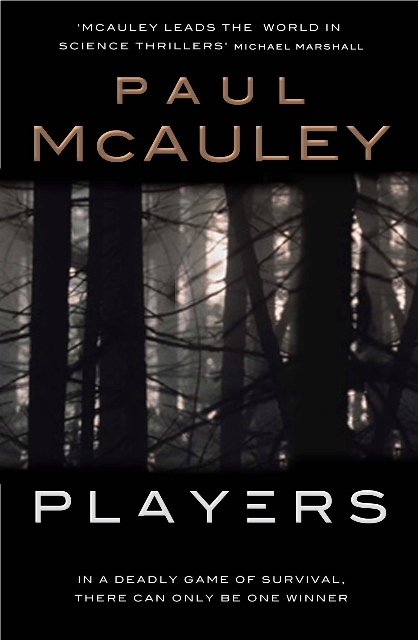
Players: The Cover


Here’s a rough of the cover for Players. I very much like the menacing glow burning through the trees (much of the novel is set in the woods of South-west Oregon, where I spent some time last year; they are both lovely and spooky - especially spooky when there’s a lull in the ambient insect- and bird-song, and you think: bear).

I’ve just finished the copy edit, and now I have to work up notes about the changes I made, and key in all the changes in the hard copy to the electronic version of the text. I’ll start putting up some chunks from it soon.

Saturday, July 29, 2006

Chasing Perfection

I’m coming up to the final stretch of copy-editing work on Players. After that, the manuscript will be checked over at the publishers, and then it will go off to the printers. When I get a set of proofs, I’ll have a last chance to correct infelicities, repeated words, howlers and simple spelling mistakes before the book goes into production. Almost inevitably, some mistake or other will get through; you can chase perfection as long as you like, in the company of your editor, sub-editor, copy-editor, friends . . . but it's like Zeno's paradox. You can only approach the target in ever smaller increments, you can never reach it.

You might think that poets have it easier - their books, after all, usually contain far fewer words than the average short story, let alone a novel. But as Don Paterson notes in a day-in-the-life article in the Weekend Guardian, they have to watch out for a special horror - inadvertent acrostics formed by the first letters of succeeding lines. On the other hand, he’s able to read his poems line by line backwards to ferret out glitches; just try doing that with a novel. I dare you.

Wednesday, July 26, 2006

Caveat Emptor

These people claim to have one of the guitars once owned by legendary Blues singer Robert Johnson (thanks to Steve Baxter for the tip, and Jack Womack for the link). Frankly, I think they need to provide little more provenance than ‘it looks like the one in the photograph’ before they get their $6000000.

Saturday, July 22, 2006

The Butterflies of Memory

Just received my copies of Ian Watson’s terrific short-story collection, The Butterflies of Memory.

My introduction begins like this:

If you’re of the opinion that science fiction is above all else a literature of ideas, then Ian Watson is your man, and this collection, which contains more than enough ideas to set up a couple of lesser writers for life is very definitely your cup of meat. Of course, ideas aren’t everything. For one thing, apart from a few incredibly rare once-in-a lifetime, fifty-carat, career-defining originals, ideas are as cheap and ubiquitous as advertising. Ideas, good or bad, are the human animal’s speciality. Day in, day out, we see clouds and think them very like whales. We put together two and two and make five. And even if you do have an idea that’s both brilliant and original, in the end it’s what you do with it that counts, and that’s where qualities like hard work, talent, and that indefinable but instantly recognisable quality, voice, come into play.

Ian Watson knows all about this, of course. Check out ‘How to be a Fictionaut’, which not only has a lot of fun with the myth of ideas and originality, but also pushes the notion of the anxiety of influence about as far as it will go.

This isn’t to say that the ideas on display here aren’t witty, outrageous, daft, unsettling and plainly fantastic, because quite frankly that’s exactly what they are. But more importantly, they have also been woven into stories by a writer who not only possesses a restless and capacious imagination, but also knows exactly what to do with his ideas, and has an enviable talent for stretching them in unexpected ways, testing them to destruction, or using them to smash open accepted notions about the way the world works.

Thursday, July 20, 2006

I Don't Just Make It All Up, You Know

In her New Scientist cover story about hypervelocity stars, Maggie McKee reveals where I got one of my ideas for Eternal Light. (You have to be a subscriber to view the article. Or you buy a copy of the magazine.)

Superman Redux

So I didn’t get around to reviewing Superman Returns, but Roz Kaveney did, generating much comment.

Monday, July 17, 2006

English Summertime

Out to a favourite pub for Sunday lunch, and then a slow walk back home, along the towpath of the Regent’s Canal. I used to walk along the canal regularly when I lived nearby, and in my ten years in London, I’ve seen its dilapilated Victorian brick factory and warehouse buildings be replaced by smart but mostly soulless apartment buildings right on the water. One of these, the Gainsborough Buildings, on the site on what was once a film studio (where Alfred Hitchcock worked, before he left for Hollywood), made an appearance at the beginning of Whole Wide World. It had not yet been built when I began the novel; now, it is a small, exclusive city-state in the badlands of Hackney - ordinary citizens can’t even walk or drive past them, because the council has obligingly blocked off the road. There are many more blocks like this along the canal, now, and more to come. The neglected and overgrown dereliction of the old buildings gave the feeling of how London might be if it had been abandoned to nature; a long, narrow mixture of wilderness and industrial heritage running through North London and the East End. Now, it’s more like a tawdry imitation of the sets of Blade Runner, with badly designed yuppie hutches elbowing each other for a stretch of coveted waterside real estate. A taste of things to come, as the marshlands and playing fields along the River Lea disappear under the Olympic developments.

But if you could ignore the serried windows of the apartment blocks, there are still barges puttering along the canal and houseboats moored up alongside the towpath; and the hot sun beat gold highlights from the water, the weeds were all in ragged bloom, and the hot dust of the towpath was as silky as talcum powder underfoot: summertime, in England.

Thursday, July 13, 2006

Only Correct


Here’s a picture of the corner of my office where I’m currently working in the copy-edited manuscript of Players. It has already been subjected to my editor’s scrutiny, of course, but having taken her comments to heart and made the appropriate modifications, the manuscript is back again. This time just about every page contains corrections and suggestions for micro-improvements; it’s time to rethink every line all over again. More importantly, it has been marked up for the typesetter with time-honoured hierogylphic instructions, and you realize that the novel that has been a more-or-less private conversation with yourself for the past year or so has begun its journey towards the bookshops.

I once visited Longfellow’s house in Cambridge, Mass; the view from the study, down to the Charles river, is preserved for the nation. Maybe poets need to look out of windows; most writers I know face away from potential distraction, like so many penitents.

Monday, July 03, 2006

Superman v. The Planet Of Slums

I was lucky enough to attend a preview of Superman Returns yesterday; I may write a short review at some point, but meanwhile I’ll content myself with saying that I do believe it’s going to be a good old-fashioned summer blockbuster. Haven’t had one of those in a while.

I’ve also just finished Mike Davis’s Planet of Slums. Sometime this year, for the first time in human history, the number of people living in cities will outnumber the rural population. And one billion people will be living in slums circling the cities of the South. Planet of Slums describes the evolution of the megaslums and the rise of an urban population that is completely disconnected from ordinary economics and politics. As with all of Davis's books (which include the classic City Of Quartz, one of the best books about Los Angeles ever written), it’s packed with vivid summaries and extrapolations of current trends backed with trenchant argument, imagining a future in which the enclaves of the rich make war against the squatters and outcasts that inhabit vast squalid termitaries of the displaced and dispossessed.

Saturday, July 01, 2006

Secret Doors

I promise not to put too many pictures up here, but I thought I should at least have a go at linking one or two. This is from my research files for Cowboy Angels. It’s the route that field agents use to reach the gate between their reality and ours, located on the 49th Street side of the Waldorf-Astoria hotel. The two doors open onto a stairway and a freight elevator that give access to a loading platform in Grand Central Station that fell into disuse after the station’s own power plant was demolished following a switch to ConEd as a source of electricity. There’s an unconfirmed story that President Roosevelt, in his specially adapted automobile, was whisked from train to street via the freight elevator when he visited New York.

If you’re wondering about the low resolution, it was taken with my thumb-sized Philips wearable digital camera.

More Dick

Joshua Glenn has a thoughtful piece on the film of A Scanner Darkly and director Richard Linklater over on Slate.

Tuesday, June 27, 2006

On The D.

Yesterday to a preview of A Scanner Darkly in a plush screening theatre in Warner Brother’s London headquarters. Director and screenwriter Richard Linklater is clearly a fan of Philip K. Dick’s work; his adaptation of Dick’s semi-autobiographical novel about an undercover cop falling apart under the insiduous influence of the brain-killing drug Substance D, is, some necessary compression apart, faithful to both the text and the melancholy spirit of the novel. It was shot as a live action film and rotoscoped by computer animation to provide a graphic novel look that works pretty well; it’s hard, really, to see how the scramble suit effects could have been done so effectively otherwise. Hallucinatory weirdness is kept to the minimum, although there’s some very subtle distortion here and there, especially towards the end. Given that the story is largely plot-free and packs a lot of dialog, it does sag a little in places, but does its best by Dick's intricate drug-fueled paranoid riffs, is seasoned with some lovely touches of black humour, and the diminuendo ending, containing just a flicker of hope, is faithful to that of novel. Fans of Dick’s work will almost certainly love it, but I fear that its bleak, amorphous plot will have limited appeal to the general public. Keanu Reeves as undercover narc Bob Arctor is basically Keanu Reeves; Robert Downey Jr is a tour de force as the manically unpleasant James Barris; Woody Harrelson and Winona Ryder turn in solid performances, and Rory Cochrane is going to hate being called the new Jack Black.

Saturday, June 24, 2006

Forbidden Planets

I’ve just received the proofs for my story, ‘Dust’, one of a round dozen collected in the anthology Forbidden Planets. Others are by Stephen Baxter, Paul Di Filippo, Scott Edelman, Matthew Hughes, Alex Irvine, Jay Lake, Ian McDonald, Michael Moorcock, Alastair Reynolds, Chris Roberson, and Adam Roberts. Edited by Peter Crowther, with an introduction by Ray Bradbury and an afterword by Stephen Baxter, it celebrates the 50th anniversary of the classic movie.

Another story, ‘Winning Peace’, the one I was writing in April, set in the same future history as ‘Dust’, will appear in Gardner Dozois’s and Jonathan Strahan’s The New Space Opera.
Back now to reading Cowboy Angels (for the first time in three years) and making notes for the many tweaks needed to bring it up to speed.

Saturday, June 17, 2006

Stalking Alfie

All novelists worth their salt must work their way under the skin and into the minds of their characters; it’s a necessary step on the way to thoroughly inhabiting the novel’s world. Some try to create a character by listing his likes and dislikes, by asking how he behaves while eating with a group of people, how he reacts to rain or sun, how he reacts to someone much poorer than him, or to someone much richer? And so on, and so forth. One is reminded of the attempts of phenomenologists to describe and catalogue their sensory experiences - the relationships between ideas in their minds and the things in the world that they represent. Others, especially comic novelists, borrow extensively from people around them, exaggerating and mixing traits from a variety of acquaintances. My approach is probably the most common, and is much less systematic. It’s rather like stalking a bird through a dense forest. I know that it’s small and brown, and sometimes I can hear its song, but I need to see it entire, just for a moment, before I can know what it is.

In Mind’s Eye, I had the name of the main character from the first. (Names have a talismanic importance - they must strike the right chord in the memory.) Alfie Flowers: a sturdy London name. I knew that Alfie lived in London, and I knew a good deal of his family’s history, and knew that he suffered from an atypical form of epilepsy - it’s a necessary part of the story - and that this made him cautious, made him look at the world at a slant in case it surprised him in the wrong way. After a false start involving trading old Airfix kits on eBay, I knew what he did for a living too: he was a street photographer, following in the footsteps of his missing father, a 1960s hip fashion photographer turned war documentarist.

It took a little while longer to find out where he lived. I find that walking helps to loosen knotted thoughts and joggle ideas together; I walk a lot, when I’m writing the first draft of a novel. On my way back from a long ramble one day, about a hundred yards from my home, I realized that I standing across the street from where Alfie Flowers lived: a narrow plot of land beside the North London railway, with a small, old bus garage and a couple of caravans. He lived in one of those caravans, and had his darkroom in the other. In summer, he ate his meals outside, at a picnic table. And so on.

But I didn’t see him clearly until he was returning home on a crowded train:

Alfie slumped in his corner, a large, somewhat shapeless man, like a bear that hadn’t been properly licked into shape by its mother, his blond hair a disarrayed halo, wearing a red check shirt and baggy black elephant cords, his bag clutched to his belly, his big feet in strap sandals. He had prehensile toes, long and double-jointed, thatched at their second joints with pads of dark hair.

At last, I was on the inside.

Tuesday, June 13, 2006

Sidewise Award Nominations

This year's Sidewise Award nominations have been announced. The award, which has been been presented since 1995, recognizes excellence in alternate history.

Long Form:
Ian R. MacLeod, The Summer Isles (Aio Publishing)
Sophia McDougall, Romanitas (Orion)
Paul Park, A Princess of Roumania (Tor)

Short Form
William Barton, "Harvest Moon" (Asimov's September 2005)
A.M. Dellamonica, "The Illuminated Heretic" (Alternate Generals III, edited by Harry Turtledove, Baen April 2005)
Kim Newman & Paul J. McAuley, "Prix Victor Hugo Script"
Jason Stoddard, "Panacea" (SciFiction, September 14, 2005)
Lois Tilton, "Pericles the Tyrant" (Asimov's, October-November 2005)

It’s rather cool to find our little jape up there with stories published in traditional venues.
Newer Posts Older Posts