Saturday, January 20, 2007

The Sorrows of Young Hannibal

Thomas Harris’s Hannibal Rising, which gives us the origin myth of his most famous creation, Hannibal ‘the Cannibal’ Lecter, displays Harris’s flair for concise narration and grand Guignol effects (as well as his weakness for tagging Hannibal’s victims with physically or morally repulsive characters, and his obvious dislike of the human herd), but it never quite lays to rest the feeling that it’s a franchise cash-in. After all, it is no more than an elaboration of a few pages of flashback in its predecessor, Hannibal, and a flashback that itself seemed pretty unnecessary, given that it attempted to explain the motivation of a monster who boasted to Clarice Starling in The Silence of the Lambs, ‘Nothing happened to me, Officer Starling. I happened. You can’t reduce me to a set of influences.’

The movie version of the novel shares this problem of redundancy, but like the novel it’s by no means as bad as it could have been. Apart from some necessary elisions and compressions, it sticks fairly close to the novel - not much of a surprise, given that Harris wrote the screenplay. In 1944, Hannibal Lecter’s family hide in the summer lodge when the Russian advance sweeps through their Lithuanian estate. His mother and father and their servants are killed in a firefight between a Russian tank and a Nazi Stuka; then a band of ragged looters take over the lodge and kill and eat his little sister, Mischa. Hannibal escapes, and after eight years flees a Soviet orphanage, and makes his way across Europe to France and his only surviving relative, the Japanese widow of his uncle. Plagued by nightmare flashbacks, he exacts a horrible revenge on a butcher who insults his aunt, and becomes a medical student and hones the skills he requires to track down the war criminals who murdered his sister.

It’s a handsomely staged period movie, with good direction by Peter Webber (who previously helmed Girl With A Pearl Earring), and despite a variety of Mittle-European accents the actors acquit themselves well. Gong Li brings a watchful stillness and quiet resolve to the part of Lady Murasaki, Hannibal’s aunt (although one wonders why a Japanese actress wasn’t given the role); Rhys Ifans plays Gaspar, the leader of the war criminals, with eye-rolling relish; and Gaspard Ulliel is a striking and devilishly gleeful young Hannibal. What the movie lacks, as does the novel, is a suitable antagonist for Hannibal to measure himself against. In The Silence of the Lambs he played cat-and-mouse games with Clarice Starling and in Hannibal he was chased not only by Starling but also by a venial Italian police inspector and his only surviving victim. In Hannibal Rising, Lady Murasaki does little more than fret over Hannibal’s monstrous descent, the French detective who investigates his trail of murders, Inspector Popil (played by The Wire’s Dominic West), is an incidental nuisance issuing impotent warnings, and until the final reel Gaspar is mostly offstage.

All that’s left is a series of increasingly gruesome set-piece variations on the theme of decapitation as Hannibal slashes through the ranks of the war criminals until he reaches their leader. There’s some small tension when Gaspar kidnaps Lady Murasaka, but it’s too little, too late. And although the movie tries to make something of the possibility that Hannibal can make a Faustian choice between good and evil, there’s little to be wrung from it because we already know what Hannibal will choose, and in any case Inspector Popil, echoing Red Dragon’s Will Graham, tells us that the human part of Hannibal died in the forest during World War Two, giving birth to the monster. And despite Ulliel’s hypnotic performance, it’s hard to muster sympathy for Hannibal’s devil, which makes his revenge all the more unpalatable.

Tuesday, January 16, 2007

Coming Attractions

The paperback was never quite out of print, but I’m pleased to announce that Gollancz will be republishing Fairyland in their new Modern Classics series, along with Stephen Baxter’s Evolution, Greg Bear’s Blood Music, Greg Egan’s Schild’s Ladder, Richard Morgan’s Altered Carbon, Christopher Priest’s The Seperation, Alastair Reynold’s Revelation Space, and Dan Simmons’s Hyperion. All with neat, graphic-design covers, coming to a bookshop or online merchant near you in August.

Meanwhile, I’ve been told that Players will feature in a front-of-store promotion in Waterstone’s next month. This is Good Stuff, as an awful lot of foot traffic (ie potential book purchasers) doesn’t make it past the barricade of front tables with their come-hither special offers, 3 for 2 stickers, and velcro filaments that attach to you while the book squawks buy me or my pet dog will die in the plaintive voice of a big-eyed starving orphan...

Monday, January 15, 2007

My Generation

So I’m listening to the latest Ray Lamontagne CD, Till The Sun Turns Black, and I’m thinking, Oh boy, what a great collection of 1970s albums he must have. And then I realise that it’s probably his father’s collection.

Stuff like this can make a man feel his years.

It’s a great CD, by the way.

Wednesday, January 10, 2007

Lake Deja Vu


The lead article in this week’s Nature, summarised on JPL’s site, confirms previous reports that there are presently lakes of what is presumably liquid methane and ethane on Titan. There are all kinds of lakes in all kinds of places, it seems. Some have been compared to flooded volcanic calderas, like Crater Lake in Oregon, which I visited a couple of years ago while doing research for Players, much of which is set in the forests of the southwest of that state; here’s a low rez photo to prove it. The island in the lake is called Wizard Island, and it’s another, smaller volcano inside the much larger one. With its panoramas of volcanic cones, and pumice fields, it’s a truly alien landscape for the British visitor; how strange and wonderful that it may be replicated in different materials on Titan, where a couple of my characters will shortly be playing a desperate game of hide and seek...

Tuesday, January 09, 2007

Dead Tyrant Storage

Last week, Richard Dawkins gave a refreshingly different reason why Saddam Hussein shouldn’t have been hung. His mention of using a time machine to retrieve Hitler for psychological study rang a very faint bell - didn’t someone write a short story on this theme?

In other news, ‘Dead Men Walking’ has been picked up by David Hartwell for his Best SF anthology. Gosh.

Sunday, January 07, 2007

Elsewhere

As threatened, I’ve posted the first two and a half chapters of Players on my much neglected web site.

Wednesday, January 03, 2007

Out There

From the good people who are swinging Cassini around the Saturn system, some choice images of moons seen previously, but never in such detail, and moons never before seen too. Glorious.

Tuesday, January 02, 2007

The Dreamer Awakes

The day after New Year’s Day, London is almost back to normal. On Christmas Day itself, G. and I walked down through Clerkenwell to the Thames, and at times were quite alone on streets where the only movement was litter blowing in the wind and pigeons pecking after it. All the buildings shuttered, asleep with that peculiar suspended stillness that’s so different to the quiet of the countryside, all except for St Paul’s Cathedral, lighted and open, getting ready for the Eucharist service, the sound of its bells floating after us as we crossed the footbridge to the South Bank. In the week between Christmas and New Year, many parts of the city were still so deserted they might have been sets from a movie depicting the aftermath of some depopulating disaster; but now everyone is back, and the city is awake again.

In the post today, the first of the year, a contract from Gardner Dozois, who wants to include my story ‘Dead Men Walking in his Year’s Best annual collection. Which is as good a start to the year as any.

Sunday, December 31, 2006

End Times

I think the extract above should be the last I’ll post here. By now, if you’ve been reading these snippets, you’ve met all the principal characters in Players, progressing much further will give away too much of the rest of the plot, and in any case the novel will be published in February if you want to find out what happens next (it’s not too early to preorder). I’ll probably put up a couple of complete chapters on my web site, though. Meanwhile, I’ve spent the last day of 2006 reading through and printing out the manuscript for the edited version of Cowboy Angels; it’s sitting by my elbow on the desk, cooling from the laser printer, as I type this. And I have to get back to the new novel, too. Busy, busy, busy . . . I’m not quite up to the standards of Anthony Trollope, who would upon completing the last lines of a novel immediately begin the first lines of the next, so as not to waste a minute of the time he alloted himself each day for composition before going off to his work at the post office (I can’t help wondering how completely he made the switch from novelist to civil servant each day, especially as he insisted that authors must live with their characters ‘in the full reality of established intimacy’). No, I’m a little more indolent. Before I head out to the Moon, and the moons of Saturn, and renew my acquaintance with Macy Minnot, Cash Baker, Sri Hong-Owen and all the rest, I’m taking tomorrow off. Happy New Year.

Players - 22

Although he still hadn’t reached the save point in the ruins of downtown Los Angeles, Daryl was feeling pleased with himself. He’d closed out bids on three items he was selling on eBay, drawn from the store of gadgets, maps, and other valuables he’d acquired during Seeker8's adventures in Trans, and the deals had fattened his PayPal account by just over four hundred dollars. Even better, his partner, Ratking, finally had reached out to him, explaining that he’d had to attend to some urgent business out in the world, but now he could devote his attention to the final stage of the treasure hunt.

> I’ve developed a new strategy. I can’t come with you, but I’ll be watching over you. I’ll be your guardian angel.

> Lay it on me, Daryl typed.

They were instant messaging, East Coast to West Coast and back again. It was one in the morning in Brooklyn, just after Daryl’s latest attempt to get Seeker8 to the save point had failed.

> I purchased a hack that lets me watch anyone in the game. I’ve become a point of view, pilgrim. I’m the eagle that dwells on the rock. Wherever you go, I’ll be right there with you. I’ll be the voice in the burning bush. I’ll speak to you out of the whirlwind.

Daryl, reading this, hunched over the glowing screen in his hot dark cell in Brooklyn’s unsleeping anthill, wondered what had happened to his partner while he’d been out of the loop. Previously, Ratking’s messages had been terse and clipped, pure business and always straight to the point, but now he was on fire with self-importance and a Biblical fervour.

After a moment’s thought, popping gum with machine-gun rapidity, Daryl rattled out his reply:
> I’d rather you were watching my back, helping me knock down the warewolves.

Strictly speaking, Seeker8 had been taken down by tar babies this time, but it had been a pack of warewolves that had driven him into the broken channel of the Los Angeles River, with its smoking cinder cones, fields of congealed lava, and asphalt pits from which dozens of tar babies had clambered, lumbering stiff-legged towards him from every direction like giant teddy bears dipped in sump oil, eyes glowing red, stubby arms spread wide. He’d killed thirty or forty with incendiary bullets and grenades before he’d been caught from behind in an unbreakable embrace and carried off and drowned in a deep pool of oily water. The night before that, warewolves had chased him howling through the ruins, playing with him, nipping at his heels, harrying him with balletic coordination until they’d finally closed in and taken him down.

Each attempt to reach the next save point had been harder than the last. It wasn’t just that the warewolves were making things difficult. The game itself constantly evolved as players roamed across it and interacted with each other, finding treasures, trading secrets and weapons, making alliances, building or destroying fiefdoms. The game learned from players’ moves, adjusted itself to their strategies, messed up their plans by throwing storms and earthquakes, bandits and monsters into their paths. Daryl had been worrying that he had reached a no-win stalemate, reloading time and time again to try to make progress from a hopeless position, but now his partner was back with the promise of fresh information and this weird new mystical slant. Telling Daryl now:

> The eagle dwells and abides on the crag of the rock, and the strong place. That’s me.

Daryl massaged his forehead with one hand, and with the forefinger of the other hit the Caps Lock key and pecked ?

> Read the Book of Job, pilgrim. Meanwhile, you need to reach that save point. Let me make some suggestions.

Ratking might have started to have sound like the preacher at the church Daryl’s mother attended each and every Sunday, but his advice was as detailed and sensible as ever. After some back and forth, he told Daryl to wait until tomorrow evening before he tried to move on.

> I’ll be watching then. And when you reach the next save point, we’ll work out what to do next.

Sunday, December 24, 2006

Players - 21

The blonde waitress, Janice, was a tall and big-boned young woman, with acne in the corners of her mouth and too much blue eyeshadow. She said that she’d heard about what happened to Edie on the TV news, just about everyone was cut up about it, and confirmed that Edie had been at work last Thursday but hadn’t turned up on Friday. ‘It’s a fucking shame what happened to her, excuse my French. She was a real darlin’. Everyone but Sneaky Pete liked her.’

‘Sneaky Pete?’

‘Mr Schopf, the manager? I don’t suppose he was much help to you.’

Janice had an accent from someplace three thousand miles south and east of Portland that lifted every other sentence into a question. She wore a candy-striped cotton dress and a white apron with a scalloped trim. Her dirty blonde hair was pulled back in a ponytail fastened with a rubber band, and there was a ballpoint pen tucked behind her ear.

Summer said, ‘Mr Schopf thought you might be able to help me.’

‘I don’t know how I can, but I can try.’

The girl was shifting from foot to foot in her trodden-down flat-heeled shoes, easing the weight on her ankles. Summer suggested that they sit in an empty booth. When they were settled, she said, ‘Did you know Edie socially, or just here at work?’

‘Just at work. We talked when we snuck cigarettes out back? I know she was on probation, and she wanted to go straight. Her big idea, she wanted to go work in one of those big offices downtown. Excuse me.’ Janice pulled a handkerchief from her sleeve and dabbed at the corners of her eyes and said in a pinched voice, ‘I thought she was sweet, y’know?’

Summer said, ‘Did she have a boyfriend that you knew of?’

Janice blew her nose with surprising delicacy. ‘She sure did. Real nice boy, name of Billy.’

Summer felt a quick flare of hope. ‘Did you ever meet this Billy?’

‘Just the once. He came by on Edie’s first day. I think he wanted to see where she was working?’

Garrulous, sharp-eyed Janice, every cop’s idea of a dream witness, gave Summer a description of Edie Collier’s boyfriend: six foot nothing, brown eyes and cheekbones to die for, shoulder-length black hair, rangy, wearing Hi-Top sneakers, blue jeans out at both knees and a raggedy old T-shirt. ‘And he had a couple of fingers missing from one of his hands.’

‘Which hand?’

‘The right.’

‘Can you remember which fingers were missing?’

‘The little finger, and the one next to it.’ Janice wrinkled her nose, remembering. ‘They were cut off at the knuckle? He kept his hand behind him, or in his pocket, like he was ashamed of it, but I saw it when he lit a cigarette.’

‘Did Edie ever tell you how her boyfriend lost his fingers? Was it some kind of industrial accident, for instance?’

‘Uh-uh.’

‘How about his last name?’

Janice looked up at the ceiling for a moment, thinking. ‘I don’t believe it ever came up. Like I said, I only met him that one time.’

‘Did Edie mention what he did for a living?’

‘I believe it was something to do with computers. He played games in competition, something like that? I know when he came in that time he had one of those laptop cases. But whatever he was into, it can’t have earned him much money -- the two of them were living out of his van.’

Thursday, December 21, 2006

Players - 20

The Black Rock Desert, Nevada. The sun a fiery nail hammered high in the wide blue sky; hot wind blowing threads of alkali dust across the playa towards bare mountains rippling behind glassy layers of heat haze.

Carl Kelley was standing in a thin wedge of shade at the rear of the big RV, wearing a baseball cap, an unbuttoned denim shirt and black combat pants, sipping from a bottle of spring water, and watching with edgy and uncharacteristic impatience as Dirk Merrit’s ultralight stooped and turned and climbed a couple of miles away. The buzz of the ultralight’s rear-mounted prop sounded like a bee at a window, rising and falling as Merrit harried the sacrifice to and fro across the dry lake bed, taking his bloody time about it.

The RV, a Coachman Cross Country SE finished with ten coats of hand-rubbed black lacquer and customized from stem to stern, was an ideal way of transporting sacrifices to remote sites where Dirk Merrit could act out his fantasies. The sacrifice could be kept trussed and gagged on the bed in the main sleeping compartment; Dirk Merrit liked to stretch out his unlikely length on the modified recliner behind the big, comfortable driver’s chair. And because people who own RVs often attach all kinds of leisure equipment to them, no one looked twice at the trail bike hung on the rear rack, or the Cumulus motor glider folded on its twenty-foot trailer.

The volume of the walkie-talkie clipped to Carl’s belt was turned right down because he was tired of listening to Dirk Merrit’s breathless whoops of glee, and he didn’t bother to follow the action with the pair of Bushnell field glasses hung around his neck because he knew from all the other times how it would go. If the sacrifice stood its ground, Dirk Merrit would fire shots around it until it ran; when it ran, he chased it and dive-bombed it and took pot shots until it was too tired to run any more, and then he landed and dispatched it with his crossbow.

All in all, it was an expensive, complicated, and dangerous way to get your rocks off, and Carl had lost all patience with it. Also, he felt a squirt of acid in his blood every time the flimsy little aircraft swooped low. Dirk Merrit took unnecessary risks because he thought he was smarter than anyone else and was going to live for ever. Carl would be glad enough to see the back of him, but it wasn’t quite time for him to die. Soon, but not quite yet.

Actuality

I’ve just received advanced copies of Players, and as usual had the strange feeling holding in my hand a physical representation of something that’s been in my head for the past couple of years. I must say the design and layout is striking and quite handsome. But as yet, I haven’t read any of it, being very aware of the Awful Curse of the About-To-Be-Published: an author, on reading in the first copy of his new book a random sentence on a random page will spot a howler that’s entirely his own fault. Unread, the book remains, like Schrodinger’s cat, uncollapsed into its final quantum state.

Wednesday, December 13, 2006

Players - 19

Summer sat at the back of the wood-panelled courtroom and watched things go down pretty much as Mark Kirkpatrick had predicted. A line of shackled prisoners shuffled in, mostly wife-beaters, petty thieves and hung-over drunks, all of them wearing orange jumpsuits with ‘Macabee County Correctional Facility’ stencilled in black letters across their chests and backs. Randy Farrell was hunched between a wincing teenager and a dignified black man with a shaven head. When he noticed that Summer was looking at him, something hardened in his face and he looked away.

The court officer, a balding man wearing an ancient Colt in a worn leather holster under his paunch, ordered everyone to rise, and the judge appeared from a door behind the bench like a figure in a medieval clock. Randy Farrell’s case was first up. Mark Kirkpatrick said that his client wished to plead guilty, and asked to approach the bench. He had a brief whispered conversation with the judge, stepped back. The judge fixed Randy Farrell with a sharp stare and told him that assault on an officer of the law was a serious matter, but given the circumstances and the recent tragic events she was minded to mitigate the sentence to a fine of five hundred dollars and a suspended sentence of a hundred days. The prosecutor made no objection, and the judge banged her gavel and moved on to the next case.

After that, everything moved with the smooth dispatch of a well-rehearsed execution. Randy Farrell was released into Summer’s custody, and after he had changed into his own clothes in a restroom and paid his fine at the cashier’s desk Summer drove him out of the parking lot and through Cedar Falls’s one-way system to the I-5.

Although no one followed them, Summer had the feeling that a hundred years ago they would have been tarred and feathered and ridden out of town on a rail. She let Randy Farrell sit up front next to her, but he hardly said a word on the long trip back to Portland.

Tuesday, December 05, 2006

Players - 18

Joseph Kronenwetter’s neighbour was a widow by the name of Rhonda Cannon, a sensible, sharp-eyed, garrulous old bird in jeans and a man’s shirt. She had no objection to answering Summer’s questions, telling her that she had known Joe Kronenwetter from birth, it was a darn shame he’d turned out the way he did.

‘He was a nice little boy, tow-haired and cute as apple pie. He got into a few scrapes with the law when he was a teenager, but it wasn’t anything serious, and he straightened up after he joined the army. His father, now, he was a drinking man. That’s how they reckon the house burned down, he passed out one evening with a lit cigarette in his hand. It was just after Christmas, in the middle of a snowstorm. My husband -- he was still alive then -- saw a light flickering through the falling snow, and realized the Kronenwetters’ place was on fire. It took the fire trucks more than an hour to arrive, not that it would have made any difference if they had turned up right away: the house was already alight from top to bottom when my husband spotted it. It was one of the strangest sights I’ve ever seen in my life, that house throwing yellow flame and black smoke into the night and snow coming down all the while.’

‘Joseph Kronenwetter was in the army at the time.’

‘Yes, ma’am, getting ready for the First Iraq War. He was given compassionate leave when his parents died in the fire, came back for the funeral, stood straight and tall in his dress uniform by his parents’ grave, and then he went right back to Kuwait to fight Saddam. He’s the only one of his family left. He had an older brother that died in a traffic accident, and there’s a sister who upped and went to live in Los Angeles, no one knows if she’s alive or dead. Anyhow, either the deaths of his parents hit him hard or something happened to him in Kuwait, but when he quit the army and came back here you could see at once that he was a changed man. He’d never been what you could call talkative, but when he came back he didn’t hardly care to pass the time of day. He was drinking heavily, he grew his hair and shambled about in ragged clothes like he was some kind of hobo, and when he did talk to you it was most often to sound off about how people were out to get him.’

‘What kind of people?’

Rhonda Cannon looked away, shrugged. ‘Oh, it was just nonsense. He said that people were hiding in the woods and watching him, nonsense like that. I paid it no heed.’

Summer said, ‘I know you don’t want to speak ill of your neighbour, ma’am. But anything you know about him could help us understand why this happened. It might even help him.’

‘I can’t see how, seeing as you have him locked up.’

‘It might help get him the right treatment.’

Thursday, November 30, 2006

Have A Very Cthulhu ...

...Christmas.

Thursday, November 23, 2006

Players - 17

When his mother came back from work at half past midnight, Daryl Weir was still up, still deep in Trans. A slender, athletic black boy who looked a lot younger than his sixteen years, he was sitting cross-legged on a corduroy beanbag in T-shirt and boxers, hands folded around his customized controller, his face about a foot from the screen of his computer. The screen was the only source of light in the small, stuffy bedroom. It showed a solidly built man in a leather kilt and a harness hung with all kinds of kit marching at a steady pace down a ruined street, cradling an AK-47 in his muscular arms.

The man in the kilt was Daryl’s avatar, a fortune hunter with the handle Seeker8. Daryl was watching him from the usual player’s viewpoint, a few yards behind the back of his head, and steering him with his left thumb. The street stretched away across a parched plain gridded with low ruins and overgrown with a scrub of leafless bushes and a scattering of giant cactuses with crooked arms raised in surrender against a technicolour sunset. When he heard his mother call his name through the closed door of his room, Daryl hunched a fraction of an inch closer to the screen. He really didn’t need any distraction right now, not when Seeker8 was still a long way from the next save point and night was coming on fast.

The front door of the tiny apartment opened directly onto the living room, with the main bedroom and the bathroom off to the left, and the second bedroom, Daryl’s, and the kitchen off to the right. As Seeker8 marched along at an unvarying pace down the middle of the street, past the rusted shells of cars, low mounds of rubble, and street lights leaning at different angles, Daryl heard through the thin plasterboard wall the solid clunk of the refrigerator opening and closing, and knew that his mother was pouring herself a glass of chocolate milk. In a moment the TV would come on; when she got back from her night work, cleaning bank offices in Manhattan, his mother liked to relax in front of the TV with a comforting drink, a White Russian or iced chocolate milk spiked with vodka, before going to bed. But instead of the sudden blare of the TV, the door behind Daryl clicked open, and his mother said, ‘Sweetie, you still up?’

Thursday, November 16, 2006

Quote of the Week

'Very few people would want to have their brain replaced by someone else’s...’

Professor Bruce Lahn, New Scientist

Wednesday, November 15, 2006

Players - 16

Across the room, the rack of TVs flooded with red light. All of them showed the same picture: a man with an unlikely muscular build in leather harness and a kilt jogging through the levelled ruins of a city.

Dirk Merrit said, ‘Remember him?’

Carl was getting a very bad feeling. ‘He’s the partner of your latest sacrifice. The one in Brooklyn. The one you said you weren’t interested in. The one you said would give up after he was left on his own.’

‘Because he was younger and more inexperienced, yes. But he has managed to reach the ruins of Los Angeles after all. He’s been beaten back three times, but he is persistent and clever. He’s a stayer after all. If I don’t do anything, I do believe he’ll reach the oracle soon. And if he has the password that gets him past the oracle, or if he can guess it, he’ll be one step away from the source of those valuable trinkets Mr Hunter Smith likes to sell on eBay.’

‘So put the wolves on him,’ Carl said.

The wolves were a bunch of players in a Romanian click farm, paid by Dirk Merrit to defend the Los Angeles basin from intruders.

On the TV screens, the muscular man jogged past a row of dead palms. Their shrivelled fronds were etched black against a swollen red sun.

Dirk Merrit said, ‘His game profile suggested that he was the junior partner. But now I’ve had to revise my opinion. Not just because of what he has achieved on his own: I’ve read the emails he exchanged with our sacrifice, too. He’s a prodigy.’

‘I thought you’d given up trying to crack that laptop.’

When Carl had kidnapped the latest pilgrim and his girlfriend, he’d brought the guy’s laptop back too.

‘It was quite a clever little bit of encryption. But as it turns out, I’m cleverer,’ Dirk Merrit said complacently. ‘I read every one of this player’s emails, and he’s easily the equal of his partner. Which means that he’s equally worthy of my attentions.’

Sunday, November 12, 2006

Meanwhile . . .

I’ve been pounding away at the first draft of a novel for the past few weeks, getting up to speed, getting inside the beast. And at the same time I’ve been tackling an edit of another novel . . . Which is why I’ve been posting with decreasing frequency, I’m afraid.

Meanwhile, Al Reynold’s marvellous short-story collection, Zima Blue, for which I wrote the introduction, is available in trade and limited edition from Nightshade Books.

Forbidden Planets, edited by Peter Crowter Is Out Right Now, and includes my short story ‘Dust’. About which I said:

The creators of Forbidden Planet made no secret of the fact that they’d borrowed and updated the plot of Shakespeare’s The Tempest. In the same spirit, I hope that no one minds that my little homage to that marvelous film borrows and updates its robots, monsters, and super-technology hidden in an underground alien city.

And Jonathan Strahan has posted the fantabulous listing for the space opera anthology he’s editing with Gardner Dozois. I am not worthy . . .

Wednesday, November 08, 2006

Players -15

Denise and Summer drove down a road that switchbacked between trees and outcrops of rock, a sharp bend suddenly revealing a narrow valley blocked by a tall wedge of white concrete, stark in the floodlights burning along its top. Straight ahead, halfway up the side of the valley, was a broad shelf where three towers stood, also floodlit.

Denise said, ‘That’s the dam, and that’s Merrit’s house -- if you can call it a house.’

It was like a fairy-tale castle, Summer thought, or a trio of old-fashioned rocket ships. The tallest tower was easily a hundred and fifty feet high, with a little glass dome glinting at the top -- yeah, just like a spaceship. The other two towers were shorter; one looked half finished, ending in an uneven crown of rebar. Arrow-slits and round windows shone at different heights in their smooth, tan walls.

Denise parked her Jeep Cherokee behind a black Mercedes SUV at the foot of the tallest tower. She and Summer got out and buckled their bracelets to their wrists. It was very quiet. A steep wooded slope rose on their left towards the black sky. The other two towers were spotlit beyond rocks and stands of bamboo. Although Summer was amused by the obvious theatricality of this spooky setting, she felt a tickle of apprehension as she followed Denise to the smooth flank of the tower, where a castle door swung open silently, a touch straight out of some dumb horror movie. The foyer, pinched between a pair of curving staircases and lit by the lurid flicker of a cluster of TV sets that hung overhead like a chandelier, narrowed to a big steel door that, like the castle door, swung open when Denise and Summer walked towards it, revealing a large room with leather couches and armchairs grouped around an open fireplace in the centre. There were all kinds of objects in niches and behind glass in the adobe walls, clusters of animal heads hung above them, and a tall man stood on the far side, his back to Summer and Denise as he studied or pretended to study a flat-screen TV that was showing some kind of cartoon, a Mad Max-style warrior jogging along a ruined street towards a cluster of broken skyscrapers.

The man’s hands were clasped behind him, dead white against the green silk of his robe -- no, it was a kimono, Summer realized, that big red target on the back was a chrysanthemum. The tall collar of the kimono was turned up, so that she couldn’t see his head; its hem ended just above his knees. His shanks were as pale as his hands, and as hairless as a mannequin’s.

He kept his back to Summer and Denise as they approached. ‘Detective Childers, so nice to see
you again,’ he said. ‘Congratulations on the arrest, by the way. It’s good to know that our police are so efficient. Or should I say so lucky?’

His voice was a light baritone, as engaging as a chat-show host’s.

‘It was a little of both,’ Denise said. ‘This is -- ’

‘Detective Summer Ziegler of the Portland Police Bureau,’ Dirk Merrit said, and turned in a sudden flare of green silk.

Summer’s first thought was that it was a cheesy move that he must have practised a lot. Her second was that he was wearing a mask. Then he smiled at her, and it was as if a red wound had opened in his stiff white face.

Thursday, November 02, 2006

Boy, Is My Face Red


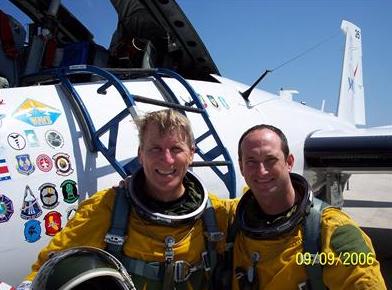
I confess - I was wrong about the photo on the previous post being taken from the ISS, and Al Reynolds proved it (see the discussion thread for details). And from the thread on digg.com that Al Reynolds ferretted out, courtesy of CubicZirconia, these are the guys who took the photograph from their WB-57 reconnaissance plane. They look more like astronauts than astronauts. More links to cool pictures on that site by the way...

Monday, October 30, 2006

Why I Write, Part 12


I pulled this down from one of the message boards where I lurk. I think it came from NASA via Warren Ellis’s site, but I’m not privy to the latter and can’t locate it on the former. Anyway, it’s beautiful: a shuttle launch photographed from the International Space Station.

Revenge of the Dorkofascist Galacticons

Via Jack Womack: Why the right wing fell in and out of love with Battlestar Galactica, or, what’s really wrong with US science fiction right now.

Sunday, October 29, 2006

Down with skool!

Lucy Ellmann, in a review of Elfriede Jelinek’s Greed, starts testifying:

What is killing the novel is people’s growing dependence on feel-good fiction, fantasy and non-fiction. With this comes an inability or unwillingness to tolerate any irregularities of form, a prissy quibbling over capital letters, punctiliousness about punctuation. They act like we’re still at school! Real writing is not about rules. It’s about electrifying prose, it’s about play.

Amen, sister! Amen!

As in mainstream fiction, so in science fiction. Why have we allowed the commissars of correctness to stamp their boot on what should be one of the most vital, playful and imaginatively transgressive genres, turning it into a bland prose factory churning out product by the yard?

Friday, October 27, 2006

Players - 14

Dirk Merrit was sitting at his big desk in the library, his white, angular face steeped in the glow of the computer’s flat screen, his right hand twitching a cordless mouse as he scrolled across a set of architectural plans. On the other side of the dark room, the plasma TV and the bank of smaller screens around it were all showing the same looped clip, sound muted, taken from the local TV station’s evening news: a wasted-looking fellow in black lunging at a much bigger man in an orange jumpsuit, the picture jolting as the camera was caught in the mêlée, showing a confusion of feet, a blur of indistinct motion, settling on a woman in a grey pants suit throwing the man in black against the side of a police cruiser, pinning him there while a sheriff’s deputy handcuffed him. Each time the clip jumped back to its beginning, light and shadow swung across the walls like a flock of birds turning on the wing.

Carl Kelley, walking across the room through television light, knew that Dirk Merrit could hear the ticking of his combat boots on the poured-concrete floor, but the man waited a full minute before dismissing with a click of the mouse the plans he had been scrutinizing -- the plans for the mansion -- and swinging around in his chair. After Carl had explained that he’d overhauled and fuelled up the RV, and packed the ultralight into its trailer, that everything was good to go,

Dirk Merrit said, ‘Tomorrow, at dawn.’

‘It’s your party.’

‘I have the feeling that you’re still angry because I choose to honour the sacrifice rather than give in to expediency.’

Carl didn’t want to get into that again. ‘How’s he doing?’

‘He’s angry, too,’ Dirk Merrit said. ‘He threw his dinner at the wall and stood there in the dark with his fists raised. I believe he was hoping to get into a fight. He’s a feisty boy, Carl. We’re going to have a lot of fun together.’

‘The quiet ones usually run better.’

‘We’ll see.’ Dirk Merrit gestured at the rack of TVs. ‘Do you know what that’s all about?’

‘I imagine the big bloke in orange is the one we framed.’

‘Looks suitably crazy, doesn’t he?’

Carl shrugged.

‘I do hope you’ll be over your sulk tomorrow,’ Dirk Merrit said. He sounded amused.

‘I just came up to report that everything is ready. If there’s nothing else, I’d like to turn in, seeing as how we have an early start.’

‘The fellow in black, he’s the girl’s stepfather. The woman, there . . . ’ Dirk Merrit turned back to his computer, moved the mouse to the menu bar at the bottom of the computer screen, clicked on an icon. Across the room, the action froze on the TVs. ‘She’s a detective from the Portland Police Bureau. Do you think it signifies anything?’

‘She probably brought the stepfather here to ID the girl’s body.’

‘I think so too.’ Dirk Merrit clicked the mouse again and the sequence ran on, the detective shoving the stepfather against the side of the cruiser and pinning his arms while a sheriff’s deputy handcuffed him. Dirk Merrit saying, ‘She’s rather feisty too, don’t you think? I bet I could have a lot of fun with her, in the right circumstances.’

Friday, October 20, 2006

Don't Look Back In Anger

Science fiction is in trouble, no doubt about that, either. It has lost a considerable share of the market it once owned, its audience is growing older because it is having trouble attracting new readers, and it has lost confidence in itself. Reading through the responses to my little rant, and thinking on it some more, I know that I can’t offer a pat solution to this (and hey, if I had a solution, do you think I would share it with you, until I’d written that genre-defining, best-selling novel?). But I think a couple of things have become clearer.

There’s nothing wrong with old skool sf. There isn’t even anything wrong with old-fashioned Star Wars style sf, if that’s what floats your boat. But if that’s all science fiction has to offer, then it will no longer be a vital genre: it will have become a museum of taxonomy. Because retreating from the present into the familiar comfort of the past means giving up on something that makes science fiction distinctive. It means no longer dealing with the shock of the new, no more wild extrapolations or metaphorical constructs ripped from the bleeding edge of science and technology, an end to pushing trends to their limits, and explorations of the limits of what makes us human. Goodbye to all that; hello to a little cell that’s getting smaller by the minute, padded with worn-out tropes from some mythical Golden Age, inhabited by catatonics.

Science fiction isn’t going to win a new and wider audience by turning its back on the world and talking to itself. It has to engage. It has to produce novels that are part of the world’s conversation. Paul Cornell is right. If someone somewhere could write a definitely great populist but finely imagined science fiction novel, it would not only be a lovely thing in its own right; it would, like a supernova, make the science fiction galaxy more visible. But I’d go further. One singular novel, or one lone author, is in danger of being traduced by the too-good-to-be-science-fiction brigade. If we’re going to get our mojo back, we need a shelfload of good books that connect the present with fabulous futures, weird worlds, and even weirder ideas made as real and plausible as any armchair.

So if you’re a writer, write from the heart as well as from the mind. Aim for an audience if you like, but know this: at best you’re going to hit nothing more than a temporary, here-and-gone demographic. Wouldn’t it be better to try to write the book that means more to you than any other book? You’ll probably fail. But you can always try again, and fail better. And, dear reader: buy books. Tell people about the books you like. Spread the word. Behave like you have found the best and finest secret in the world. And who knows? Perhaps you have.

Thursday, October 19, 2006

Players - 13

Denise Childers said, ‘When we talked last night, on the phone, you said you’d be willing to help out.’

Summer said, ‘I’m still willing.’

‘That’s good, because I have a couple of favours to ask,’ Denise said. ‘First off, I’d like to take you up on your offer of finding out whatever you can about this boyfriend, this Billy no-last-name. What he does, who he associates with . . . You know, the usual stuff. If you could track him down and bring him here, I’d love to sit with him and have a long talk about Edie Collier.’

‘Is this an official favour?’

‘If you mean, am I going to get Sheriff Worden to ask your boss if he can give you some time and resources to chase up any leads, then no, it isn’t exactly official. As far as the sheriff’s concerned, the case is down. Nothing to see, time to move on. Otherwise I’d go up to Portland myself.’

‘I guess I can talk to Edie’s probation agent when I get back, and ask around at the place where she worked. But I’ll have to clear it with my sergeant first, and he’s already pissed because I’m taking an extra day down here.’

‘If it’s going to cause problems . . . ’

‘I’ll find a way around it,’ Summer said. ‘I have my own reasons for wanting to help out.’

Denise smiled. ‘Jerry and his little practical joke being one of them, I bet.’

Summer smiled too, relieved that Denise had brought it up. ‘If you mean the dust-up between
Randy Farrell and Joseph Kronenwetter, then yes.’

‘You probably don’t know it, but Jerry is good friends with the TV reporter who just happened to be there when your Mr Farrell and Joe Kronenwetter pitched up at the same time. Right now he’s probably telling his buddies down at the Hanging Drop, the cop bar, all about it.’

‘I already had a pretty good idea that he’d set it up,’ Summer said, and explained about the phone calls Jerry Hill had made at the morgue, his beeper going off on the way back to the Sheriff’s office. ‘It isn’t just about that, though. I want to do right by Edie Collier, and I think there’s a lot more to what happened than your sheriff wants to believe.’

Denise said, with a sad smile, ‘It’s a real heartbreaker, all right.’

There was a silence. Summer saw Edie Collier’s face plain, her serene indifferent calm, and knew that Denise was seeing her too.

Summer said, ‘You said you had a couple of favours to ask. If finding Edie Collier’s boyfriend is one, what’s the other?’

‘I’m going to visit someone who might shed some light on the nature of Joe Kronenwetter’s monster, and the question of why Edie Collier ended up where she did. I was wondering if you wanted to come along.’

Wednesday, October 18, 2006

Why I Write, Part 302

Tuesday, October 17, 2006

Beneath The Valley Of Top Of The Pops

A bunch of top, terrifying and positively weird outsider tunes courtesy of the archived 365 Days Project. My top three so far: the bathos of ‘Love Hurts’ by the Phi Mu Washboard Band (144), the unexpectedly lush arrangement of Barbie and Ken’s ‘Nobody Taught Me’ (151), and the cheerful lunacy of the Reverend Glen Armstrong’s ‘Even Squeaky Fromme Loves Christmas’ (148).

Sunday, October 15, 2006

Don't Fence Me In

I was supposed to get on with my attempt to jump-start the new novel today, having lost much of Friday thanks to an existential hangover caused by too much desperate fun at the launch of The Joke’s Over, Ralph Steadman’s book memorialising his times with Hunter S. Thompson. But after making some notes on the immediate direction of the plot and some local colour Sunday morning, I engaged in a little bit of monging around on the Web, came across Lou Ander’s rant and assorted associated pieces as noted above. So that was half the morning gone, hey ho.

Then, walking to the Farmer’s Market (yeah, I’ve been getting really bourgeois lately), I became more and more enraged by Kristine Kathryn Rusch’s piece in Asimov's, mostly because it exemplifies the lamentably pious, holy-than-thou obsession with definitions that's becoming rife in the science-fiction community. If you really want to kill SF as a genre, go right ahead and tell people what is and what isn’t really SF, and don’t forget to exclude people whose work borrows from and expands on the central themes and tropes of the genre simply because they forgot to include a heroic narrative or some other tick mark that meets the approval of the Guardians of the True Quill.

Listen, here’s the secret. There’s no one right way to write a novel. There’s no one correct style, or tense, or subject, or angle of attack. But the one thing all novelists should be doing is aiming at the Universal nerve. Literary novelists try to hit the Universal by particularising the experiences and inner life of a character. Science-fiction novelists try to hit the Universal by particularising the Universe. And since the Universe contains pretty much everything, SF should be a big, roomy mansion that welcomes all kinds of fantastic fiction. Instead, it’s becoming a shabby little theme park jealously guarded by self-appointed narrow-minded gate-keepers. If you want to save SF, argue right back. Better still, laugh at them. Because their Achilles heel is this: they don’t have any sense of humour.

And while we’re at it, what’s this American obsession with the New Wave? Look, it happened thirty years ago. It shook things up a bit, it added some useful stuff to the common humus of the genre, but the people responsible have moved on. It isn’t around anymore. It’s as dead as a parrot. So why are people still acting as if filthy dirty New Wavers are about to ravish their precious little genre and piss on the furniture afterwards? Get over it, or get out of the way.

True Grit

I guess I should mention this little pearl from the wonderfully passionate Lou Anders, in part grown around a bit of grit I sent to Meme Therapy in answer to a question they asked. Ian McDonald has some good things to say too, especially about Kristine Kathryn Rusch’s unfocused idea that SF is too serious, should get back to the kind of entertainment you find in tie-ins and Star Wars, and Lou Anders follows up here.

Friday, October 13, 2006

Onward

The proofs of Players are finally back with the publishers, margins red-inked with the thorny squiggles used for marking up copy for composition, fixed now in its final form.

While I’ve been reading my book backwards and forwards very very slowly, the Ig-Nobel prizes have been awarded (my favourite is the investigation into why dry spaghetti strands usually break into more than two pieces when flexed, something that briefly engaged the late great Richard Feynman), the Mars rover Opportunity reached Victoria crater, which is where it will probably spent the rest of its unexpectedly long life (Opportunity and Spirit were expected to remain functional for only 90 Martian days; so far they’ve spent an amazing 970 Martian days exploring the surface), and Yahoo is collecting stories and pictures which it plans to laser into space and also archive in a digital time capsule.

Thursday, October 05, 2006

Kinetica

Dancing robots? Right this way.

Monday, October 02, 2006

The Kids Are Alright

Philip Reeve’s A Darkling Plain, the final volume of a quartet of children’s science fiction novels set in mobile cities that tour a post-apocalypse landscape, has just won the 2006 Guardian’s children’s fiction prize. An interview with him was published in Saturday’s Guardian review section, and very enjoyable it is too. Although the interviewer, Julia Ecclestone, can’t help noting that it reads more like an alternative history than science fiction", as if, y’know, it would be really embarrassing to think that an honest to God SF novel ever won a literary prize, so let’s pretend that it isn’t really SF at all. And as if no alternative history was ever SF.

Anyway, Reeve’s quartet, begun with Mortal Engines, which he describes as the kind of "’big and rambling book’ he would have enjoyed as a teenager" sounds like the pure quill to me. And I bet that I would have loved to have come across it back when I was a teenager, and reading anything that was even remotely associated with the special spine-tingling mind-expanding strangeness I had discovered in SF - adult SF, that is, for there was precious little children’s SF back then. What happens, I wonder, to all the fans of Reeve’s novels (and to fans of all the other SF and fantasy children’s novels) when they grow a little older? Do they move away from SF and fantasy, and if so, why? And why do so many people stop reading as they grow up? Are SF and fantasy publishers trying to capture the attention of this large and avid audience? And have SF conventions any ideas about attracting younger readers? It seems to me that the average age of convention-goers increases at a rate of about a year per year, which given my advanced years is a bit worrying. If the genre is to stay vital, it needs to find answers to these questions.

Sunday, October 01, 2006

Players - 12

Jerry Hill said, ‘Here’s how I see it, Joe. I’ll lay it out for you, and any time you think I got something wrong, you just jump right in and tell me. Okay? Way I see it, you’re driving along, and you see this pretty young girl standing by the side of the road, holding out her thumb, looking for a lift. She’s wearing nothing but a flimsy dress and she’s a young, good-looking girl, you can see the shape of her body through that thin material. So you do what any red-blooded man would do. You stop your truck and you tell her to hop in. So far, you haven’t done anything wrong, but now she’s sitting right beside you in that thin dress, you can smell her, and she smells so good you want to eat her up. You live by yourself out in the country, I bet a week might go by without you talking to anyone, much less a delectable peachy-fresh girl like this. She got into your truck of her own accord, in that thin little dress, she’s talking away, maybe she’s leaning at the window letting the wind blow her hair back and you can smell her and you want her. You ache for her, don’t you? Any man would, right?’

Watching this on the little TV, Summer realized that Jerry Hill wasn’t interested in getting Kronenwetter to confirm or deny the story. No, the son of a bitch was making sure that he got his version of events on record.

Look at him now, smiling up at the camera, saying, ‘So you make a move. And then she’s screaming, and you panic and somehow or other you knock her out. And when you’ve done that, you’ve crossed the line. And crossing the line frees you up. You can do anything you like. So you take her back to your cabin -- or no, maybe first of all you pull off the road and drag her out of the truck into the ditch and you have her right there, don’t you, Joe? Because you can’t wait. Because she’s so young and fresh.

‘And afterward, you know you can’t let her go,’ Jerry Hill said, his voice getting louder. ‘So you take her back to your cabin, you drag her down into your cellar. You rip off that thin little dress and those black panties, and you chain her up. You keep her down there, naked and chained like an animal. We know you did, Joe, because we found the leg-irons you used. And you know what? Those leg-irons have her blood on them. The very same blood we found on her dress and on her panties.’

Kronenwetter shook his head violently, hair whipping from side to side, his teeth bared in a
grimace, his eyes squeezed shut.

The noise he made was shrill and raw, like razor-wire ripped from his throat.

Summer felt as if someone had dropped an ice cube down her back. One of the detectives said, ‘Jesus.’

On the TV, Denise Childers said, ‘Maybe we should take a break.’

Jerry Hill caught hold of a handful of Kronenwetter’s hair, winding it around his fist, pulling back the big man’s head, leaning down to speak in his ear. ‘You picked up that little girl from the side of the road. You kidnapped her and you held her prisoner and you raped her. How many times? Five? Ten? Twenty? You did all that, and then she got away and what did you do? Nothing. Because you just didn’t care. Because you thought you were so fucking powerful there was no way you would get caught. Or wait, maybe you wanted to get caught. Is that it? Is that why you left her dress and her driver’s licence and her library card and her panties down there in your cellar? Is that why you left the fucking leg-irons there? Is that why you’re blubbering now, you piece of shit?’

Kronenwetter’s mouth worked inside his beard and he gave a wordless cry, so loud that everyone around Summer jumped. On the TV, Jerry Hill had let go of Kronenwetter’s hair, and the man was shaking his head, shouting.

‘It wasn’t me! It wasn’t me! It was the monster!’

Saturday, September 30, 2006

Whoops Apocalypse

I’ve been back from two weeks of desperate fun in New York and adventures in Vermont, New Hampshire and Massachusetts for a few days, but almost all of that time has been taken up with checking the proofs of Players and trying to comb out as many goofs, inconsistencies, spelling mistakes, word-processing errors (a whole bestiary of horrors made possible by sloppy cutting-and-pasting and on-the-spot editing) and syntactical errors as possible. Amazing what survives four drafts, editing, and copy-editing...

Arriving in the post while I was away were copies of Gregory Maguire’s Wicked and Susanna Clarke’s The Ladies of Grace Adieu, both with embossed jackets sans dustjackets. Is this a new trend for literary fantasy?

Wednesday, September 13, 2006

Limited

It turns out that Players will have a limited hardback edition as well as the trade paperback edition that, hopefully, will be all over the bookshops in February. The hardback is for the library trade, but I may be able to persuade a friendly specialist bookseller to order up a few.

Meanwhile, unless I stumble across an internet café in the New England woods, I’m out of here for a while...

Players - 11

Jerry Hill took his time on the drive back to the Justice Building. Keeping well under the speed limit, stopping at intersections to let other vehicles go through ahead of him, stopping at a drive-through coffee shop and spending five minutes bantering with the waitress before placing his order. He told Summer that Cedar Falls was a fine little town -- if she was considering staying overnight he could show her a barbecue place that served the best steak in the county, plus he knew of a motel he could recommend. It was basic but comfortable, and cops got a discount there, if she knew what he meant.

Treating her to his shit-eating grin, relaxed and confident, an alpha male on his home turf. She wondered how many women he’d managed to talk into taking a room at this motel of his. She saw him turning up an hour or so after she’d checked in, saw him standing in the doorway with a bottle of something or other and a couple of glasses, saying he thought she might want some company . . . And told him she planned to be back in Portland by the evening.

‘I wouldn’t count on it,’ Jerry Hill said. ‘I’m gonna need to talk to Randy again.’

‘I’ve already told you everything I know,’ Randy Farrell said.

‘We’ll see about that,’ Jerry Hill said. His beeper went off and he checked it and put on a little speed, sounding his horn as he sped through an intersection, saying, ‘Unless you want to leave Randy behind, Detective Ziegler, it very much looks like you might not be getting back to Portland tonight. Think about that motel, why don’t you? I’ll be happy to fix you up.’

‘I bet this is a fun town,’ Summer said, ‘but I really do have to get back to Portland. I think we should ask your partner if she thinks it’s necessary to talk with Mr Farrell again.’

‘She’s welcome to sit in on the conversation. You too,’ Jerry Hill said, swinging his big pickup into the parking lot behind the Justice Building. Saying with mock innocence, ‘Oh my, what do we have here?’

A TV van was parked among the black and white cruisers and civilian vehicles, and there was a small commotion at the rear entrance of the building. Two deputies were arguing with a smartly dressed woman and a man with a video camera up on his shoulder, while two more deputies helped a big shaggy-haired man in shackles and an orange jumpsuit clamber out of the back of a cruiser. Summer realized that the prisoner must be Joseph Kronenwetter, and turned in her seat to tell Randy Farrell to stay right where he was. But he was already clawing at the handle of his door, and Jerry Hill caught Summer’s arm when she reached for him, saying, ‘Let the poor guy have some fun.’

‘Get your hands off me,’ Summer said, and jumped down and chased Randy Farrell across the parking lot.

He was running flat out. When one of the deputies, a woman, got in his way and tried to grab hold of him, they whirled around in an awkward tangle. He smacked her in the eye with an elbow, she lost her footing and sat down hard, and he dodged around her, throwing wild punches and kicks at the prisoner, yelling that he was going to kill the fucking son of a bitch. Then Summer slammed into him and drove him against the side of the cruiser, grabbing hold of one of his wrists and wrenching it up behind his back, pinning him there while a burly deputy handcuffed him and two more deputies hustled the prisoner away, the reporter shouting questions, and the video camera sucking it all in.

Tuesday, September 12, 2006

Players - 10

The morgue was in an annexe behind the medical centre, connected to the main building by a short corridor with wide double doors at each end. In Portland, relatives and friends identified bodies at one remove, via a TV screen. In Cedar Falls they did it the old-fashioned way, in a small white-tiled room with the body lying on a gurney and covered from head to feet in a stiff blue sheet. When the attendant folded back the top portion of the sheet from the dead face, Randy Farrell said at once, ‘That’s her.’

Summer recognized Edie Collier too, remembered driving past Meier and Frank in her cruiser and spotting the department store’s detective, an ex-cop by the name of Tom McMahon, chasing the girl through crowds of Christmas shoppers. Summer had cut in front of her at an intersection, had been handcuffing her when Tom McMahon had come puffing up. In a drab little office in the basement of the store, Edie Collier had watched with calm indifference as Summer went through her shoulder bag; Summer remembered finding a paperback of Billy Collins’s Nine Horses among the usual debris, the pages much underlined and annotated, remembered asking Edie Collier if she was a poetry fan, trying to make some contact. But the girl had barely shrugged, her gaze as luminously untroubled as a Madonna’s when Tom McMahon had told her that the store would be pressing charges. In court, she’d pled guilty with the same serenity, lost in some private world while the judge told her that her priors and the fact that she’d been arrested for shoplifting while on probation for the same offence suggested to him that she should spend Christmas in jail -- it would be her chance to think about the course her life was taking and get straightened out.

Randy Farrell, sitting right behind his stepdaughter in the courtroom, had leaned forward to whisper something to her before she was led away; she’d smiled and touched his hand as if to reassure him that she would be all right. Now he brushed back stray strands of hair from her dead face, and with the tender gesture of a parent tucking in a sleeping child adjusted the sheet to hide the beginnings of the crudely stitched Y-shaped autopsy incision. There was a rose tattooed on the ball of her right shoulder, a banner lettered Billy in Gothic script curled around its stem.

After five years of policing the streets of Portland, Summer had developed calluses on her soul; most of the time, she did her work with the tough-minded pragmatism of a doctor triaging battlefield casualties. She had good days, she had bad days, and while she hoped the good outweighed the bad, she’d learned that keeping a tally brought nothing but grief, and she tried her best not to bring home what she saw on the streets. But she’d also learned that some cases hooked the heart. Edie Collier, raised in a chaotic household with a violent drunk for a mother and a stepfather in and out of jail, was exactly the type who would end up as a victim on a mortuary gurney; Summer had encountered dozens like her down and out on the streets of Portland. But now, looking at the girl’s dead face, turned a delicate shade of green by the fluorescent light of the viewing room, Summer felt a hook dig deep, and knew that this was one of the cases she would never forget.

‘You have to see this.’ Jerry Hill lifted up the other end of the sheet, exposing the dead girl’s legs to mid-thigh, and pointed to the two parallel welts above the knuckle of her right ankle. ‘This is how we figured out she’d been chained up someplace.’

Size Isn't Everything

A couple of weeks after the reclassification of Pluto, there’s a new twist in the debate about planetary taxonomy. A team of researchers have discovered that a red dwarf star has a companion body with just twelve times the mass of Jupiter, but orbiting so far out that it almost certainly didn’t form by accretion within its primary’s circumstellar disk, like a planet, but by collapse of clouds of hydrogen gas, like a star. It’s a zoo out there.

Saturday, September 09, 2006

Players - 9

Denise Childers was patient and meticulous, drawing out Randy Farrell on every point, making notes in a rounded hand. Summer prompted him to tell the story about how he had spotted Edie and her boyfriend in the shopping mall. Jerry Hill, leaning by the door with his arms folded across his chest, watched impassively. It took half an hour. At last Denise Childers closed her notebook and thanked Randy Farrell again, told him that the information he had given would greatly help the investigation.

She added casually, ‘By the way, is the name Joseph Kronenwetter familiar to you?’

‘Is he the guy that killed Edie?’

‘Have you ever heard the name before?’

Randy Farrell shook his head.

‘Did Edie ever mention it to you?’

Randy Farrell shook his head again. ‘She never mentioned this place, either. I don’t know what she was doing here.’

‘That’s something we’d very much like to find out too,’ Denise Childers said.

From his sentry position by the door, Jerry Hill said that he would take Summer and Randy Farrell to the hospital, get the chore of identifying the body out of the way. That was the word he used: chore. When Denise Childers gave him a sharp look, he said amiably, ‘You go ahead and write this up. I promise to take good care of them.’

As he drove Randy Farrell and Summer through the town in his cherry-red Dodge Ramcharger, Jerry Hill explained that Denise Childers was a good detective who liked to do things by the book, but sometimes the book got in the way of ordinary human decency. He, on the other hand, didn’t have a problem with letting them know about the latest developments in the case; in fact, he said, he considered it to be his Christian duty to enlighten them.

‘Denise spotted what she thought were marks made by some kind of shackle on one of the girl’s legs. When the ME confirmed her guess, all of a sudden we were looking at a potential kidnap/homicide. We started canvassing the area yesterday afternoon, and that’s when I had my lucky break,’ Jerry Hill said, smiling at Summer.

Randy Farrell said, ‘You found this guy. Kronenwetter.’

‘It’s better than that,’ Jerry Hill said. ‘Yesterday evening, I paid him a visit to ask him the questions we were asking everyone in the area. Mr Kronenwetter is known to us from various incidents involving trespass and poaching, and he’s done jail for assaulting a police officer. When I banged on the door of his shack, you can bet I had my pistol drawn and a couple of deputies at my back. The guy comes out reeking of whiskey, he’s shouting all kinds of wild nonsense, and he has a handgun stuck down the front of his pants. I arrested him for threatening a police officer, brought him in, booked him. When he went up before the judge for arraignment this morning, he was sent to the county jail for psychiatric evaluation, and around the same time we get a phone call telling us to take a look in his cellar. Which is where we found a set of leg-irons, the girl’s driver’s licence, her social security and library cards, her dress, and panties with blood on them that we’re gonna send off to Eugene for DNA typing.’

‘Son of a bitch,’ Randy Farrell said.

Summer, riding shotgun beside Jerry Hill, turned to Randy Farrell and said, ‘Are you all right hearing this?’

Randy Farrell ignored her, asked Jerry Hill who had made the phone call that fingered this creep, he’d like to shake their hand.

‘Some guy who didn’t leave his name,’ Jerry Hill said. ‘We figure a neighbour. Joe Kronenwetter pissed off just about everyone unfortunate enough to live close by him. We went straight to the county jail and explained to him exactly how much trouble he was in, asked him if he had anything to say for himself. He didn’t say a word, just kept shaking his head and moaning. He wouldn’t even talk to the public defender. We left him there to be evaluated by the shrink, and to think about just how much trouble he’s in. When the District Attorney has finished the paperwork we’ll bring him in and charge him and go around it again.’

‘Son of a bitch,’ Randy Farrell said again.

‘Don’t you worry, Randy, even if he keeps up the crazy-man act we have enough to put him away for a very long time.’ Jerry Hill aimed his grin at Summer. ‘So tell me, detective, you ever get this much excitement up in Portland?’

Monday, September 04, 2006

On Infodumping

Anonymous asks (regarding my post about novels as a vehicle for learning about stuff):

Why a minimum of infodumping? The infodumping is often quite enjoyable. (And on rare occasions from writers we won't name, the best part).

Well, liking most infodumps is certainly nothing to be ashamed - so unless you’re a character from an Italo Calvino novel, Anonymous, you don’t need to hide behind a pseudonym.

The only kind of infodump that’s rightly despised is the infamous dialogue form (‘As you know, Professor,’ a character will begin, and then tell the Professor what they both know). Other than that, the three main types of infodump that I recognise are all perfectly fine. There’s the catch-up or historical infodump, which summarises compresses events outside the main narrative (It was ten years before she saw her husband again - a time of immense change...). There’s the interiorised travelogue, which uses the character’s response to events or landscape to smuggle in information. And there’s the straight-no chaser unabashed infodump - a sentence, a paragraph, a page, that nakedly and often rhapsodically explains something.

I’ve used all three kinds of infodump in just about every novel I’ve written, and don’t intend to stop now, but I’m going to have to show some restraint this time around, for otherwise the whole damned book will be a kind of prose-poem landscape rapture about Saturn’s moons. And while they are as wonderful and wild and strange than anything ever imagined, I want to bring them to life by having my characters inhabit them, and then there’s the small matter of this big sprawling plot I have to fit in...

Sunday, September 03, 2006

Farewell...

...Smart-1.

Players - 8

Cedar Falls was a sprawling town cut east to west by the Umpqua River and north to south by the cantilevered lanes of the I-5. Summer Ziegler followed the long curve of the freeway exit down to a four-lane boulevard lined with motels and gas stations, drove across a concrete bridge that spanned the sluggish river, and bumped over a single-track railroad that ran along the western edge of the town centre. The train station had been converted to a bank. There were several blocks of shops and restaurants and small businesses; houses straggled up the steep side of the river valley towards a bare crest crowned by radio, TV and microwave antennae.

The Macabee County Sheriff’s office occupied two floors of the town’s Justice Building, a four-storey slab of concrete and tinted glass that shared a block with the Macabee County Juvenile Correctional Facility, the city hall, and an imposing Greek Revival courthouse. The detectives’ bullpen was on the third floor, a long room cluttered with pairs of back-to-back desks and rows of filing cabinets. On one side, offices, interview rooms and holding cells; on the other, tall windows and a nice view across the town towards the river. This was where Summer Ziegler and Randy Farrell met Denise Childers, the detective in charge of the investigation into Edie Collier’s death. Denise Childers introduced them to her partner, Jerry Hill, told Randy Farrell that she was very sorry for his loss, and started to explain that although the Sheriff’s office in Macabee County didn’t have the resources of a big city like Portland, on the whole they managed pretty well.

Jerry Hill said, ‘What Denise is trying to tell you is that we turned this case from an accidental death to a kidnap/homicide and brought in the doer, all inside of twenty-four hours.’

Summer said, ‘Wait a minute. Someone kidnapped Edie Collier?’

Randy Farrell said, ‘You know who this guy is? You arrested him?’

He spoke so loudly that a woman working at a nearby photocopier turned to look at him.

‘Hold on there, Mr Farrell,’ Denise Childers said, shooting an annoyed look at Jerry Hill. ‘Let’s not get ahead of ourselves.’

‘If you arrested some creep for this, I think I have the right to know about it,’ Randy Farrell said.

‘All I can tell you is that we’ve arrested a man, but we haven’t charged him yet,’ Denise Childers said.

She was slightly built and in her early forties, wearing blue jeans and a suede jacket, shoulder-length auburne hair clipped back from her pale face. It was the kind of face, Summer thought, that looked out at you from Depression-era photographs of migrant workers, from earlier photographs of pioneer families posed in the doorways of their sod cabins. Careworn but tough. Determined and forthright.

Jerry Hill said, ‘The guy we like for this is a local boy. I arrested him yesterday over another matter, and this morning we came across some stuff that ties him to Edie Collier.’

A burly man in his forties, with a cap of dry blond hair and the hectic complexion of a dedicated drinker, Jerry Hill was wearing blue jeans too, with a blue short-sleeved shirt, and a burgundy-knit tie spotted with old grease stains. A Sig-Sauer .38 rode on his right hip. Summer felt overdressed in her grey pants suit, and her good black purse slung over her shoulder.

Randy Farrell said, ‘What kind of stuff?’

Denise Childers said, ‘I’m sorry, Mr Farrell, but we can’t go into that at this stage.’

Jerry Hill said, ‘We haven’t questioned him yet, which is why Denise is being so cautious, but believe you me, he’s square in the frame. He’s going down.’

Randy Farrell was bewildered and angry. Blood flushed his sallow cheeks at the hinges of his jaw. He said, ‘You knew that Edie was killed, you found the fucker that did it, and you didn’t tell me?’

‘I’m telling you now, aren’t I? And watch your language, sport,’ Jerry Hill said, smiling at Summer. ‘There are ladies present.’

‘How did you expect him to react?’ Summer said.

She’d taken an instant dislike to Denise Childers’s partner. Jerry Hill appeared to be the perfect example of the kind of macho old-school cop who made a lot of noise about having no time for political correctness or snotty-nosed college kids who believed they were better than police who’d learned their trade on the street, the kind who made sure that suspects banged their heads when they were put in the back of a car, who believed it was a fine joke to ask a female colleague how they were hanging.

Denise Childers said, ‘It was my call, Mr Farrell. I thought it would be better to speak to you about this in person. We’re just as anxious as you are to get at the truth, and I promise you that we are going to do our best by Edie. That’s why we’d appreciate it if we could talk to you about her.’

Jerry Hill said, ‘Just a little Q&A. A man like you, I’m sure you know the drill.’

‘Oh yeah,’ Randy Farrell said bitterly. ‘I know the drill.’

Summer said, ‘Remember that you’re here for Edie, Mr Farrell.’

Randy Farrell turned on her. ‘You knew that all along that she’d been murdered, didn’t you?’
‘I know as much about this as you.’

Summer had offered to help the investigation into Edie Collier’s death when she had talked to Denise Childers on the phone last night, suggested that she could try to track down the girl’s boyfriend, ask him what he thought she might have been doing in Cedar Falls. She’d been hoping that she could turn Ryland Nelsen’s errand into something meaty, something that would prove to the other detectives in the Robbery Unit that she had the right stuff, prove that she could do her job without someone looking over her shoulder, give her career a nice push. But that was blown out of the water now.

Saturday, September 02, 2006

Learning The World

In another of his short essays about the novel, John Sutherland meditates on the role of the novel as a vehicle for instruction and ‘clueing-up’ in the ways of the world. He’s pretty sympathetic to science fiction, pointing out that it ‘has done as much for the factual scientific education of the average reader as all the educational reforms introduced since CP Snow’s 1959 polemic The Two Cultures lamented his fellow Britons’ epidemic ignorance of the second law of thermodynamics.’ And while I at first bridled at Sutherland’s suggestion that because a high proportion of Americans believe in X-File alien probings (how quickly SF authors get tired of being asked about UFOs), SF may have been responsible for ‘dumbing down the citizenry’, on reflection, he has a good point; after all, although SF writers aren’t responsible for the finer flights of fancy of flying saucer afficiendos, they did after all invent and propogate tropes about aliens and alien invasions. And worse than flying saucer fever, SF has produced a clutch of post-catastrophe novels that mendaciously suggest that plague, nuclear war or asteroid impact may be a beneficial winnowing of the dumb and undeserving, and that clever and resourceful people will flourish and bring in a Utopia. As if. (On the plus side, SF in the 1950s and 1960s definitely boosted interest in space travel; many people working for NASA were hooked by SF at an impressionable age.)

Whether or not novels instruct and enlighten the reader and make her a ‘better, or at least, better informed’ citizen (a lovely notion), they certainly allow the authors to indulge in their interests and obsessions. I had a lot of fun researching paleolithic art and theories of consciousness for Mind’s Eye, and delving into police procedures and the economies of massively multiplayer online role-playing games for Players. And right now I’m deeply immersed in the landscapes of Saturn’s moons, trying to figure out how to convey their strange and wonderful beauty with a minimum of infodumping.

Tuesday, August 29, 2006

Players - 7

Carl Kelley braced Pat Metcalf Wednesday lunchtime, when the security company manager arrived at the estate for his weekly inspection. Walking straight up to him, saying, ‘I want a word.’

'Make it quick. I’m running late.’

They were standing beside Metcalf’s black Range Rover in the parking lot by the gatehouse, with a view down the valley to the tall narrow vee of the dam and the lake spread behind it, the ruins of the old lodge and holiday cabins on one side, forest on the other. It was a warm, sunny day. A hawk was circling in the stark blue sky.

Carl said, ‘I’ll come straight to the point. I found one of your guys in the mansion last night, wandering around the trophy room.’

‘Yeah, Frank Wilson told me about that,’ Metcalf said. ‘He also told me you threatened him.’

‘He was pricing Mr Merrit’s possessions like an auctioneer. What are you going to do about it?’

‘He found the door open and checked it out. Why should I do anything?’

Pat Metcalf was a heavy-set man with an untidy mop of hair dyed blond, wearing a sport jacket over a white shirt and bolo tie. He’d been a senior detective in LAPD’s Vice Unit until he ended up on the wrong side of an assault charge after beating up a working girl and putting her in a coma because she wouldn’t give him a freebie. That had been ten years ago, but he still possessed a cop’s bullish arrogance and made it clear that he considered Carl to be some kind of untrustworthy freeloading lowlife. Saying in passing, ‘I’ve got your number, buddy.’ Or, ‘Don’t think I don’t know.’ Or, ‘You and me, anywhere, any time.’ Eye-fucking him with belligerent contempt. Daring him to try something.

Metcalf was giving Carl that look now. Carl gave it right back, saying, ‘Did you know that Frank Wilson has done time? I don’t suppose you do, or you wouldn’t have hired him.’

‘I interview a guy for a job, I can’t ask him was he ever arrested. That’s a straight violation of Federal law -- invasion of privacy. I can’t ask him if he’s ever been a mental patient either, or if he’s gay or has HIV.’

‘Frank Wilson is sporting a prison tattoo on his hand. He was definitely convicted for something,’ Carl said.

‘So?’

‘So that story about finding the door open was a load of bullshit.’

‘I told you, the guy got lost.’

‘Which reminds me of the other thing that bothers me. Here’s a bloke wandering around the trophy room, claiming to have wandered in through an open door. But why was the door open in the first place?’

‘Maybe there’s a problem with your system. If I were you, I’d get it fixed,’ Metcalf said, and made a move to go past Carl.

Carl said, ‘Either the system was broken, or Mr Frank Wilson got hold of a bracelet that allowed him entry into a part of the mansion where he had no business being. Maybe I should look into that.’

‘What do you want me to do? Fire his ass?’

‘That’s what I’d do.’

‘Yeah, but you don’t have to find halfway decent guards who’ll take wages that’re less than they can earn flipping burgers. And you know what? I’d rather employ someone who’s done jail than some crazy queer dripping with the virus.’

‘If all your employees are like him, maybe we’d better find another security company.’

‘If you’re not happy with the service my company provides, why don’t you raise the matter with Mr Merrit? Oh, but I bet you already ran to him with your paranoid little story, and he told you to forget about it. Is that why you’re sore?’

‘I’m pissed off because there’s been a breach in security and you aren’t taking it seriously.’

‘There hasn’t been any breach in security,’ Metcalf said with exaggerated patience, ‘so quit bothering me with this weak shit about conspiracy to rob or whatever. Stick to your own job, whatever the fuck it is, and keep your nose out of my business.’

Carl let the man walk past, then said to his back, ‘Who mentioned anything about a conspiracy?’

Sunday, August 27, 2006

Unsurprisingly...

...Kim Newman and I didn’t win a Hugo for our little performance piece at last year’s Hugo award ceremony in Glasgow, but at least we lost out to one of the best episodes from the terrific first series Doctor Who; it’s been a while since a British TV show has been nominated for, let alone won, a Hugo, and the revived Doctor Who has been British TV at its best. Good to see, too, that Robert Charles Wilson won a Hugo for his novel Spin - a well-deserved tick mark for a fine, thoughtful and imaginative writer.

I wasn’t at Anaheim, and thanks to the time difference between the UK and California, I slept through the award ceremony. But I’ve been to enough of the things to know how it goes. The only sensible and sane reaction to having your work put on the short list for an award is to think how nice to be noticed, but of course I won’t win, not when when I’m up against relentless self-promotor X, the tremendously popular Y, or the unfairly talented Z. But if you attend the ceremony, you can’t help feeling, as the moment approaches, that perhaps you really do have a chance of winning - why else would you have put yourself through all this? Not that you tell anyone that you fancy your chances of course, knowing full well that hubris is a lightning conductor for fate, but despite the fact that the sensible part of your brain continues to list the cold hard reasons why you aren’t going to win, your serene self-belief continues to persist right up to the moment that the grinning envelope-opener announces that the award has gone to someone else. In fact, for a split-second, as X, Y, or Z leaps up and lopes for the stage, you exist in a parallel universe where you have won, but then applause for the winner collapses that still-born reality, and it’s time to congratulate the winner and find a stiff consolatory drink to calm your nerves. Having spared myself that ordeal, all I have to do is thank everyone who nominated and voted for us.

Friday, August 25, 2006

Exterminate!

Spare cash burning a hole in your pocket? Why not bid on this home-made robot with more than a passing resemblance to the croak-voiced enemies of Doctor Who?

Monday, August 21, 2006

Point And Click

Suggest a target for the Mars Orbiter Camera on board Mars Global Surveyor.


And here’s one of my favourite of all of the pictures beamed back from the still-functioning pair of Mars rovers. Not only because it was taken on my birthday last year, but also because sunset on Mars really makes you realise that it’s so very different from Earth.

(Note - the direct link to the picture turned out to be broken, but you can get to it via the NASA homepage by clicking on Larger Image.)

Sunday, August 20, 2006

Players - 6

After they had set off again, Randy Farrell explained that he’d been diagnosed with liver cancer three years ago, the doctors had cut a tumour as big as a goose egg out of him. He’d gotten better, but four months ago the cancer had come back worse than ever, had spread to his bones and his pancreas. He didn’t have long to live, which was why he wanted to do right by Edie. Also, he said, he loved the girl as if she was one of his own. He’d been a son of a bitch when he was younger, beating up on his girlfriends, even beating his mother once, but marriage and helping to raise his stepdaughter had grounded him. He’d even quit drinking after his last stretch in the joint, but not before the damage had been done.

His confession was well rehearsed and laced with jargon he’d probably learned at Alcoholics Anonymous meetings and cancer support groups. But he seemed sincere, telling Summer that Edie had loved to read, English had been her best subject at school and she would have studied it in college if she hadn’t grown wild and gotten into trouble with the police. Telling her that Edie had loved a little black cat she called Edgar Allan Poe, that Edie had sewn her own clothes from patterns, and she had been a pretty good artist, too. Edie and her mother had never gotten along, Randy Farrell said, but he hoped he had been some help to her. When he’d seen her that one time after she ran off, she had been full of plans; he’d given her money to buy something smart so she could try to get back to school, train for an office job. Meanwhile, she’d been waitressing in a short-order place. The manager took a kickback straight from her basic pay because she’d been on probation and he could violate her back to jail any time he wanted, but she had been making that up on tips.

‘Everything was going right for her, except for that no-good boyfriend.’

‘Have you remembered anything more about him?’

Before driving to the Farrells’ house Summer had phoned around Portland’s five precincts in case Edie Collier’s boyfriend had reported her missing, but she’d had no luck.

Randy Farrell said, ‘I saw them together once, by accident. I was on the floor above them in the Lloyd Center, looking to buy something for Lucinda’s birthday. I saw Edie with some young guy outside the multiplex there.’

‘Did you get a good look at him?’

‘When I spotted them, like I said, I was on the floor above. By the time I had ridden down on the escalator, they’d split. Went to see a movie, I guess.’ Randy Farrell was quiet for a moment. Summer glanced at him in the rear-view mirror. He was looking at something inside his head and the corners of his mouth were turned down. Saying at last, ‘I just realized that was the last time I saw her.’

‘When was this?’

‘Two weeks ago to the day. I got Lucinda a crystal dolphin. She loves shit like that. Edie didn’t even send a card, I’m sorry to say.’

‘That was the only time you saw Edie’s boyfriend?’

‘If the guy she was with was her boyfriend, yeah.’

‘What did he look like?’

‘I didn’t really get to look at him.’

‘Well, was he white or black?’

‘White.’

‘How old would you say?’

‘I guess about Edie’s age. Maybe a little older, it’s hard to say.’

‘Edie was eighteen.’

‘Nineteen next month.’

‘So this boyfriend, Billy no-last-name, was eighteen or nineteen.’

‘Maybe a little older. I didn’t get a real good look.’

‘How tall was he?’

‘I was pretty far away.’

‘Taller than Edie? Shorter?’

‘Maybe a head taller. He had black hair, too, shoulder length.’

‘What he was wearing?’

‘Jeans, I think. Blue jeans. And a big plaid shirt, some kids wear them like a coat over their T-shirt? Like that. And he had a briefcase too. Apart from that, he looked like any of those kids who hang around Pioneer Square.’

‘What kind of briefcase?’

‘What do you mean?’

‘Was it metal or leather?’

Randy Farrell thought for a moment. ‘I guess it was more like one of those cases you carry those small computers in. You know, with a shoulder strap.’

‘A laptop computer case.’

‘I guess.’

‘Did you get a look at his face?’

‘I only saw him from behind.’

‘Shoulder-length black hair, blue jeans, a plaid shirt. And a computer case.’ It wasn’t much, but it was something. There couldn’t be too many street kids who lugged around a laptop computer - or, at least, its case.

Randy Farrell said, ‘Edie told me they were in love. She showed me this cheap ring he bought her. Way she talked you could see she thought he was Mr Wonderful, but don’t you guys say that in a murder case the first suspect is the one nearest the victim?’

‘I don’t have an opinion one way or another, Mr Farrell. It isn’t my case.’

Friday, August 18, 2006

Snakes On A Plane

Kim Newman has to see it on the day of release because there are no press shows; how could I resist the invitation to tag along? Along with the usual ads and trailers the presage the main feature, there’s one of those short films for Orange mobiles in which a star makes a pitch that’s derided by a committee of movie execs interested only in product placement. This time the star is Steven Seagal, and the piece is snappily directed and packed with sharp one-liners and neat parodies on action movie tropes. In short, it’s everything that the main feature aspires to be. The set-up is famously simple. Brutal Hawaiian gangster Eddie Kim wants to get rid of a witness (Wolf Creek’s Nathan Phillips) to his slaying of a public defender, and arranges for a big crate full of venomous snakes and equipped with a timer release to be placed on the 747 in which the witness, under the protection of Samuel L. Jackson’s FBI agent, is flying to Los Angeles. The snakes are released and people start dying as the 747 lumbers into a tropical storm. The mayhem on the plane is fine, there are some good jokes and shocks, air stewardess Julianna Margulies is a nice foil to Samuel L. Jackson’s cool, and of course there’s the famous line added after the webstorm of publicity. But the movie can’t make up its mind whether it’s a spam-in-a-cabin slasher or an Airplane!, the snakes, mostly very obviously CGI’d, are a pretty monotonous multi-headed enemy that doesn’t do much but snap and lunge, a promising sub-plot with a rogue snake farmer is dismissed too quickly, and the action sags for about twenty minutes before picking up for a slum-dunk ending. Snakes On A Plane doesn’t live up to its hype (what movie could?), but it could have been a lot worse than it is, and at ninety minutes it definitely doesn't outstay its welcome.

Here's Kim's pithier review.

Thursday, August 17, 2006

Players - 5

It was a straight shot down the I-5, through the Willamette Valley to the beginning of Oregon’s banana belt. It started to rain soon after they set out, but forty miles south of Portland the sun broke through, lighting up a ragged chasm in the clouds, probing farmland on either side of the freeway with slanting fingers of light. Randy Farrell spent the first part of the trip zoned out in the back seat of the Police Bureau Taurus, waking only when Summer turned off the I-5 at Springfield for a pit stop at a Wendy’s. After picking over his plain burger and fries, he disappeared into the men’s room. Ten minutes later, Summer went to look for him and found him out back by a Dumpster, sucking on the last half-inch of a tightly rolled joint.

‘I’m licensed to use it,’ he said, giving her a defiant look. ‘It helps control the nausea I get after I eat. You don’t believe me, I have a registration card my doctor gave me.’

‘I don’t need to see your card, Mr Farrell. I’ll wait by the car until you’ve finished, but don’t be too long.’

After they had set off again, Randy Farrell explained that he’d been diagnosed with liver cancer three years ago, the doctors had cut a tumour as big as a goose egg out of him. He’d gotten better, but four months ago the cancer had come back worse than ever, had spread to his bones and his pancreas. He didn’t have long to live, which was why he wanted to do right by Edie. Also, he said, he loved the girl as if she was one of his own. He’d been a son of a bitch when he was younger, beating up on his girlfriends, even beating his mother once, but marriage and helping to raise his stepdaughter had grounded him. He’d even quit drinking after his last stretch in the joint, but not before the damage had been done.

His confession was well rehearsed and laced with jargon he’d probably learned at Alcoholics Anonymous meetings and cancer support groups. But he seemed sincere, telling Summer that Edie had loved to read, English had been her best subject at school and she would have studied it in college if she hadn’t grown wild and gotten into trouble with the police. Telling her that Edie had loved a little black cat she called Edgar Allan Poe, that Edie had sewn her own clothes from patterns, and she had been a pretty good artist, too. Edie and her mother had never gotten along, Randy Farrell said, but he hoped he had been some help to her. When he’d seen her that one time after she ran off, she had been full of plans; he’d given her money to buy something smart so she could try to get back to school, train for an office job. Meanwhile, she’d been waitressing in a short-order place. The manager took a kickback straight from her basic pay because she’d been on probation and he could violate her back to jail any time he wanted, but she had been making that up on tips.

‘Everything was going right for her, except for that no-good boyfriend.’

Monday, August 14, 2006

The Hearts of Conspiracy Theorists Everywhere Quicken

According to Sky News, NASA has lost the original footage of man's first steps on the moon.

Sunday, August 13, 2006

Playlist

After seeing the picture of my office that I posted here, Fred Kiesche asked me about the CDs lined up above my computer - what are they, and do I listen to them while I work? Mostly, like the fat wedge of Steely Dan, they’re the overspill from the groaning shelves downstairs in the living room, leavened with a bunch of recent arrivals - stuff by The Handsome Family, Richmond Fontaine, Drive-By Truckers, Ali Farka Toure, Roy Harper, Lokua Kanza, reggae compilations... Pretty mainstream stuff, really (the racks of 1920s and 1930s American music are all downstairs).

I don’t listen to much music when I’m doing the first draft, but having familiar stuff on random play on the computer helps rhythm and flow of the endless redrafting (it has to be familiar stuff, so it works mostly on my back brain). The older I get, the less distraction I can tolerate.

Some of my novels have a soundtrack; some don’t. Players doesn’t, because I think that using musical preferences as a short-hand for characterization in thrillers is a bit of a tired cliche - and too often it’s a form of showing-off by the author too.* I suspect that if Summer Ziegler listens to anything, it would be jazz-lite solo singer stuff; she certainly doesn’t slump down in an easy chair at the end of the day and sip bonded bourbon while listening to Dock Boggs.

*I know, I know: I'm guilty of it in Whole Wide World, but the punk thing is supposed to be part of John's voice rather than a quirky character tic. Honest.

On the other hand, Cowboy Angels, which was partly inspired by the idea of the lost, weird America Greil Marcus wrote about in Lost Republic does have a soundtrack. Here it is (the songs on it are either name-checked or hinted at in the text, and appear in narrative order):

Man Gave Names To All The Animals - Bob Dylan
Hook And Line - Hatton Brothers
Acony Bell - Gillian Welch
Kentucky Avenue - Tom Waits
Who Knows Where the Time Goes - Fairport Convention
Wolf Among Wolves - Bonnie ‘Prince’ Billy
America - Simon & Garfunkel
Romance in Durango - Bob Dylan
Cold Cold Cold - The Handsome Family
Lost in the Flood - Bruce Springsteen
I See A Darkness - Johnny Cash
Slow Train Coming - Bob Dylan
I Dream A Highway - Gillian Welch
Train Song - Tom Waits
Newer Posts Older Posts