Thursday, October 20, 2011

Alternate History

This is the first few pages of an alternate beginning to Gardens of the Sun, some 20,000 words which I ditched because a) it set up the dichotomy at the heart of the novel a little too clunkily and b) because I decided it would be better to tell the story of the long road to peace from the point of view of the characters who'd been dragged into events leading up to war in The Quiet War. Might publish it as part of an ebook collection one day.

Everywhere Karyl Mezhidov went, people were talking about war. One day, he stopped at a little oasis close to the Palatine Linea, in the south-east of the sub-saturnian hemisphere of Dione, and discovered that an extended family from Paris had taken up residence. Refugees.

Karyl would have wished them luck and moved right on, to another oasis or shelter, or to one of his caches of supplies, but he’d been out prospecting a long time, he was low on food and fuel, and besides, they seemed like nice people and it would have been rude to have turned down their offer of hospitality. So after he’d plugged his rolligon into the oasis’s grid, replenished its food maker with yeast base, and fixed a minor problem with the suspension of the rear off-side wheel, he spent a little time working up the details of a trade for some of the phosphates he’d extracted from a drift in exchange for the family’s hospitality, so neither side would have to short out on kudos. And when that was sorted out to everyone’s satisfaction, he sat down for the evening meal with the family and a woman who, like him, was passing through on her way to somewhere else.

They all sat around a rug spread by the stream that ran around the circumference of the oasis, in the shade of pines and firs, the oasis’s chandelier of sunlamps dimming down to twilight, and the tent’s big panes beginning to polarize; although the sun at Saturn delivered only four per cent of the insolation on Earth’s surface, and at this high southern latitude hung low even at noon, it was becoming brighter than the darkening interior. The oasis sat in a neat round crater with a slumped rim, so there was a good view across a cratered swale to a flat-topped hill, the edge of Adstratus Crater, that rose above the close, curved horizon against the black sky. The view kept drawing Karyl’s attention as he told his hosts a little about his prospecting work, and they told him the latest news from Paris, the increasing paranoia, the peace wardens who had been armed with pistols and were enforcing a raft of new regulations and zealously searching out dissenters. Because its mayor was at the forefront of opposition to the presence of ships from Earth in the Saturn System, everyone was convinced that Paris was going to be hit hard when the war began, and many citizens were leaving for settlements where they had family connections, or for untenanted oases like this one, planning to sit things out as best they could.

‘No one and no place will be safe anywhere on any of the moons,’ Shizuko, the family’s other guest, said scornfully. ‘Sure, they’ll go for the cities first. But when they have the cities under control, they’ll go after the big settlements, and then everyone else. Moving here, you’re just putting off the inevitable.’

Shizuko was a serious and intense young woman with a tall crest of red hair and bright yellow eyes. She disagreed loudly and volubly with almost everything the family said, and clearly thought that Karyl was a possible ally. Smiling at him now, saying that even gypsies like him wouldn’t be safe, asking him what he would do when the inevitable happened.

Everywhere he went, people were always asking him for his opinion about the war. Truth was, he didn’t have an opinion. Oh, he knew that it was inevitable. Ships of the Brazilian and European joint expedition had been in orbit around Mimas for months, the Pacific Community had set up a camp on Phoebe, at the outer edge of the Saturn System, and although there were all kinds of diplomatic discussions, although many cities had claimed neutrality, it was clear that the three great powers wanted to take control of the entire Saturn System. But if it was inevitable, then there wasn’t anything that could be done to stop it, and as far as he was concerned, he didn’t see why it should change things. Why would anyone be interested in what he did?

So he shrugged and said that he hoped he’d be able to keep on working.

‘Do you really think they’ll let you or anyone else wander around? They’ll round you up,’ Shizuko said. The lamps set amongst the bowls of food spread on the rug put bright sparks in her yellow eyes as she looked at everyone around her. ‘All of you. Probably lock you up inside Paris, along with everyone else. If they don’t H-bomb the city first, that is, or drop a rock on it. If they do that, they’ll lock you up in a camp instead, or truck you off to Mimas or Rhea or Tethys. They’ll turn the entire system into a prison camp, no exceptions. So rather than trying to pretend that the war doesn’t have anything to do with you, you should be doing something about it, right now.’

‘We have already done something,’ David, the eldest family member said. ‘We have moved here.’

People lounging around the rug laughed, but Shizuko wasn’t going to be put off. She was one of those tedious people who went everywhere with an agenda at the forefront of their minds.

‘They already control the sky. Their ships are faster than our ships, they are armed with real weapons, and they are crammed with soldiers. Soon they’ll control the cities too. And then everything else. Despite what your mayor says, there’s nothing we can do about that - I see some of you are surprised to hear that hear that I agree with you, but it’s perfectly obvious. We can’t win this war, but we can win the peace. There aren’t many of them, and they are far from home. History teaches us that occupation of one country by another always ends in the defeat or retreat of the occupier. There are things we can do to hasten that,’ Shizuko said, and launched into a brief and efficient lecture about preparing for life after war, and strategies for making the lives of the invaders from Earth as uncomfortable as possible.

There was an embarrassed silence when she had finished. At last, David said, ‘Clearly you have your way, and we have ours.’

‘Trying to hide out here won’t work.’

‘We are not trying to hide. We are here. We make no secret of it to you or to anyone else.’

‘It doesn’t matter. They’ll come for you any way. They’ll take you away.’

‘No,’ David said. ‘We will resist them. Not like you, by sabotage, attacks on their soldiers, assassination, and so on. But by nonviolence. You shake your head. You think no doubt that it is no more than pacifism. It is not. It is a means of persuasion, just as violence is a means of persuasion. But instead of using force and causing suffering to defeat the enemy, we will use our minds, and win over the enemy by love.’

He was short, with a fringe of white hair around a liver-spotted pate, and a considerable belly spilling into the lap of his shorts. Clearly one of the original settlers, one of the people who had fled the Moon a hundred years ago, when Earth had made it clear that the Lunar refuges would be closed and their populations forcibly repatriated. Like Karyl’s grandfather, who had told him many stories of those hard times. The last time Karyl had exchanged messages with Rainbow Bridge, he’d been told that everyone was sitting tight and hoping for the best. Even though there was a ship from Earth in orbit around Callisto and it was obvious that what was going to happen here was going to happen there, too. He wondered now what it must be like to have lived so long that you found yourself caught up in the same kind of situation all over again. Clearly, it hadn’t caused David to lose hope. He spoke quietly but forcefully, and the people around him clearly agreed because they were nodding and smiling. He was not only an unreconstructed human being, with his pot belly and thatch of chest hair and crooked toe nails, he was also an old-fashioned patriarch -- a rarity in the patchwork of matriarchal societies of the Saturn System.

‘I’m sorry to hear it, because they’ll kill you,’ Shizuko said.

‘We are prepared for that,’ a woman nursing a baby said, with a sharp look that Shizuko met with a smile.

‘People will die, no doubt,’ David said. ‘But in the end, nonviolence is stronger than violence.’

Shizuko laughed and said that they had their way and she and her friends had hers, they’d see who would be more successful. ‘I know that you didn’t try nonviolence on your mayor, or if you did you had no luck.’

‘He isn’t our enemy,’ David said.

And there it was again, the divide between generations. Most of the pioneers and their children and grandchildren wanted nothing to do with war, and weren’t willing to fight against the enemy. But their great-grandchildren, the rising generation of Outers, were more aggressive because they believed that they had more to lose. They’d already been struggling to overcome the resistance of the older generations to expansion further outwards, to the moons of Uranus and Neptune and beyond. And now they wanted to confront the enemy head on, because the enemy wanted to put an end their dream of expansion before it had begun. For a hundred years, the Outer System had been more or less left alone as Earth recovered from the catastrophe of the Overturn: ecological crashes and climate change ten times worse than anthropogenic global warming, and wars and famines too. But now the three great powers of Earth had done much of the great work of reclamation and reconstruction they had turned their attention outwards, to the little utopian principalities of
the moons of Jupiter and Saturn. Wanted to bring them under control before they spread into the outer dark, and changed themselves so radically that they would become, in effect, another human species. One with greater powers than unreconstructed humans, angels or devils who wouldn’t ever be bound by the laws of old Earth.

Karyl had heard the same arguments over and again ever since the first ship from Earth had arrived in the Saturn System, and nothing had changed. One side argued for the higher moral ground, whether it was pacifism or nonviolent resistance, citing the success of Gandhi, the fall of the Soviet empire, the Arab Spring, and so on; the other believed that the anarchist Pierre-Joseph Proudhon had been right to assert that human beings were born perfectible, but would never be perfect, that violence was an indelible part of human nature that couldn’t be edited out without destroying all those qualities - fearless exploration, insatiable curiosity, creativity - necessary to the human spirit. And so the Outers were divided amongst themselves, and couldn’t agree what to do about the enemy, and so nothing was done. It was depressing, really, and so unnecessary. Even if the Outers did spread outward, and radically change themselves, it would have nothing to do with Earth. And if the great powers of Earth wanted access to the scientific knowledge that the Outers had preserved and accumulated in the last century, there was surely a way of trading it. Everything could be traded for everything else, after all. Karyl had tried out these arguments long before, on a woman he’d slept with while staying over in the garden habitat of the Jones-Truex-Bakaleinikoff clan, and she’d told him that the three great powers weren’t really going to war against the Outers - no, the Outers were the prize that Earth’s great powers were squabbling over amongst themselves. Once one looked liked winning the prize the others had to join in.

Whatever. Everyone around the rug argued amongst themselves and the chandelier and the moonscape dimmed down, and red and green and blue fireflies winked under the dark boughs of the firs and pines, and Karyl drank too much of the pine-sap mead that was being passed around, and when he woke early the next morning he had a bad headache that the traditional cure of breathing pure oxygen didn’t quite flush away. He was hoping to drive off without any fuss, but Shizuko came into the garage as he was performing some final checks on his rolligon. She was getting ready to leave too, she said, and asked him where he was heading next.

‘Oh, down the Palantine Linea, perhaps. Out in that direction, somewhere or other.’

Karyl was wary because it was clear that the woman was a member of the resistance, although it wasn’t called the resistance, but ‘our thing’ or ‘this thing of ours’. They were everywhere, trotting out their agenda, looking for recruits, asking favours.

Shizuko laughed. ‘It’s all right. I don’t intend to follow you. You have your prospecting, and I have business of my own. And I’m not going to try to recruit you. You’re from Callisto after all, and I hear that they’re a pretty conservative lot in the Jupiter System. Still, I have to admit that someone like you would be very useful. You gypsies know Dione like no one else, you have all kinds of hideaways and caches . . .’

She was standing close, with one hand on his arm, smiling down at him, her gaze warm and more golden, in the bright light of the garage, than yellow. Karyl felt a definite attraction to her, and wondered if she trying to seduce him, if she was wearing a pheromone or a hypnotic. Not that she’d need any biochemical help. It had been a long time since Karyl had slept with anyone, he’d been spending a lot of time out in the country these days, avoiding as much as possible all the nonsense about war. And she was quite a woman too, powerful and confident . . .

Shizuko laughed again, and broke the spell, and said again that she wouldn’t try to persuade him, but perhaps he could think hard about things. ‘And when it comes, as it will, when things change, as they will, remember that we need your help.’

‘What will you do?’

Shizuko’s gaze grew darkly serious. ‘I’ll fight them in any way I can.’

‘Well, I hope it doesn’t come to it.’

‘It will. It’s happening right now. Coming straight towards us. Can’t you feel it?’

Her grip had tightened on his arm and her face was close to his and he could feel her heat and was breathing in her spice. Then she stepped back and the spell was broken. She looked around at the bare walls of the garage and then lifted her tunic to reveal a small plastic tool tucked into the waistband of her shorts. A 9mm recoilless pistol made by a manufactory in Paris, Shizuko said. The same kind of weapon carried by the peace wardens there.

Karyl felt a cold shock cleave through him. He’d never seen a pistol before. It was like being confronted with a truly wild and deadly animal.

Shizuko told him that it shot explosive rounds. One was more than enough to kill a person. If they tried to capture her, she said, she would kill as many of them as she could and then kill herself, it was better to die free than live in chains.

So she was crazy, Karyl thought. Driven crazy by thinking about the war all the time, or already crazy and refusing to take her meds. Or just an extreme example of the way people thought, here. That was the difference between people from Saturn System and people like him. They thought themselves more radical, were more Adventurous. They though that people like him were reactionaries, clinging to old ways whose usefulness had long ended. But he liked his life. The life he had made.

He told Shizuko to take care, and she laughed and told him that she knew how to take care of herself because she had thought long and hard about it, she hoped he’d do the same.

He climbed into his rolligon, feeling a big surge of fear because he had to turn his back on the crazy woman and her venomous little tool, and managed to seal it up, and sat, quivering, in the big seat at the front of its bubble for a few minutes, until he’d calmed down. Then he started the rolligon up and drove through the inner doors and they closed behind him and the air was pumped out and the outer doors opened and he drove out into Dione’s late afternoon.
He should have felt elated at having escaped, free again to go anywhere he wanted without anyone telling him what he should do, but his bad feeling clung to him. He couldn’t help wondering what Shizuko had been doing down in the garage. Maybe just checking over her rolligon. Or maybe sticking a transponder on his. She had said that he would be useful, that he must know all kinds of hiding places. Maybe she wanted to see where he went so that she could make use of his places. Find his caches. Maybe she wanted to follow him . . .

Crazy thoughts feeding on each other like a knot of snakes. But she was crazy, so it was probably a good precaution to try to think like her, to figure out if she wanted something from him, what it was.

Still, he felt a touch of guilt and foolishness when he turned off the road, and cut east in a half-circle that took him back towards the oasis. It was late afternoon, and the sun hung low at the horizon, behind the rolligon, which chased its long shadow across smooth dusty ground where the small and large bowls of rimless craters were so brimful with blackness that they looked like holes punched through reality, with only the faintest gleam on their sunward crescents lending them any indication of dimension. Saturn, almost full, was bisected by the eastern horizon, like a fat man trying to get out of a pool, the narrow bright curve of the rings aimed almost straight up.

Four kilometers from the oasis, Karyl parked the rolligon and had the AI run a full scan on every radio channel and failed to find the beep of a transponder, then climbed into his pressure suit and clambered out of the lock and loped on a little way until the green gleam of the oasis appeared like a star on the curve of the horizon. He stood still and watched it for a little while, using the magnifying feature of his helmet’s faceplate. It was neatly fitted into the crater, the top of its coping wall level with the slumped rim, the polygonal elements of its hemispherical tent blankly shining with sunlight. Farm tubes packed with green plants under bright lights were half-sunk into the lobate apron off to one side, where ejecta melted by the heat of the impact that had formed the crater had settled and refrozen. Nothing moved out there: no sign of Shizuko’s rolligon. Maybe she had already left, heading west as she’d told him. Or maybe she was still trying to convert the family to her cause, or was working to pay off the debt of hospitality.

So at last, feeling angry now as well as foolish at the way the war had infected him with stupid paranoid thoughts, Karyl walked back to the rolligon and got in and turned it around and drove off out across Dione.

Tuesday, October 18, 2011

Science Fiction That Isn't Science Fiction (12)

The wind that blew in their faces was cold, yet somehow stale. They were looking from a high terrace and there was a great landscape spread out below them.
Low down and near the horizon hung a great red sun, far bigger than our sun. Digory felt at once that it was also older than ours: a sun near the end of its life, weary of looking down upon that world. To the left of the sun, and higher up, there was a single star, big and bright. Those were the only two things to be seen in the dark sky; they made a dismal group. And on the earth in every direction, as far as the eye could reach, there spread a vast city in which there was no living thing to be seen.
C.S. Lewis The Magician's Nephew

Sunday, October 16, 2011

Humanity

They fell silent once more, staring out of the black window, but they found only each other's faces in there and turned away.
Karin Fossum, Calling Out For You

Monday, October 10, 2011

Science Fiction That Isn't Science Fiction (11)

John Martin's Paradise Lost - Satan Presiding Over The Infernal Council.

Monday, October 03, 2011

Now You See It

So I went on holiday again, this time to St Ives, Cornwall (1950s seaside ambience enhanced by its dinky branch-line, but with C21 food, and a fractal coast walk from Zennor I thoroughly recommend).  And now I'm working on a new draft of the next novel, and at any moment the proofs for In the Mouth of the Whale will arrive. My last chance to go through the text and remove anything unsightly.

Which reminds me about the recent ministorm about whether or not Fomalhaut b, the Jupiter-sized exoplanet imaged by the Hubble Telescope, a few years ago, actually exists. Scientists were able to trace Fomalhaut b's orbit from Hubble Telescope images from 2004 and 2008.  Now, new data seems to show that Fomalhaut b isn't where it should be, at the inner edge of the dust ring (where, supposedly, it is sweeping the edge clean and giving it the sharp profile that suggested the presence of a planet before Fomalhaut b was imaged), but seems to have wandered into the edge of the ring. One astronomer, Ray Jayawardhana, suggests this proves Fomalhaut b is an artifact; another, Paul Kallas, the lead investigator of the team which first identified Fomalhaut b, suggests it's due to use of a different Hubble imaging system, after the one that took the 2004 and 2008 images failed, something sort of backed up by a third astronomer, Christian Marois, who points out that since Fomalhaut b has an orbit with a period of some 800 years, it's highly unlikely that it would throw a substantial deviation so soon after it was discovered.

Jayawardhana and Kallas have a history of rivalry, but that won't determine the existence or otherwise of Fomalhaut b; only more measurements will. How different science would be if scientific truths were determined by force of will; it would be like . . . magic.
 
I have some small interest in this. Part of In the Mouth of the Whale is set in the inner edge of Fomalhaut's ring of dust; part of it is set on a ringed, Jupiter-sized gas giant just inside that inner edge. If Fomalhaut b turns out not to exist, then I guess I'll have to suggest that another planet just like it does, only we haven't discovered it yet. Meanwhile, as the very good report about the kerfuffle in Nature concludes:

For its part, Fomalhaut b seems to know what it's doing, even if no one else does.

Saturday, October 01, 2011

There Are Doors (Slight Return)

Spotted in Bruges, by the side of a canal.

Monday, September 19, 2011

A Transect

When I get stuck on a plot point or find myself typing instead of writing, a walk usually clears my head and gets me thinking again. This is one of my longer walks, more or less due south to the Thames.


Friday, September 16, 2011

Under A Double Star


Into town today to talk for a couple of minutes on the BBC World Service about the recent discovery of a planet orbiting the Kepler-16 binary system. Both stars are smaller than the sun, one an orange K-type star, the other a red dwarf; the orbit of the planet, Kepler-16b, is similar to that of Venus; comparisons have been made to Star Wars' Tatooine (the hook on which so many news stories have been hung).  But Kepler-16b is about the size of Saturn, although with a higher density, suggesting that it possesses a core of ice or rock about half its diameter, enveloped in deep atmosphere at a chilly -100° C.  Not much chance for any carbon-based life like ours to see those double sunsets and sunrises, then, although it's possible that the planet's core might retain some heat and warm lower layers of its atmosphere, or that there might be a moon with an atmosphere that's both thick enough and with the right composition to generate a greenhouse effect.

Given that the Kepler spacecraft has discovered one planet around a stable binary star system, it's pretty likely that there are plenty more out there, and that some will be much more Earth-like than Kepler-16b. Perhaps there are even planets around triple-star systems; maybe even a planet or two orbiting a system with six suns, as in Isaac Asimov's short story 'Nightfall', where night is a rare and frightening event . . .

Well, it's nice to know that there are real-life equivalents of science-fictional scenarios.  Even better, we're beginning to understand that the universe is stranger than we can imagine.  Kepler-16b isn't the first explanet to be discovered orbiting a binary system.  There are two planets bigger than Jupiter orbiting the eclipsing binary NN Serpentis, 1700 light years away.  The stars, a red dwarf and a white dwarf, are believed to be a cataclysmic variable system, with the material drawn off from the red dwarf forming an accretion disc around the white dwarf.  When material from the disc falls on to the white dwarf, it triggers nuclear fusion and a cataclysmic outburst.  If enough material falls on to the white dwarf it could increase the interior density of the white dwarf, ignite runaway carbon fusion, and trigger a supernova. Imagine the view from a moon of one of those gas giants if that happens . . .

Thursday, September 15, 2011

O Superman

Tuesday, September 13, 2011

On Mars

Found in PC World magazine during research:
"Probably the most special day I've had as a rover [driver] was the day I built my first drive solo on Mars," [Ashley] Stroupe said. "We were on the plateau on Husband Hill, and we were driving along the edge to get imagery of the valley below. I parked us right on the edge and got a spectacular view."

"I remember looking at those tracks and realizing what they meant -- my first tracks on Mars, and the first tracks actually made by a woman driving on another planet," she said. "I am proud of it every time I see that panorama from the very top looking down at those tracks."
It's an especially powerful piece of empathy or projection because driving a rover is more like one of those ancient text-based computer games than Gran Turismo or Second Life.  The Mars rover team at JPL keep in contact with their machine viaNASA's Deep Space Network, and because their time on the network is limited and the round-trip for signals between Earth and Mars takes between 8 and 42 minutes, driving by direct law isn't possible. Instead, while the rover rests during the Martian night, its team of drivers and scientists plan out the next day's moves, code them, and test and retest them before uploading them. The rover then executes those moves the next day. Yet note how by the second sentence of Stroupe's description, the pronoun has changed from I to we.   Identification is complete. "We were on the plateau on Husband Hill..." We were on Mars...

Friday, September 09, 2011

Cover Me


Hey, here's the cover for In The Mouth of the Whale.  It's by Sidonie Beresford-Browne, and I like it a lot. There's a lot going on in the novel, but quite a bit of it involves spaceships (I know they have wings: they're on their way down into the atmosphere) and chunky worldlets and a gas giant.

Wednesday, September 07, 2011

The Hippity-Hop Theory of Writing

"Because I don’t work with an outline, writing a story is like crossing a stream, now I’m on this rock, now I’m on this rock, now I’m on this rock."

Ann Beattie (from The Paris Review)

Friday, September 02, 2011

Snark Hunting

I was away - a short break in Bruges.  Lovely, thanks.  And now I'm busy with the copy edit of In The Mouth of the Whale, dealing with queries and corrections raised by a fantastically sharp-eyed editor with a good and solidly old-fashioned (in the best sense of the world) grounding in grammar who has not only read every word and noted every punctuation mark of the MS, but has queried the correctness and value of each and every one too. It's the first time I've done this kind of thing entirely on screen.  For every other novel and story of mine, I transferred marks made on a printed MS to an electronic file; this time, I'm hunting for overstrikes and red-lined corrections with the help of the search-and-replace function, and recalling a little of the performance anxiety I felt when I transferred from typewriter to word processor. But I get to read the whole thing again, this time in physical form, when the proofs are delivered, and the thing moves another step closer to actuality.

Tuesday, August 23, 2011

Some Remarks on In The Mouth of the Whale


It’s a stand-alone novel that’s set 1500 years after The Quiet War and Gardens of the Sun and picks up the story of one of the players in the old drama: Sri Hong-Owen, a gene wizard who is her own greatest experimental subject.

Sri wants to live forever.  After a treatment that went badly wrong left her confined to a vat, she created a strange family from her own flesh and set off for the star Fomalhaut, to found her own empire in its great planetary ring. But history has overtaken her, as history always overtakes people who live too long. Her starship was damaged; she died; those of her children who survived have rebooted her by recreating her childhood.

Meanwhile, a posthuman group, the Quick, has reached Fomalhaut ahead of Sri and founded a new civilisation which fell to another group, the fierce and largely unmodified True, who enslaved the Quick and set up their own empire.  And now, as Sri’s starship approaches Fomalhaut, the True are fighting interlopers from another interstellar colony for control of the gas giant Cthuga, whose core may be the home of a vast strange intellect.

What else? There’s an outcast librarian who, with the help of his Quick servant, fights demons in fragments of a vast data base. The disappearance of one of the scions of a powerful family. Thistledown cities and an archipelago of engineered worldlets. A big dumb object floating in atmosphere of a gas giant planet, probing for signs of life. War in the air. A vivid dream of childhood that begins to unravel. A secret hidden in the cityscapes of a virtual library. The termitarial mindset of a cult that’s lasted 1500 years. Visions of cul-de-sacs in human evolution. The utility of intelligence. The cost of longevity, and that perennial problem of what to do for the rest of your life after you die . . .

Coming soon, as they say.

Wednesday, August 17, 2011

Sense/Memory

Today's walking break took me along the Regents Canal to St Pancras, then back up through a scrappy neighbourhood north of Euston Road's hurricane of tin and carbon monoxide. Very quiet there, only a few cars parked up and the air heavy with sultry August heat, pavements dusty and brick walls radiating warmth, this specific combination twitching a vivid and vertiginous memory almost fifty years old of walking aimlessly along a half-remembered summer street close to the bungalow in Portchester my family rented for a year.

Writing a novel, someone wrote, is an act of memory. I'm halfway through the second draft of the ongoing, although much of it, so far, seems to be new stuff.

Some links:

A shooting star seen from orbit
An arrow-shaped cloud the size of Texas on Saturn's moon Titan.
Odyssey crater, Mars.
Vesta's wacky craters.

Tuesday, August 16, 2011

Spaceships That Aren't Really Spaceships (1)

Monday, August 15, 2011

Retromania


Just received in the post, a copy of a spiffy little hardback edition of Philip K. Dick's Do Androids Dream of Electric Sheep? done up in early 1960s Gollancz yellow-jacket style (inducing in me vertiginous nostalgia for the SF novels in like livery that I read way back when, when I first started reading SF), with a short introduction what I wrote.*  An honour to be asked; a joy to reread the novel, and rediscover how swift, and sad, and funny it is.

It's due out on the 1st of September, part of the 50th birthday celebrations of Gollancz's science-fiction and fantasy line.  Four other SF novels and five fantasy novels will be published in the same format at the same time.  They were chosen by readers from a short list of eligible** titles.  You can find the listings and other details here.

*readers old enough to remember searching out Gollancz yellowbacks in their local libraries will get the reference at once
**that is, titles to which Gollancz have the hardback rights

Thursday, August 11, 2011

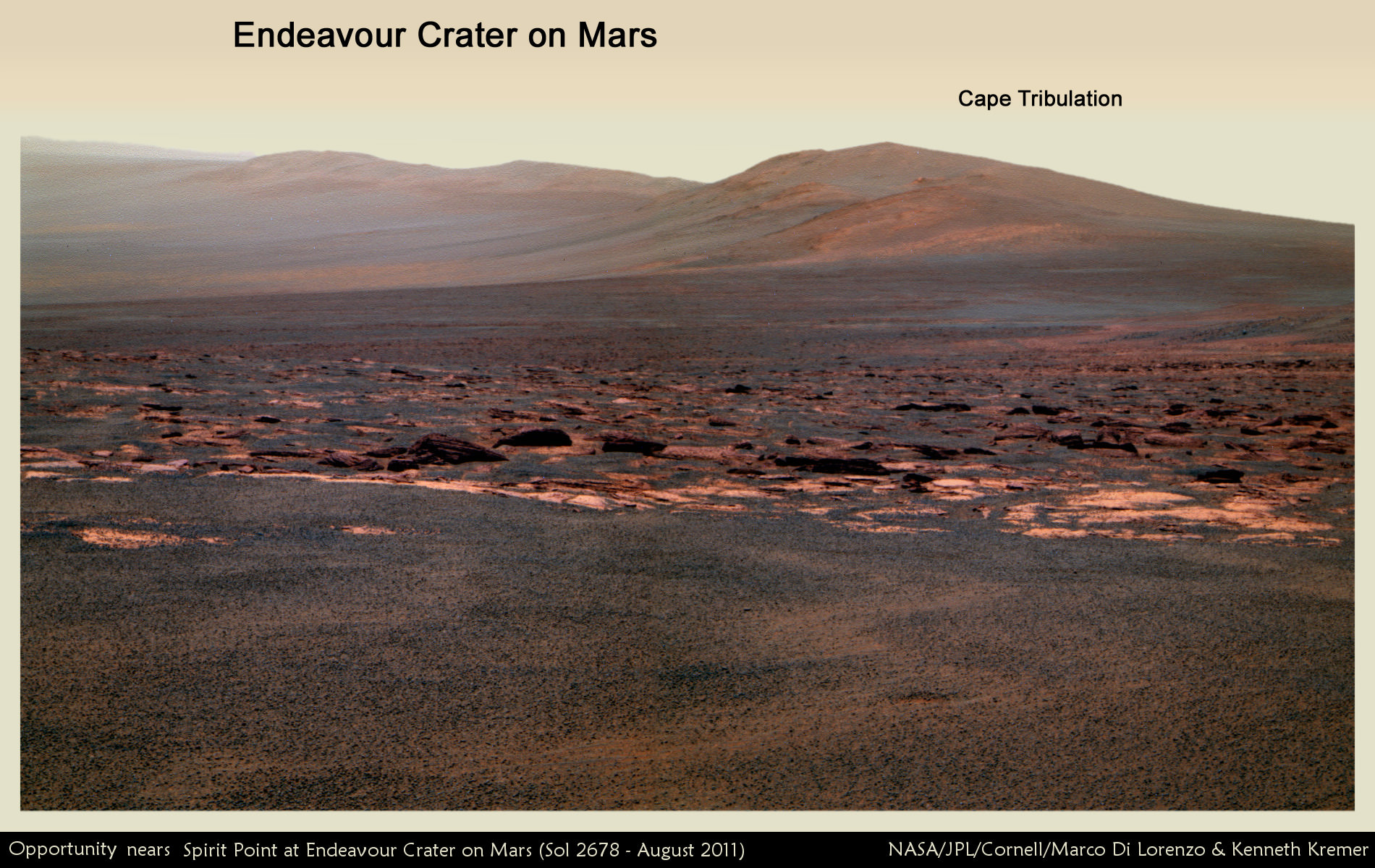
Red Remembered Hills

Credit: NASA / JPL / Cornell / Damien Bouic

The two rovers, Spirit and Opportunity, have taken many panoramic pictures of the Martian landscapes they've traversed, but I think that this is one of the loveliest.  (To see it full-size, check out the entry in the Planetary Society's blog, where I found it; a variation on the same scene can be found here.)  It's a view taken by Opportunity two days ago, looking across the western foothills of the rim of Endeavour Crater, and it's lovely for two reasons.

The first, for those who have been following the progress of the rovers since they landed on Mars more than seven years ago, is that this is the end of a small but epic journey of some 21 kilometres that began in 2008, after Opportunity left Victoria Crater.  All that time, driving backwards because one of her front wheels is jammed, the rover has traversed a landscape of rippled sand and exposed plates of rock, interrupted by the occasional smashed dish of a small crater.  Twenty-one kilometres - 13 miles - doesn't sound much.  A good afternoon's ramble.  But Opportunity is no bigger than a golf cart, is long past her warranty date (she was supposed to operate for only 90 Martian days, or sols), is being steered by remote control by operators on Earth, and the terrain, while it has been mapped and photographed by orbiting spacecraft, contains unknown perils and traps. While Opportunity was travelling, her sister rover, Spirit, became inextricably stuck in a patch of loose sand, and succumbed to the Martian winter after operating as a stationary science platform for more than a year.  Opportunity ploughed on, backwards.  At sol 2681 she finally reached Spirit Point, named after her sister rover and at the edge of a ridge known as Cape York.  Now she's ready to begin the science part of her fifth mission extension.  Endeavour Crater is some 22 kilometres across, much bigger than Victoria Crater.  The rock layers exposed by the impact that created it are deeper and older, and there are signs that some of the layers are clay-bearing phyllosilicates formed in the presence of water.

But the other reason it's an especially lovely view is that it is in many ways quite Earth-like.  The ridges may mark the edge of an impact crater (and the rocks in the foreground were thrown from another much small impact crater beyond the right-hand side of the photomosaic), but they have been eroded into soft shapes by millions of years of wind-blown sand, and they are also softened by the hazy atmosphere, giving a very familiar effect of a landscape fading into the distance.  Alien and familiar, they wouldn't look out of place in an Earthly desert. It's very easy to imagine standing there, and walking forward into the unknown.

Friday, July 29, 2011

Drive, He Said

'All you need to know about American society can be gleaned from an anthropology of its driving behaviour. That behaviour tells you much more than you could ever learn from its political ideas. Drive ten thousand miles across America and you will know more about the country than all the institutes of sociology and political science put together.'
Jean Baudrillard, America

Thursday, July 28, 2011

More Soviet SF

To the BFI Southbank last night, to see two more films in the BFI's excellent Kosmos: A Soviet Space Odyssey.  The first, Mars (1968), was the last major film made by director Pavel Klushantsev (Road to the Stars) before his contract with Odessa Studios was terminated in 1972, and he was forced into retirement.  I was looking forward to seeing Mars because a couple of clips in the documentary that accompanied the screening of Road to the Stars showed a wonderfully gonzo alien scenario complete with cosmonaut dog in a dog-shaped spacesuit.  Well, the dog didn't disappoint, but the bulk of the film is a lively but badly dated educational documentary showing that you can prove anything by analogy -- even, in 1968, after Mariner 4 showed Mars to be a battered hostile world lacking any of the romance implied by Percival Lowell's 'canals', the presence of higher forms of Martian life.  Klushantsev's depictions of possible variations of life on Mars are marvellous, however, and the brief portrayal of a lifeless Mars is startlingly close to close-up images beamed back by the Viking landers and other American robots.

Toward Meeting A Dream, from 1963, is a more conventional science-fiction film in which aliens from a nearby star are attracted to Earth by the broadcast of a particular piece of music, crashland on Mars, and are rescued by hero cosmonauts.  The special effects (re-used by American director Curtis Harrington in his SF potboiler Queen of Blood) depicting both Mars and the alien world and its advanced technology are state-of-the-art, as good as anything in Forbidden Planet, and the Russian space facilities on the Earth and Moon are equipped with all kinds of realistic hardware, but as for the story and characters . . . well, let's just say Soviet SF cinema operated on conventions at a slant to Western expectations.  During a conversation afterwards, Kim Newman (who has seen most of the films in the BFI's season) and I identified the following Rules for Successful Soviet SF:

(1) There must be a stirring song, repeated at intervals, and written by one of the characters.
(2) There is no real plot beyond depictions of the selfless heroism of the characters, but a narrator will fill in any holes in the story.
(3) There is no plot because there must be no conflict or violence: problems are solved by application of idealism and logic rather than fists and rayguns.  In Toward Meeting A Dream, an American scientist argues that aliens approaching Earth may be hostile and bent on conquering the human race, and is, at the end, very publicly humiliated.
(4) Characters are differentiated by random tags, and there must be no character development (because that would imply that the Soviet heroes possessed flaws which must be corrected).  So if you're, say, a chess-playing joker at the beginning of the film, for the rest of the story you'll be carrying a chessboard and, when your comrades refuse to play you because they know you're the best chess-playing cosmonaut in the universe, you'll make a joke about it.
(5) As in American SF of the period, the only female character on the ship operates the switchboard.
(6) If a character dies, it will turn out that the whole story was not only a dream, but it was his dream.  And at the very end, some element of it will come true.
(7) Pack all this into a film less than an hour long, either to make room for the main feature, or for a two-hour documentary on pig-iron production in Kazakhstan.

Wednesday, July 20, 2011

Ongoing

Most writers are interested in how other writers write. In their environments; in their habits; in their productivity. Not because they’re neurotics, worried that they’re doing it right, or working hard enough (or not only because they’re neurotics), but because writing is a private process, and a mysterious one, too. In a piece for last Saturday’s The Week In Books feature in the Guardian (which the Guardian doesn’t seem to archive online, any more, so I can’t provide a link), Philip Hensher noted that his friend Alan Hollinghurst ‘is a devotee of Ishiguro’s “crash” method. After a long period of planning and thinking, the author retreats into a cell and writes furiously for up to 12 hours a day.’ Hensher’s method, on the other hand, is slow and steady:
Writing my latest novel, King of the Badgers, I got up at 6:30, five to six days a week, and wrote until 10. I reckon to produce between 400 and 1,500 words a day, and then do a lot of crossing out.
There are other methods, of course - Vladimir Nabokov wrote sentences and paragraphs on index cards, and then assembled them into the finished work. But it seems to me that the Crash and Slow and Steady methods are at either end of a spectrum that encompasses most common variants of writing methodology. I’m of the slow and steady school, although I don’t write within a set time but try instead to produce a fixed amount each day. I’m working on a second draft at the moment - rewriting, crossing out, inserting new material - and attempting to make a quota of around 2000 words a day. Yesterday I was writing so slowly that I could have used the blood sweated from my forehead for ink. Today I finished inside two hours. So it goes. I do have a plan before I start the first draft, but it isn't in any way detailed, and I certainly don't spend months thinking about the book before I start. As far as I’m concerned writing is a process of discovery. The trick is to keep moving forward.

Tuesday, July 19, 2011

New World


An image of Vesta taken by the Dawn spacecraft two days ago from a distance of 15,000 kilometres, when (as you probably know) it went into orbit around the asteroid. Dawn will slowly spiral inward, and will take many more images at closer range, but this is a great early look at the ravaged worldlet, the second largest body in the asteroid belt (bigger version here).  We're looking down at the south pole, which about a billion years ago was hit by a large body.  Some debris spalled off by the impact resurfaced Vesta; the rest, about 1% of Vesta's original mass, went into orbit around the sun. HED meteorites are part of this debris, so we already have samples of Vesta's crust.  The big whack left behind a big crater.  It's about 500 kilometres across, almost as wide as Vesta's mean diameter.  The lump in the centre is an uplifted central peak; there are also huge cliffs, and ridges forming chevron-like features. Over at the Planetary Society blog, Emily Lakdawalla has posted a nice analysis, comparing the chevron features inside Vesta's south pole crater with those of Uranus's moon Miranda.  Miranda's chevrons were probably formed by diapirs or plumes of upwelling warm ice; if the chevrons sit at the top of the plumes, those ridges may be the edges of uptilted blocks.  Since we know that Vesta was once geologically active and almost certainly has an iron core that was once molten (all the HED meteorites are igneous material), it's tempting to speculate that big whack may have triggered some kind of residual geological activity.  Could there be ancient volcanoes, on the opposite side?

Monday, July 11, 2011

Road to the Stars

Last Friday, the day of the launch of the last space shuttle, and the end until who knows when of the United State’s capability to send human beings into space, I went the British Film Intitute to watch a marvellous old Russian film about space travel, Pavel Klushantsev’s Road to the Stars -- shown with a documentary, The Star Dreamer, that provided useful historical context and a nice overview of Klushantsev’s career.


Klushantsev began to make Road to the Stars in 1954. He’d started his career in a Leningrad studio making documentaries, and The Road to the Stars begins in straight-forward documentary style, with a dramatised biography of the father of astronautics, Konstantin Tsiolkovsky, and a sequence on early experiments in rocketry that establishes the basic physics of spaceflight. Then, without changing style (or the portentious narrator), the film jumps into the future. Ingenious special effects, with meticulously detailed models and sets, and realistic depictions of cosmonauts manoeuvring in free fall (amongst other tricks, Klushantsev shot actors hung on wires from below, and used a revolving set), are deployed to show the launch of the first three cosmonauts into space, the construction and operation of a space station in low Earth orbit, mapping the Moon’s surface by a robotic surveyor, and the first manned flight to the Moon. Some of the scenes allegedly influenced Stanley Kubrick’s 2001: A Space Odyssey.


Just before Road to the Stars was finished, in 1957, Sputnik 1 went into orbit. The Russian authorities insisted that Klushantsev insert material about Earth’s first artificial moon, and gave his film a wide release. Space was the next big thing; the Soviet red star was in the ascendent; Road to the Stars was, as far as the authorities were concerned, a prime piece of propaganda. More than a million people saw it in Russia; it was screened in twenty- two other countries. Segments shown by Walter Cronkite on the CBS evening news allegedly galvanised the American participants in the space race. Road to the Stars seemed like a blueprint for the Soviet conquest of space: space travel as an inevitable step in the evolution of Russia’s socialistic scientific utopia, proceeding by logical steps to the Moon, with journeys to other planets soon to follow.

It’s a future we didn’t get, of course. America won the race to the Moon; Nixon cancelled a programme to build rockets that would send astronauts to Mars; after the last Apollo mission, no human being has ventured beyond low Earth orbit. Klushantsev went on to make a full-length feature film about the first expedition to Venus, Planet of the Storms, that showcased more marvellous special effects, but ran into trouble when a commissar objected to the tears of a female cosmonaut (‘No Soviet cosmonaut would cry’). His film was given a restricted release; the script for the next, about a race to the Moon involving Russian, American and German spacecraft that ended in peace and harmony, was rejected. He made further documentary-style films about space travel (scenes from one about Mars, with giant animated flowers and a dog in a dog-shaped spacesuit, look wonderful) but retired a disappointed man, more or less forgotten until American special-effects artist Robert Skotak tracked him down, just before his death in 1999.

Unsurprisingly, some of scenes in the film seem quaint (nothing dates like the future), but it’s infused with warmth and charm, and its cheery optimism about the benefits of space exploration and colonisation outshines the occasional passages of naked propaganda. At the end of Road to the Stars, two cosmonauts descend a spacecraft’s ladder to the Moon’s surface. There’s a close-up of the first tentative step, and the bootprint it leaves.


But there’s no solemnity; no tick-box of tasks to be performed. The cosmonauts dance out across the surface, and when they see the Earth floating above the Moon’s mountains, they embrace each other with glee, overwhelmed with amazement and happiness at being on the Moon. It’s a wonderfully touching moment, reminding us that although robot spacecraft have and still are sending back amazing pictures and reams of data, the old-fashioned notion of human exploration, while perhaps foolishly and unrealistically romantic, still stirs emotions no robot can reach.

 (You can watch the whole film, without subtitles, here.)

J.G. Ballard's House


...is for sale.

Friday, July 08, 2011

Free Entry to British Library Event

I'm appearing on a panel at the British Library Tuesday 12th July, talking with Pat Cadigan, Toby Litt and Kim Newman (and a virtual Margaret Atwood) about our favourite items in the Out of the World exhibition.

I have not one but two free entries up for grabs. If you want to come along, email me at PJCMcAuley at gmail dot com and I'll add your name to the list on the door.  First to email wins!

EDIT: They're gone!

Tuesday, July 05, 2011

The Secret of My Success

Harold Pinter on his plays, 1963 (pinched from Dangerous Minds):

I’m not a theorist. I’m not an authoritative or reliable commentator on the dramatic scene, the social scene, any scene. I write plays, when I can manage it, and that’s all. That’s the sum of it.
I’ve had two full-length plays produced in London. The first ran a week, and the second ran a year. Of course, there are differences between the two plays. In The Birthday Party I employed a certain amount of dashes in the text, between phrases. In The Caretaker I cut out the dashes and used dots instead. So that instead of, say, “Look, dash, who, dash, I, dash, dash, dash,” the text would read, “Look, dot, dot, dot, who, dot, dot, dot, I, dot, dot, dot, dot.” So it’s possible to deduce from this that dots are more popular than dashes, and that’s why The Caretaker had a longer run than The Birthday Party. The fact that in neither case could you hear the dots and dashes in performance is beside the point. You can’t fool the critics for long. They can tell a dot from a dash a mile off, even if they can hear neither.

Monday, July 04, 2011

Where I'm At...

...rather than 'where I've been', because I've been right here, behind the curtain, spending most of my time dealing with the editing stage of In the Mouth of The Whale.  Right now, I have the whole thing in my head and can spin it around like a CAD/CAM model and examine its threads and connections, its components and framework from any angle.  That won't last, but it has allowed me to know which changes were highly local, and which struck echoes and required secondary changes in various parts of the text.  But now it's done, and the amended MS has been sent back, and I think that, if nothing else, I've pinned down the first word: When.

Meanwhile, I'm rereading a couple of novels for a panel at the British Library on July 12th, in which I'll be discussing favourites from the rather good Out of This World exhibition, along with Pat Cadigan, Toby Litt, Kim Newman, and the virtual Margaret Atwood.

Oh, and I've finished and sold a short story, 'Bruce Springsteen', to Asimov's Science Fiction Magazine.  It should be in the January 2012 issue.

Meanwhile, below the cut in the last post, Boogeyman259 asks, 'Could you please send me your origional notes about remote sensing from Cowboy Angels.'  Afraid I can't, Boogeyman, since I didn't make extensive notes about something mentioned only in passing.  And anyway, gee, I hardly know you, and you don't give me any clue about why you want to know this stuff, or why you can't find it out for yourself.  But you did say 'please' (I'm not being sarcastic; too many people demanding something or other don't), so I'm happy to tell you that the CIA were certainly into remote viewing once they realised what their Soviet counterparts were up to, in the psychic line.  There are passages about it, and the rather eccentric cast of characters involved in it, in Jeffrey T. Richelson's The Wizards of Langley, and there's at least one whole book about it, too: Jim Schnabel's Remote Viewers: The Secret History of America's Psychic Spies. I bet there's all kinds of stuff about this on the WWW, too, but I'm not going to look it up.  It's probably at least as reliable as your average novelist: we do tend to make things up for a living, or at least bend and twist stubborn facts to more convenient shapes.  In this case, though, I didn't have to make it up; in fact, the truth is (more than usual) a lot weirder than fiction.

Sunday, June 05, 2011

The Idiot's Tale

‘Any idiot can face a crisis; it is this day to day living that wears you out.’ – Anton Chekhov

The relevance to the thinness of a certain mode of science fiction and fantasy, which advances narratives by a series of crises and cliffhangers, should be obvious.

Friday, May 27, 2011

Something For The Weekend


Just put up on amazon in the UK and the US, the Kindle edition my short-story collection Little Machines, previously available only as a limited edition hardback.  Cover by the multi-talented Michael Marshall Smith.
Monsters! Alien invasions! Lost Worlds! Mad Scientists! Secret Histories!

In the seventeen stories collected here, multiple award-winning author Paul McAuley takes a fresh look at staple themes spanning science fiction, horror, and alternate history. A hero who once helped repel an alien invasion, ruined by self-doubt after his bruising experiences in the eye of the media, must try to save the world all over again. Best-selling author Philip K. Dick confronts Richard Nixon and a conspiracy that has taken control of America. A book dealer discovers strange and dangerous rivals on the far side of the internet. A science-fiction fan explains why he became a serial killer. And in 'Cross Roads Blues', the course of American history hangs on the decision of an itinerant musician.

Sunday, May 22, 2011

Our Fictionless Futures

Last week, my editor at Gollancz, Simon Spanton, asked a question on Twitter: ‘Can anyone think of an SFnal future that has an explicit reference in it to that future's own SF?’ A few of us responded, mostly referencing alternate history novels nested within alternate history novels; it was Malcolm Edwards who pointed out that Vernor Vinge’s Tatja Grimm’s World featured a mobile publishing house that, as it turned from producing fantasy to science fiction, helped to bootstrap its own civilisation. Tatja Grimm’s World was first published in 1969. More than forty years later, examples of science fiction in fictional futures are still rare.

As Walter John Williams pointed out in his blog, just a month earlier, ‘For almost the entire history of science fiction, the one thing you would never find in a science fiction novel was, well, science fiction. Every person in a science fiction story behaved as if science fiction itself was never invented.’ There are a fair few depictions of science-fiction novelists in science fiction set in the present: Kurt Vonnegut’s recurring character, the hack SF author Kilgore Trout, is probably the best known example; in Barry Malzberg’s Herovit’s World, an SF author finds himself in his imaginary future; an SF author tours and escapes Hell in Larry Niven and Jerry Pournelle’s Inferno; a failed SF author, after surviving burial by remaindered copies of his novel during an earthquake, helps save a remnant of humanity in the disasterous disaster flick 2012 (although more by his driving skills than any deep knowledge of SF tropes); the hero of Walter John William’s cyber-thrillers This Is Not A Game and Deep State is not only a former SF writer but also an RPG gamer. And so on.

But in the futures it has made its own, SF itself appears to have died out. Worse, the novel itself appears to have died out, too. There are poets (Rydra Wong in Samuel R. Delany’s Babel-17; the Kid in Dahlgren); musicians (the touring orchestra in Kim Stanley Robinson’s The Memory of Whiteness; the discorporating singers in Thomas M. Disch’s On Wings of Song; any number of revived/cloned rock stars); painters (the evolving robot artist in Alastair Reynolds’ ‘Zima Blue’); and sculptors (J.G. Ballard’s ‘The Cloud-Sculptors of Coral D’), but precious few far-future novelists. The only one I can call to mind is Katin Crawford, the moon-fixated perpetual student in Delany’s Nova, who wants to revive the lost art of the novel and after endless false starts finds his subject matter in the adventure on which he embarks, and writes the novel you, the reader, hold in your hand (although doesn’t that make it a memoir?). I’m sure there are other examples, but on the whole, writers of fiction about the future don’t believe that written fiction will survive into the future, even as eBooks. In The Quiet War, I hinted that novels had been rolled up into immersive role-playing sagas, but even RPGs and their descendants may have a limited shelf-life: Hannu Rajaniemi’s debut novel, The Quantum Thief, features an obscure cult that’s preserved otherwise forgotten archaic computer games. It seems that as far as SF writers are concerned, the future is inimical to fiction of any kind ...

Saturday, May 21, 2011

Starships

I've been thinking about Luca Zanier's fantastic series of photographs of places of power ever since I came across them, via Mrs Deane. With their hyperrealistic lighting and perfectly framed compositions, they look like outtakes from unmade or unknown Kubrick movies.  They also look like, I've just realised, starship control rooms.


Changing course in a starship would be a rare, momentous, and potentially catastrophic action.  Everyone aboard would participate - if only to watch.  There would be no need for panels with buttons and blinking lights.  The 23rd Century equivalent of iPads would take care of that. But one thing Star Trek definitely got right: you'd need a space where people could gather to discuss what to do, and to watch the biggest and best HDTV screen you could buy.  Of course, any reality-based starship design would probably be a compact tincan stuffed with AI, genetic codes, and templates for machines that could build machines that could build habitats and creches (or bigger, better AIs).  But in an ideal imaginary case, there'd be something this:

Monday, May 16, 2011

A Sense Of Yearning For A Future That We All Knew Would Never Come To Pass


My interest in pop music came late in my teenage years, long after I began to devour every SF novel I could find. We had more books than singles or LPs in the house: the singles were my sisters, the LPs my mother’s small collection of film soundtracks. My grandmother, who lived next door in the 1930s, had an old windup 78 player set in a cabinet, with one of those recurved horns that acted as a loudspeaker. There was Top of the Pops, which everyone seemed to watch in the late 1960s and early 1970s, the enforced jolliness and restricted playlist of Radio 1, and the pirate radio stations my sister chased across the dial of our radiogram, and that was about it until one day in 1972 I bought my first LP: David Bowie’s The Rise and Fall of Ziggy Stardust and the Spiders for Mars (I still have it). It was SF; it was a concept album with a proper narrative arc; I played it to death.

I’m still a fan of Bowie. Bowie in his 70's pomp, at least. And every since Jack Womack pointed me to it, I’ve been following the track by track story of his career on the blog Pushing Ahead of the Dame. It recently reached one of my all-time favourite Bowie songs, “Heroes”, anatomising both the song and the circumstances of its creation in wonderfully acute detail. Even if you’re not especially interested in “Heroes”, or David Bowie, it’s worth reading for its insights into the creative process. Here’s the important stuff that’s often left out of creative writing courses. Starting from scraps of discarded material. Pulling the structure together using a mixture of technique and improvisation and use of found material. Finishing it in a final burst of inspiration (or desperation). All of this at least as important as any planning; all of it following instinct rather than agreement on what's allowable.  Sure, studio recording is a collaborative effort, but Bowie is at the centre, and very often, especially during the Long March of writing a novel, even before your editor becomes involved, isn't writing is a collaboration - a dialogue with your past selves?

Sunday, May 08, 2011

Robert Johnson


Today marks the centenary of the birth of the great, late bluesman, Robert Johnson.  Or at least, the best guess of when his birthday was, for his life is poorly documented, like those of many African-Americans born in segregated Mississippi, and it is also overshadowed by myth. Thanks to Mack MacCormick and other researchers, we know that Johnson's family was split up when his father had to flee a lynch mob after becoming embroiled in a property dispute with white landowners. After his mother died when he was still young, Johnson left his wife and the child he fathered with another woman, and became one of the many musicians wandering the high roads, low roads, and railroads of 1930s America.  Early in his career, he latched onto Son House, who recalled that Johnson was an awful guitar player who disappeared for a short spell and returned as a fully-fledged musician, so starting the legend that he'd learned his licks from the devil, either at first-hand, or via one of his tutors, Ike Zimmerman.  Johnson died at the age of 27, from drinking poisoned whiskey supplied by a jealous husband, and soon after cutting 41 tracks that were reissued on two LPS by Columbia Records during the folk music revival of the early 1960s.  He died in relative obscurity (even the site of his grave is disputed), and he had little influence on his contemporaries.  But via those two Columbia Records LPs, his guitar playing and singing influenced many British musicians, including Eric Clapton, Robert Plant, Fleetwood Mac, and the Rolling Stones, and their music fed back into the US music scene.  Johnson is renowned as an innovator and early pioneer of rock and roll.  A 2CD compilation, The Complete Recordings, was issued in 1990, won a Grammy; four of his songs are included in the Rock'n'Roll Hall of Fame; The Complete Recordings has been deposited in the National Recording Registry of the Library of Congress.

My own small tribute is a story I published early in my career, and republished in revised form in Little Machines.  It imagines a time-travelling historian becoming embedded the story he's been sent to research, and creating an alternate world in which Robert Johnson died just before his music was properly recognised in a concert in New York City: an unkinder world which is our own.  Here's the beginning:
The first time Turner heard Robert Johnson play was to a vast crowd in Washington, D.C., December 5th 1945, the night the desegregation bill went through, and just three weeks before Johnson was assassinated. The second time was on what was supposed to be a routine archive trip, June 3rd 1937, a jook joint just outside the little Mississippi town of Tallula, and it was something else.
Afterwards, Turner hung around outside, an anonymous still point in the crowd that, slow as molasses, dispersed into the hot dark night. The music still thrilled in his blood. Songs he’d had known only as ghosts in the crackle of a few badly worn 78s or no more than titles in charred files from the fire-bombed office of an obscure record company had one after the other ripped through the heat and noise of the crowded jook joint, so much sound from one man and one guitar, driving the whoops and pounding feet of the dancers, that Turner doubted his state-of-the-art Soviet recorder had been able to capture one tenth of the reality.
Turner had once played a little guitar himself, enough to know that what the old bluesmen said about Robert Johnson was true. Even before the New York concerts, the years in prison on a trumped-up murder charge, his letters and his protest songs, the Freedom Marches and he Segregation Riots, near-canonization after his assassination, he had been the best of them all. The hard little capsule planted under the skin beneath Turner’s collarbone, where the grain of Americium hung suspended in its Oppenheimer pinch, tingled. He should have cut out and closed the Loop when Robert Johnson had finished his set. Get in, do the job, get out. Don't give the paradoxes any chance. But Turner had heard raw truths in Johnson's songs; for the first time since he'd been brought home after the Peace Corps had been disbanded, he felt alive again. Before he closed the Loop, he wanted to meet the man whose music had cut him deep.
The sandy yard and dark road in front of the jook joint were empty now; only Turner and three men sitting on the sagging porch were left. The men, all in various degrees of drunkenness, were passing around a chipped enamel jug in the yellow light of a couple of kerosene lanterns, talking in low voices and glancing sidelong at the stranger in the dark suit it hung oddly around Turner, and the suspenders which held up the trousers were gouging his clean white shirt (soaked in sweat), and polished two-tone shoes (which pinched like hell). He strolled over to them, casual as he could, wondering if one of them was the man whose recollections about Robert Johnson, told to a field researcher in some twenty years time, had brought him here. His pulse in his throat, his mouth dry, he asked where Robert Johnson was.
One of them said, "He out back somewhere."
Another added, "With a woman. Comes to women, Bobby Johnson's like a snake in a henhouse."
The third wanted to know who was asking. Turner gave his cover story of being a talent scout, named a large New York record company. It was sort of true.
The man, burly and barechested under bib overalls, fixed a mean look on Turner. "Never heard of no gentleman of colour working for no record company before."
"Bobby Johnson, he already done got himself a deal," the first man said. He was the oldest of the three, his face a map of wrinkles like drying mud, his eyeballs yellow as ivory,his nappy hair salt and pepper. He peered at Turner and said, "You got yourself seventy-five, Mr New York, you can walk into Mr Willis’s dry goods store tomorrow and buy a record of his ‘Terraplane Blues’."
The second man, skinny and mournful, said, "I heard he been on the radio in Detroit, singin spirituals. Shit, he been round this country a couple three times now."
"Race records are a big thing in New York," Turner said, already in deeper than he'd intended.   "That’s why we’re very interested in Robert Johnson."
"What they know bout the blues in New York?" the old man said. "You go tell your boss that down here is the rightful home of the blues, no place else. Why, I play harmonica myself. I get the blues real bad sometimes."
The mournful man said, "Bobby Johnson, he got 'em worse of all."
"He got a mojo hand, no mistake," the old man said, and drank from the enamel jug and smacked his lips.
"They say ol Legba gave the boy a lesson in the blues, in exchange for his soul," the mournful man said, and there was a hush as if an angel had passed overhead.
The old man took another drink and said, "Well I don't know if that be true, but I do know one time Bobby Johnson couldn't play a lick to save himself. I got the story straight from Son House. Bobby Johnson, he could play harmonica right enough, but he was always fixin after playin gitar. Hung out every joint and dance and country picnic there was, pesterin the players to give him a chance, but he was so bad it wasn't even funny. Anyway, he went away maybe a year, and I don't know if he went to the crossroads with Legba or not, but Son House told me when he came back he was carryin a gitar, and asked for a spot like old times. Well, Son was about ready to take a break, and told Bobby Johnson to go ahead and got himself outside before the boy began. But that time it was all changed. That time, he tol me, the music he heard Bobby Johnson make put the hair on his head to standin."
It had the air of a story told many times. There was a silence, and then the mournful man said, "He near to burnt down the place tonight, and that's the truth."
The old man said, "Son House tol me Bobby Johnson tol him a man called Ike Zimmerman taught him how to play, but what truth's in that I don't rightly know."
Turner, whose first name was Isaac, felt an airy thrill.
The burly man in the bib coveralls hauled himself to his feet, using as a support one of the posts that propped up the corrugated tin roof that sloped above the porch. He pointed at Turner and said, "You fools tell this stranger whatever’s on your minds, an you don’t know who he is."
"He tol you he scouting talent, Jake," the old man said. He told Turner, "You come on down to Mr Willis’s dry goods store tomorrow, Mister New York, I show you stuff on the harmonica you ain’t never before heard."
"He ain’t no scout," the burly man said. "He got the look of the law about him."
He came down the steps towards Turner, a mean glint in his eyes.
"I’m just passing through," Turner said, and raised his hand to his chest, ready to collapse the Oppenheimer Pinch if he had to.
"Don’t pull no gun on me," the burly man said, half-angry, half-fearful, and swung clumsily at Turner and turned halfway around at sat down with comic suddeness.
The door of the jook joint opened. Yellow light fell across the yard. A slightly-built man in a chalk-stripe suit stepped out, a guitar slung across his back, a fedora tilted on his head. It was Robert Johnson. He looked directly at Turner and said, "Why, Isaac. You come back. I always wondered if you would."

Saturday, May 07, 2011

Coming Soon


 Coming to Kindle next month...

Table of Contents:

The Two Dicks
Residuals
17
All Tomorrow's Parties
Interstial
How We Lost the Moon,
   A True Story by Frank W. Allen
Under Mars
Danger: Hard Hack Area
The Madness of Crowds
The Secret of My Success
The Proxy
I Spy
The Rift
Alien TV
Before The Flood
A Very British History
Cross Roads Blues

EDIT: Every eBook needs a good cover.  This one is by Michael Marshall Smith

Friday, April 29, 2011

How It Works For Me

Story develops from character and situation.  Narrative and theme develops from story.

Thursday, April 28, 2011

Clickety-Clack

I was chatting with Jon Courtenay-Grimwood last night, after the Clarke Awards, and we got onto the topic of switching from typewriters to word processing, and how it changed our work habits.  Amongst other things, we both retyped final draft pages if we made more than five mistakes when using a typewriter, and we both wrote to the end of the page at the end of a work session; if this meant stopping in the middle of a sentence, then we wrote the end of the sentence on a scrap of paper and the next day inserted a fresh sheet of paper in the machine and carried on from there.  I doubt that anyone, now, reaches their self-assigned word (rather than page) count and stops dead in the middle of a sentence.  You just keep going, chasing that blinking cursor across the screen.  And if you're in the middle of a particular juicy and exciting scene or section, there's a temptation to keep going until the end - which means that the next day you have to cold-start the next scene from the very beginning, and risk getting blocked.  Always leave something you want to write for the next day.

I have a small nostalgia for the steady clickety-clack* of the keys imprinting thoughts onto paper letter by letter, but none at all for the messy task of ribbon-changing, of having to stop to disentangle keys that jammed together because I was typing too fast, or of waiting for a streak of Tip-Ex to dry.  And I never was (nor am I yet) a touch-typist.  As soon as personal computers became affordable, I bought one, learned how to use WordPerfect 4.2, and never looked back.

The mechanical, linear process of typewriting meant that serious revisions were left until the draft was completed.  Now, of course, you can worry away forever at what you've just written, and the changes are writ on water instead of paper.  The process is a lot more playful than it once was, takes place on the screen as well as inside your head, and is kind of . . . indefinite.  When you typed the final word of a manuscript and ripped the paper from the typewriter's platten, there was a real sense of completion, albeit momentary.  For even in the days of typewritten MSS, there was a nagging feeling that there were still changes that needed to be made once the story or novel had made it, after editing, copy-editing and proofing, into print.  That sense is perhaps a little stronger now.  Unless you print it out straight away, there's a temptation to go back time and again to a word-processed document: to tweak and fiddle and adjust this or that sentence, to endlessly fine-tune.  Nothing is ever really finished.  Instead, you have to let it go.


Which brings me to the ongoing novel, which has now about three-quarters finished in first draft, and has reached the point where, rather than start to tie everything up and aim it towards the last sentence (I do know what it is), I have the growing urge to start over, change everything that needs fixing or revision, and cut away all the persiflage.  As usual, I didn't discover the theme of the novel until it had progressed a fair way.  The plot has grown far too complicated, as I followed all kinds of exciting leads.  And just the other day, I realised that I'm missing a whole section that really needs to be included, and not just because it will contain some cool stuff about the fate of Earth, a chiliastic crusade, and involve the hero in some difficult moral decisions.  Well, it can be dropped in later.  Right now, this thing, like a shark, needs to keep moving forward.  That imperative hasn't changed, at least.

*(UPDATE) Of course, the keys really went clack clack clack, but (this isn't an original thought; I can't remember who said it) the human mind imposes a narrative on everything, turning the steady tick tick tick tick of a clock into a time-directional tick tock tick tock.  Does Chinese water torture work because the intervals between drips are just long enough to prevent the subject imposing a tick-tock narrative?  Does the lack of coherent narrative drive us crazy?

Monday, April 25, 2011

(A)temporality

The London Underground is an old system.  Its pioneer and prime mover was born in the eighteenth century.  The system itself was built before the unification of Italy and before the creation of Germany.  Its first travellers wore top hats and frock-coats; there are early photographs of horse-drawn hansom cabs parked outside the underground stations. Oscar Wilde was a commuter on these subterranean trains, travelling from Sloane Square station to his office on Woman's World at the bottom of Ludgate Hill.  Charles Dickens and Charles Darwin could both have used the Underground.  The coffins of William Gladstone and Dr Barnardo were both transported beneath the earth in funereal underground trains.  Jack the Ripper could have travelled on the Underground to Whitechapel: the station was served by the East London Railway.
Peter Ackroyd, London Under

Thursday, April 21, 2011

Gollancz SF At Fifty

Victor Gollancz Ltd, founded in 1927, started publishing science fiction and fantasy in 1961.  Many will, like me, remember hunting down Gollancz hardbacks with their distinctive yellow jackets in library SF & Fantasy shelves in the 1970s and 1980s.  The family firm of Gollancz was sold by Victor Gollancz's daughter, Livia, to Houghton Mifflin at the end of the 1980s.  A few years later, Houghton Mifflin sold Gollancz to Cassell, which was bought by Orion in 1998; the Gollancz name lives on as its SF and Fantasy imprint.  And now Gollancz Science Fiction and Fantasy is having a little contest to celebrate its anniversary. Pick what you consider to be the best title from 25 SF and and 25 fantasy books published by Gollancz, and you might win a subscription to SFX magazine, and a copy of each of the top 10 titles from both lists.  And gosh, my novel Fairyland is up there in the best SF list...

Fairyland was my sixth book with Gollancz.  My first, Four Hundred Billion Stars, was published 23 years ago, in, yes, a yellow jacket, when Gollancz was still independent publisher Victor Gollancz.  My editor was Malcolm Edwards, and I still remember our first meeting.  Gollancz was housed in a Georgian building with a tall narrow frontage on Henrietta Street, Covent Garden.  (Later, I would discover that the company owned the property backing on to the townhouse, creating a Dickensian maze of offices and corridors and odd spaces that ran through the block (was there a courtyard?  Were there clerks making entries in ledgers with quill pens?) to the next street.)

As I recall on that first visit, the reception wasn't a place to linger.  No comfy sofas, coffee tables, vases of cut flowers. There were piles of books wrapped in brown paper and a couple of motorcycle dispatch riders kicking around the small, dimly lit room.  The receptionist, working behind a counter, directed me upstairs.  All the way up to the top, several floors of winding rickety stairs to a kind of penthouse with a lot of glass looking out over London rooftops, where Malcolm presided with unflappable affability over his first empire.  He moved on just before Gollancz was swallowed by Houghton Mifflin; I stuck it out until just before Cassell, and Gollancz, was bought by Orion, under the direction of . . . Malcolm Edwards.  It's a small world.  Now I'm back with Gollancz, and my old titles have or are coming back into print, and I'm working on my nineteeth novel.  Twenty-three years.  As Matty Ross says towards the end of True Grit, time just gets away from us.

Wednesday, April 13, 2011

From My Red Left Hand

I'm pleased that most commentators took my previous post in the satirical spirit in which it was intended.  It's true, as Ilya2 remarked that you can find no (or hardly any) SF novels written after the 1980s entirely constructed from cliches, but plenty of movies (movie directors and producers are always about thirty years behind the bleeding edge of written SF, perhaps because they are inspired by the SF they read in their childhoods). But as others point out, these kind of cliches do keep recurring.  The problem with cliches is they're strange attractors.  They're the first thing you think of when constructing a scene or a scenario. They're seductively simple to use. The trick is to turn them upside down and take them apart and put them back together in a new an interesting way. Make it bigger and noiser. Go back to the reality, instead of a blurred fourth-generation photocopy.  Or do something else instead. I leave it as an exercise to the reader to construct similar very short novels out cliches mined from fantasy, horror, literary and other genres. Or as per Lois Ava-Matthew's suggestion, to extend this one into a trilogy.

Onwards. Two of my horror short stories have been taken up for reprint inside a week.  One, 'Inheritance', was my ninth published story, appearing in The Magazine of Fantasy and Science Fiction no less; it will appear in Haunts: Reliquaries of the Dead, edited by Stephen Jones, and will be published by Ulysses Press in the autumn. The other, 'Take Me To the River', will appear in New Cthulu: The Recent Weird; edited by Paula Guran, it's due to be published by Prime Books in November.

I've always loved the horror genre; in the my formative years in the 1960s and early1970s, I read every one of Herbert van Thal's anthologies, tried to catch every Hammer film that appeared on TV, and was so thoroughly chilled by Jonathan Miller's TV adaptation of M.R. James' 'Whistle and I'll Come to You' that I chased down everything by James that I could find. Writing horror stories isn't merely an homage to these primal influences; it's also a kind of left-handed exercise that allows me to flex a different set of writing muscles.  Most especially, it allows me to write something contemporary, and to draw on stuff from my life 'Take Me To The River', for instance, is set in Bristol - where I lived for seven years - during the long, hot summer of 1976, and recasts some of my experiences of the free festival scene.

Oh yes, here's the list of contributors to Paula Guran's anthology.  I hope old H.P. would approve:

The Crevasse, Dale Bailey & Nathan Ballingrud
Old Virginia, Laird Barron
Shoggoths in Bloom, Elizabeth Bear
Mongoose, Elizabeth Bear & Sarah Monette
The Oram County Whoosit, Steve Duffy
Study in Emerald, Neil Gaiman
Grinding Rock, Cody Goodfellow
Pickman's Other Model (1929), Caitlín Kiernan
The Disciple, David Barr Kirtley
The Vicar of R'lyeh, Marc Laidlaw
Mr Gaunt, John Langan
Take Me to the River, Paul McAuley
The Dude Who Collected Lovecraft, Nick Mamatas & Tim Pratt
Details, China Miéville
Bringing Helena Back, Sarah Monette
Another Fish Story, Kim Newman
Lesser Demons, Norm Partridge
Cold Water Survival, Holly Phillips
Head Music, Lon Prater
Bad Sushi, Cherie Priest
The Fungal Stain, W.H. Pugmire
Tsathoggua, Michael Shea
Buried in the Sky, John Shirley
Fair Exchange, Michael Marshall Smith
The Essayist in the Wilderness, William Browning Spencer
A Colder War, Charles Stross
The Great White Bed, Don Webb

Monday, April 04, 2011

How To Write A Generic SF Novel

Your hero must be likeable and sympathetic at all times. Like James Bond in the Roger Moore era, he’s quick with a quip, and is unruffled by any situation. No amount of exposure to suffering or slaughter should alter your hero in any significant way, although he is allowed to shed the odd manly tear or to express cold steely determination to do something about the death of a loved one. This makes him even more sympathetic. But all trauma is temporary; showing genuine emotion is difficult, and can hold up the plot. A secret past is always good -- you don’t have to deal with the parents. No bad deed goes unpunished; no good deed goes unrewarded; anyone who disagrees with your hero must suffer for it. Everyone’s behaviour has a rational explanation -- Freud is useful in this respect. No one refuses to get with the plot. Everyone acts their part, and is in character all the time. All problems are solvable. Traditionally, SF heroes solved problems by application of intelligence and scientific knowledge. These days, you can substitute lasers or AK-47s for scientific knowledge. Or swords. The equivalent of the internet or mobile phones are used only when the hero needs to find something out. Usually someone else does the actual typing. Don’t include any science that might frighten the readers.  Anything found in SF written before the 1980s is usually okay. Nanotechnology is basically magic. So is genetic engineering. Also quantum mechanics. Virtual reality is more or less the same as a video game. Planets can be treated as a single country, with uniform climate and culture, and no more than three unique features that distinguish them from Earth. Always include some non-Americans for local colour; like the Irish steerage passengers in Titanic (the movie), they're cheerful, deferential, and possess a quaint and lively culture. Also include either a kickass woman who can do the unacceptable things that would make your hero unlikeable, or a wise old soothsaying woman who speaks in parables and knows things that can’t be found on the internet. See also: sidekick comedy robot. Infodumps can put off readers. Have your characters tell each other about their situation instead. Bars are good places to do this. Bars are also great places to meet people. Unlike airport bars, spaceport bars are packed with colourful characters who all know each other. Aliens can usually be found in the corners of spaceport bars, or in a mysterious rundown quarter of the city attached to the spaceport. They’re basically cats.  Or turtles. Or some other pet animal. They often lack a sense of humour, which puts them at a disadvantage when dealing with humans. Interstellar merchants can be found in another corner of the bar, trading in spices, exotic liquors, and rare elements. No matter how technologically advanced your future society might be, its sociology and economics are basically those of the seventeenth century.  Also its battle tactics. All spaceships are big. Very big. Except the one owned by the kickass woman. And they never run out of fuel, power, breathable air, potable water, food, or reaction mass. Despite possession of gigantic highly-advanced starships, wars are usually won by your hero and a few good marines. Death is optional. At the end, everything is as it was before, except your hero is richer, more powerful, and married to the right woman, who is never the kickass woman.
There’s your story.
Goodnight, children.
Newer Posts Older Posts