Friday, September 21, 2007

Desperate Fun...

...was had by all at a small party to wet the head of Cowboy Angels, in the Phoenix Artist Club. Copies should now be out in the wild; head straight past the 3 for 2 tables to the shelves towards the back of the bookshop, where authors are democratically ranked in alphabetical order.

London's New Forbidden Zone...

Saturday, September 15, 2007

Seriously Weird

Among the science-fictional paradigms named in the mundane SF crowd’s fatwah are time-travel and parallel universes. David Toomey’s The New Time Travellers: A Journey to the Frontiers of Physics is a superb examination of ideas that are gaining serious scientific attention, including the possibility that time travel and the multiple worlds theory are two sides of the same coin. The kind of stuff, in fact, that helped me put in some solid foundations to the multiverse of Cowboy Angels.

Friday, September 14, 2007

Brautigan

For some reason, my local library, in the 1970s, had all of Brautigan's novels. And I read them all. So when I read this, I found the secondhand copy of Trout Fishing In America I bought in Vancouver, and read:

I thought to myself what a lovely nib trout fishing in America would make with a stroke of cool green trees along the river's shore, wild flowers and dark fins pressed against the paper.

Wednesday, September 12, 2007

Zapped

The images from Cassini's flyby of Iapetus that I was very much looking forward to closely analysing (trans: ripping off) has been delayed by a galactic cosmic ray hit that tripped a solid state power switch and sent the spacecraft into safe mode. What could be more science-fictional?

Borderline Anxiety (2)

Whenever mainstream or literary fiction dares to trespass on territory that science fiction considers its own, reaction from within the field ranges from the kind of hooting animosity displayed by apemen contesting ownership of a waterhole in the opening scenes of 2001: A Space Odyssey, through serene indifference, to the craven capitulation of The Simpsons' news anchor, Kent Brockman: ‘I, for one, welcome our new insect overlords . . .’

Paul Kincaid’s recent column in Bookslut is, unfortunately, a pretty good example of Brockmanism. After discussing use of a medical procedure as a plot device in Graham Swift’s novel Tomorrow, Kincaid, previously the administrator of the Arthur C. Clarke Award, goes on to imply that literary fiction may be doing a better job of portraying real science and real scientists than science fiction. While science was once ‘one of the things that cut science fiction off from the rest of literature,’ he says, now it’s ‘ordinary and about something.’ Further, now that ‘the transcendence, the wonder that were handy terms when talking about big concept sf have been taken seriously and science fiction has become almost an ecstatic experience . . . perhaps it’s a good thing that the mainstream has discovered the scientist -- because science fiction seems to have lost him.’

The insect overlords have taken up SF’s most treasured theme! Surrender at once! Round up the usual suspects and set them to work in the underground sugar caves of our new masters!

Well, it’s certainly true that literary fiction is paying more attention to science these days. And the idea that, as science becomes normalised and incorporated into the tropes of literary fiction, so SF has retreated into a kind of mystic ecstasy, is an interesting one. Unfortunately, it’s completely false. And Kincaid’s attempts to justify it don’t hold water for a second.

In discussing literary novels that feature scientists, Kincaid ranges over the past sixty-fifty years (it should be noted that he mistakenly attributes authorship of his earliest example, The Small Back Room (1942), to Nevil Shute; in fact, it was written by Nigel Balchin, and Balchin’s scientist hero was no boffin or administrator, remote from ordinary human experience, but a genuinely tortured soul). Yet after claiming that ‘we seem to be seeing fewer and fewer scientists in science fiction’, and telling us that SF is disappearing up its own transcendental fundament, Kincaid gives only one supposed example of this trend, M. Rickert’s Map of Dreams (2006). I confess that I haven’t yet read it. But I have Googled it. It’s a fantasy novella. It’s clearly labelled as a fantasy novella, and is published in a small press collection of fantasy stories. Its time-travel may well be achieved through what Kincaid describes as ‘a mixture of amateurism and mysticism’, but it can’t typify his claim that SF is retreating from realism for the simple reason that it isn’t SF.

And even if Rickert’s novella was SF, it doesn’t take much thought to come up with a hefty list of SF novels from the past decade, much less the past sixty-five years, that have dealt with science and scientists in a serious, realistic, and sympathetic manner. Here are a few, more or less off the top of my head: Stephen Baxter’s Moonseed; Greg Bear’s Vitals; Gregory Benford’s Cosm, Eater, and The Martian Race; Greg Egan’s Teranesia and Schild’s Ladder; Kim Stanley Robinson’s Antarctica, and his climate change trilogy; Bruce Sterling’s Distraction. As I have no shame, I’ll also mention my own The Secret Of Life and White Devils. I’m sure that you can think of many more, but I hope this little list is enough to convince you that SF has neither ‘lost’ the scientist, nor its interest in rigorous, serious, and thrillingly speculative explorations of the outer reaches of science and technology. Of course, some SF does have a problem with keeping abreast of science’s rapidly advancing cutting edge, but I think I’ll reserve that topic for another time.

Saturday, September 08, 2007

Robots Survive Dust Storm, Prepare To Conquer

They're alive!

Product

I’ve just received advance copies of the hardback and trade paperback editions of Cowboy Angels. As usual, I can’t quite bring myself to open them just yet, but they look lovely.

I’ve posted another extract from Cowboy Angels, the fourth, on the web site.

Wednesday, September 05, 2007

Borderline Anxiety (1)

Despite New Wave fantasies about reinsertition of science fiction into the so-called mainstream of literary fiction after the collapse of the Gernsbackian hegemony, or attempts by postmodernists to erase the hierarchy of high/low culture, the distinction between genre and mainstream is ineradicable. Science fiction, like crime, horror, or romance fiction, is distinguished by an internalised dialogue based on development and variation of unique tropes. This genre gestalt implies a border: an inside and an outside. Writers working inside a genre border must always be aware of their relationship with their chosen genre and with the mainstream outside the border. But mainstream writers are untroubled by this Janus-like duality unless they find it necessary to make use of genre tropes. Even then, if they are secure in their reputation, mainstream writers don’t need to excuse this borrowing. They might even admit an admiration for the genre to which they’re indebted. But because reputation is an important part of their self-worth, and because they’re hyperaware of status, most mainstream writers, like Jeanette Winterson (for instance), feel that they must deny that they writing science fiction when they are writing science fiction. They feel that they must neutralise the ant-pong of genre with disinfecting hyperbole. They must declare that they ‘hate science fiction.’ It’s ridiculous, of course. Hypocritical. But it usually works because journalists are usually too lazy to question it. When Jeanette Winterson declared to Liz Else and Eleanor Harris of the New Scientist that ‘I hate science fiction’, the two intrepid interviewers accepted it without demur. Would they have remained silent if Winterson had said ‘I hate scientists’, or ‘I hate Ian McEwan’?

Fortress America

Via Dan Froomkin's essential White House Watch:

Bush visited Al-Asad Air Base -- an enormous, heavily fortified American outpost for 10,000 troops that while technically in Anbar Province in fact has a 13-mile perimeter keeping Iraq -- and Iraqis -- at bay. Bush never left the confines of the base, known as " Camp Cupcake," for its relatively luxurious facilities, but nevertheless announced: "When you stand on the ground here in Anbar and hear from the people who live here, you can see what the future of Iraq can look like."

Monday, September 03, 2007

More Stuff

I’ve added a third section of Cowboy Angels (the last of the prologue) to the website. More will be put up at random intervals until publication day, September 20th. Meanwhile, as the hinge of the year swings close on summer, I’m starting in on the final revision of the ongoing.

Currently reading: Spook Country, William Gibson.
Currently listening to: Stanley Brothers, Earliest Recordings. Altogether now: 'I'm just a roaming rambler, I'm always on the roam...'

Sunday, September 02, 2007

Placating the Border Cops

I’m not certain that Jeanette Winterson’s flat disclaimer, ‘I hate science fiction,’ (see Without Prejudice) was generated by real hatred and loathing of the genre. More likely, it was a reflexive blurt driven by anxiety. Winterson is an author with impeccable literary establishment qualifications. And part of belonging to the ‘literary’ establishment is the need to maintain a strong and impermeable barrier between ‘literary’ and genre fiction, between so-called high and low art, between ‘proper’ fiction and despised, degenerate pulp. So although Winterson has felt it necessary, for the purposes of her novel, to borrow from science-fiction’s toolbox of tropes, tricks, and imagery, she has to make it clear that she is in no way tainted by or sympathetic to science fiction. Saying ‘I hate science fiction’ is not only like displaying a properly stamped passport to a border cop, proof to the cultural critics that she belongs on what she perceives to be the right side of the barrier; it’s also a powerful disinfectant spray that cleanses the taint of genre from borrowings smuggled out of the forbidden zone.

It occurs to me that the champions of so-called mundane science fiction may be displaying the same anxiety about genre taint as Winterson and other literary novelists who have borrowed from science fiction. The mundane movement, rejecting ‘myths’ such as aliens, faster-than-light travel, parallel worlds, time travel, and so on, declares strict adherence to mimesis and realistic speculation about known scientific truths. They aren’t the first science-fiction writers to attempt to differentiate themselves from the rest of the genre - Heinlein, for instance, attempted to erect a wall between real science fiction and mere fantasy by declaring that fantasy is ‘any story based on violation of a scientific fact’ - and I doubt that they’ll be the last. But like all the rest they are doomed to failure not only because their internal borders are artificial and impossible to police, but also because they are attempting to argue a case for legitimacy before a court that cares not a jot for the differences they are attempting to define.

Friday, August 31, 2007

From Fairyland

‘... You should be interested in fembots, Alex. They do what your viruses do, only it's purer, very intense and very precise. I made the first strain. It gives you a vision of the Madonna -- the Mother of God, not the pop star. I let it loose, and the hackers took over. There are fifty-eight strains I know of, now, all developed inside a year. Some reveal Elvis Presley or Princess Di, others God Herself in clouds of glory, or LGM.’

‘LGM?’

Alex is thinking of the white room -- she zapped him for sure. His brain crawls under his skull.

Milena is eager to explain. ‘Little Green Men. You know, like flying saucers. Right brain visions. There's one strain, the Streiber, that gives you a complete abduction experience, even with fuzzy false memories of rape. It's amazing what you can pack down inside a bunch of metal-doped superconducting buckyballs.’

Sunday, August 26, 2007

Housekeeping

I’ve regrouted the web site, and added another short extract from Cowboy Angels.

Saturday, August 25, 2007

Infinity And Beyond

Set up when the interweb was mostly fields brimming with golden idealism, infinityplus was one of first sites for free fiction and reviews and is still one of the best (more than 2 million words of free fiction), going static after ten years hard work by its publisher and editor, Keith Brooke.

For its tenth anniversary:
* Cross Roads Blues by Paul McAuley [novelette, 25-Aug-07, R]
* Inheritance by Paul McAuley [novelette, 25-Aug-07, R/revised]
* Paul McAuley interviewed by Stuart Carter [non-fiction, 25-Aug-07, 1W]
* Song of Bullfrogs, Cry of Geese by Nicola Griffith [short story, 25-Aug-07, R]
* Freezing Geezers by Kit Reed [short story, 25-Aug-07, R]
* The Edge of Nowhere by James Patrick Kelly [novelette, 25-Aug-07, R]
* Distant Galaxies Colliding by Gareth L Powell [short story, 25-Aug-07, R]
* Three Days in a Border Town by Jeff VanderMeer [novelette, 25-Aug-07, R]
* Tall Tales on the Iron Horse by Colin P Davies [short story, 25-Aug-07, R]
* What's Up Tiger Lily? a novelette by Paul Di Filippo [novelette, 25-Aug-07, R]
* And in the end... a last word from Keith Brooke

Friday, August 24, 2007

Whack-A-Mole Spooks And Butt-Kickin’ Bravos

Trashotron’s take on Cowboy Angels.

Without Prejudice

The latest issue of New Scientist contains an interview with Jeanette Winterson. As is all too often the case with ‘literary’ novelists who commit science fiction, she wants to make it clear that what she has written isn’t in any way SF:

Q: What do you think about novelists and science?
A: I hate science fiction . . .
Q: What’s your next book about?
A: . . . A girl builds a multi-gendered robot, which then kills her parents because it sees them mistreat her, so they both go on the run.

Actually, it’s slightly unfair to stitch her up by ellipsis. Her full answer to the question about novelists and science was this:

A: I hate science fiction. But good writers about science, such as Jim Crace or Margaret Atwood, are great. They take on science because it’s crucial to our world, and they use language to give energy to ideas. Others just borrow science and it ends up like the emperor’s new clothes, with no understanding of the material. But you shouldn’t fake it because science is too important, it’s the basis for our lives. I expect a lot more science in fiction because science is so rich.

Which is exactly what the best science fiction novels and stories, and ‘literary’ novels dealing with science, are all about. What a pity that Winterson had to spoil some common sense with a crass disclaimer.

Tuesday, August 21, 2007

More Advertisments For Myself.

I’ve put up an extract from Cowboy Angels (publication date, 29 days and counting) over on my website, adding to the free stuff already there.

Monday, August 20, 2007

Why I Write Short Stories

It isn’t for the money. You can’t make a living from writing science-fiction short stories. As John Scalzi recently pointed out, rates when Robert Heinlein started out, back in the 1940s, were much higher than they are now. Although you can earn much more in some markets outside the genre, the average in the SF field seems to be around four to eight cents (two to four pence) a word. This isn’t the fault of the markets; magazines are selling fewer copies than in SF’s Golden Age, and rates reflect that. But it means that if I write and sell a 3000 word short story, I can expect to be paid around 120 pounds sterling if I luck out on the high rate. If it was the best kind of short story, the kind that writes itself, it might have taken me three days to finish. That’s forty pounds a day, which isn’t bad, but isn't exactly in the comfort zone either. I’d be earning over 14,000 pounds a year if I could turn out and sell a story every three days, but of course, that's not really possible - I’d have to finish and sell 120 stories a year. There’s some extra money to factor in, of course, if I can resell published stories to collections, my own or reprint anthologies. One of my short stories has been reprinted more than ten times, earning far more than its original fee. But as far as I’m concerned, novels are where the real money is (which isn’t why I write them, or not entirely).

When I started out, I wrote and sold a bunch of short stories before I wrote and sold my first novel. It was the traditional route to becoming a professional SF writer. Things are a bit different now. It’s no longer necessary to make a name for yourself in the short story markets before writing and selling your novel; instead, it’s essential that you get a good, smart, hungry agent who can push your portion and outline. And there are certainly plenty of younger writers, especially those working in the heroic fantasy field, who started their careers as novelists and have never written a short story in their life. But almost all the writers of my generation here in Britain started out by publishing short stories (the only exception I can think of is Gwyneth Jones). I’m pretty sure it’s the same in the States. So, my first short stories were not only provided invaluable writing experience; they were also in part advertisements for myself.

And perhaps that’s a small part of the reason for continuing to write short stories, but it’s by no means the main reason. Now, I do it because I like to mess around with ideas - not just the ideas that form the story’s backbone, but with ideas about structure and form, voice and pace. It’s a form of play. I can also use short stories to explore and elaborate worlds that I may use in novels, or uncover corners of the world of a novel I’ve just written. The Quiet War stories are a good example of that. Over the past decade, I’ve written stories that I’m now mining, mostly indirectly, for material to supply two big novels. Right now, I’m working on a couple of stories about a shabby little interstellar empire, set in the very near future. And I have to admit that I still enjoy the tremendous satisfaction of working quickly and in a small compass, taking one idea and pushing it as far as it will go, or knocking two ideas together to see what will happen, or creating a moment that illuminates an entire life. If things go right, I have a finished piece in a few days. I tell you, it’s as bad as crack cocaine. Plus, when things go right, I get paid for it, too. It beats working for a living.

Sunday, August 19, 2007

Never Mind the Width...

From a recent interview with Norman Mailer: ‘With a novel you have to be good for months at a time. With a short story you only have to be good for a week.’

If it wasn’t for nicely impish allusion to writing as an alternative to hellraising and carousing - as a form of distraction - this would of course be little more than a pretty obvious truism. Novels are longer: therefore they take longer to write, epic marathons to the brief sprints of short stories. But there’s a little more to it than that, of course. Writing a novel is a sustained act of imagination, sure, but as well as simple linear quantitative measurements there are crucial qualitative differences between writing a novel and writing a short story, too. For one thing, the imaginative act of writing a short story is more focused and sustained than that of writing a novel. Everything counts in a short story. A novel is roomy, able to contain all kinds of digressions and expansiveness. Short stories are what they are, no more, no less. And the best kind of short story (as mentioned a couple of entries ago) appears all at once, in the round: subject, theme, narrative and voice all in place, gliding out on its own melting. As far as I’m concerned, that doesn’t happen too often. But after I’ve trashed my way to the conclusion of a first draft, I usually know what’s gone wrong, what needs to be taken out and what is missing, and after that I have the whole thing in my head, like a three-dimensional model that can examined from any angle. All that remains to be done is pruning and polishing and tightening.

This happens with novels too, but at a much later stage, and it’s less global, more mechanical - it’s the point where I really have to get down to knitting everything together, when I know, for instance, that taking out a bit of exposition on page 23 will affect the long-delayed meeting of two characters on page 412. Novels by their very nature are imperfect. There’s always minor compromise somewhere in the structure, a few factual errors or contradictions, and in genre novels particularly there are sentences and paragraphs that exist only as bridges or exposition or explanation. Bits of plumbing or bracing left exposed. No matter how much you prune and compress, it’s impossible to submerge all information beneath the surface of the narrative.

But short stories, because they are shorter pieces of prose (although their narratives may encompass entire lifetimes), hold out the possibility of perfection. Maybe that’s why I haven’t given up on them, even though the economics of the short story market means that they are, for professional writers, luxury goods. The possibility of perfection. The satisfaction of fully realising an idea in just a few days, from first light to Fall. The knowledge that if you fail, it is not an important failure.

Thursday, August 16, 2007

At St Pancras Old Church


According to the inestimable The London Encylopaedia it was at Mary Wollstonecraft Godwin’s grave in July 1814 that her daughter, Mary, and the poet Shelley confessed their love for each other. In that same year, they eloped to the continent, and in 1816, at a lakeside house near Geneva, Mary began to write Frankenstein, or The New Prometheus, whose hero infuses life into a monstrous being created from graveyard revenants.

Thursday, August 09, 2007

Progress

Sometimes you eat the bear; sometimes the bear eats you. Sometimes the story in your head spins straight out onto the page with rapt unhurried ease; more often, it stalls, refuses to wear the shape you planned for it, insists on a different direction, a new angle of attack. The story I first thought would be called ‘Oz‘ but now will probably be called ‘A Brief Guide to Other Histories’ has been like that. At first I thought I could get away with telling it in the second person singular, in the breathless rush of the present tense. I got all the way to the end of a first draft, but it wasn’t the story I wanted. So I started over, first person narration this time, telling the tale about someone’s encounter with his doppleganger at one remove. It’s work, but it’s also pleasure, too, when, as Angela Carter put it, ‘sign and sense fuse.’ But even after that happens, more work is needed . . .

Friday, August 03, 2007

Regents Canal, King's Cross


Thursday, August 02, 2007

Fairyland Redux

The new edition of Fairyland is published today.

When I was writing it, way back in 1994, I wanted to produce a vivid and crammed portrait of a near future in which biotechnology was the principle agent of change, but not the only agent of change. I used the present tense to make it seem as immediate as possible. I set it in London, Paris and Albania because at that time most of the future seemed to be occupied by America and Americans. I wrote it from the point of view of people at the edge of a conspiracy to effect a liberating transformation, who see and understand only parts of the story in which they are caught. I had tremendous fun writing it, and after it was published it won the Arthur C. Clarke Award and the John W. Campbell Memorial Award, and that gave me the final push to quit my job and start writing full time. So I’m extraordinarily pleased that Alex Sharkey, Morag Gray, Milena, First Rays of the New Rising Sun, and company have been given a new lease of life.

Wednesday, August 01, 2007

Time For Crime

The new Crime Time site is now up and running: a free online version of the magazine stuffed full of articles and reviews about crime fiction and movies...

Tuesday, July 31, 2007

First Class

Some of Paul Di Filippo's mail art.

Monday, July 30, 2007

The Zeppelin Building


Friday, July 27, 2007

Fairyland

I recently received my author’s copies of the reprint of Fairyland, part of Gollancz’s Modern Classics series - I’m afraid that the cover picture on Amazon doesn’t do justice to its lovely holographic sheen...

From the first chapter, which kicks off in the restored Great Midland Hotel at St Pancras Station:

Gilbert Scott's great curving stair takes Alex down to the busy lobby. He shakes out his black, wide-brimmed hat (yeah, Oscar Wilde) and claps it onto his head, trying to look nonchalant despite the ball of acid cramping his stomach. A doorman in plum uniform and top hat opens a polished plate glass door and Alex walks out into bronze sunlight and the roar of traffic shuddering along Euston Road.

To the north, black rainclouds are boiling up, bunching and streaming as if on fast forward. There's a charge in the air; everyone is walking quickly, despite the heavy heat. Every other person carries an umbrella. It's monsoon weather.

Thursday, July 19, 2007

Mr Brooks

Out for some time in the States, about to be realeased here, the serial killer genre gets a (slightly) new twist with Kevin Kostner as Mr Brooks, a mild-mannered businessman who is using the Twelve Step programme to try to give up his addiction to murder. Haunted and continually tempted by his alter ego, Marshall, a fine portrait of sinister and supernaturally smart hunger by William Hurt, Brooks, a.k.a. the Thumbprint Killer, steps into a world of trouble when he gives in to temptation for one last time. His double murder is witnessed by a nerdish amateur photographer (Dane Cook), who blackmails Brooks into initiating him into the murder club. So far so good. Dane Cook’s sweaty nervousness nicely ratchets up the unpredictability and Kostner (always at his best when he dons a bowtie and horn-rimmed glasses) and Hurt are a great double act; there’s a very fine moment when, after half an hour of bickering, they both laugh at the same time at the same nasty little idea, and you realise just how indivisible they really are.

Trouble is, the movie can’t resist piling on the issues. The policewoman hunting the Thumbprint Killer, played by Demi Moore, is not only a millionairess, she’s not only being taken to the cleaners by her soon-to-be-divorced husband and his rapacious lawyer, but she’s also being pursued by another serial killer who’s just escaped from prison and wants revenge. I half-expected her to be suffering from some kind of rare terminal illness, too. And Mr Brooks’s daughter hasn’t dropped out of college because she may or may not be pregnant: she’s inherited her father’s addiction, and has just botched her first effort. All of this is more or less skilfully resolved into a clever and neatly packaged ending, but it’s at the expense of proper development of the three-cornered relationship between Mr Brooks, Marshall, and the wannabe.

Demi Moore as usual sticks her chin in the air too much but wrings a few good moments from for her overblown character - but we’re also treated to the usual gratuitous scene of her exercising with grim determination (we got the message after G.I. Jane, Demi: give it a rest). Portland, Oregon, provides a fairly anonymous setting. Three out of five stars - partly in the hope that this will get Hurt much more work.

Wednesday, July 18, 2007

No End To 'Em

Jeremy Lassen asked if I’d mention that Nightshade Press is having a clearout sale. I will. They are. And because this blog is operated on the principle of unbiased coverage beholden with no special bias towards anyone in particular (except to me), I’ll also mention that Small Beer Press, Earthling, and PS Publishing also produce some pretty good books.

Monday, July 16, 2007

End of Round Two

I’m sure you’re all be thrilled to know that I’ve finished the second draft of the first Quiet War novel. Okay, well, I’m thrilled. And exhausted. Something like thirty thousand words were cut, this time around (and a few new ones added), and now the baggy monster has a definite shape and intent. It still doesn’t have a title, but that will come along. (I did think of calling this one War, and the next, Peace, but only, I swear, for a moment.)

I should take a break. But I have an introduction to write, and a short story that’s banging on the inside of my head, demanding to be let out.

I have managed to do a bit of reading. Michael Chabon’s fine The Yiddish Policeman’s Union, and then, because I liked that one so much, The Amazing Adventures of Kavalier and Clay. Michael Connelly’s The Overlook. Adam Roberts’s Land of the Headless. Al Reynolds’s The Prefect. Rajiv Chandraskaran’s Imperial Life in the Emerald City. Samuel R. Delany’s Dark Reflections. And Endless Things, the fourth and last part of John Crowley’s patient chronicle of becoming and unbecoming.

Friday, July 13, 2007

Science Friction

Peter Hollo asks which edition of Nature features the discission on biology and SF. It’s the July 5 edition, with a retro-pulp cover, and also includes an excellent article by Gary Wolfe about how SF has dealt with the ‘many worlds’ of quantum mechanics, a short story by Richard A Lovett and articles and Saturn’s eccentric little moon Hyperion (which I won’t be visiting in the ongoing novel) and a mystery about Mars’s so-called warm and wet period. They’re spoiling us.

I wasn’t going to mention the recent little spat about mainstream writers ‘borrowing’ SF tropes, kicked off by Jason Sanford’s article, ‘Dipping Their Toes in the Genre Pool: The US literary Establishment’s Need-Hate Relationship with Speculative Fiction’, published in the New York Review of Science Fiction. The affair was even summarised in the Guardian’s From the Blogs feature - yes, in a mainstream newspaper. Gosh. Matthew Cheney wrote an acerbic deconstruction, Sanford replied, and off it went. Anyway, the Nature discussion did get sidetracked on definitions of SF, and then I came across something Kurt Vonnegut wrote in his collection Wampeters, Foma & Granfallons:

‘[Science fiction} writers are joiners. They are a lodge. If they didn’t enjoy having a gang of their own so much, there would be no such category as science fiction. They love to stay up all night, arguing the question, "What is science fiction?" One might as usefully inquire, "What are the Elks? And what is the Order of the Evening Star?"’

And then this bunch of mainstream writers turns up at the party unannounced, and they don’t even have the decency to bring their own bottle...

Tuesday, July 10, 2007

How To Save Science

Make lab coats sexy.

(you'll need to page down to find it)

Sunday, July 08, 2007

The Nature of the Beast

A couple of weeks ago I took part in a conversation with three other science-fiction writers - Ken Macleod, Joan Slonczewski and Peter Watts - about biology and science fiction. A transcript of the four-way interview, mediated by the irrepressible Oliver Morton, has been published in the latest edition of Nature and it’s available online, but unfortunately you’ll need a subscription to access the article and the cartoon illo (in which I appear to be Paul Merton imitating Commander Kang).

Our favourite moments in biological sf? Ken’s can be found in James Blish’s ‘Sunken Universe’ (aka ‘Surface Tension’); Joan’s in Kurt Vonnegut’s Galapagos; Peter’s in Alice Sheldon’s ‘The Screwfly Solution’; and mine in Greg Bear’s Blood Music...

Thursday, June 28, 2007

Louder Than Bombs

The members of Acrassicauda, Iraq’s only heavy-metal band, are now refugees living in Syria. Suroosh Alvi has made a film about them.

Saturday, June 23, 2007

Harder Than The Rest

The Die Hard series of movies is one of my guilty pleasures. They don’t pretend to be anything other than what they are: big, noisy, escapist, and defiantly old-school extravanganzas. So I was happy to be able to sneak into a preview screening of the fourth and latest (courtesy of my critic pal, Kim Newman), albeit with a little foreboding. For after demolishing an office block in the first movie, an airport in the second, and large chunks of New York City in the third, how would the fourth in the series up the ante without becoming ridiculously overblown? How would the format adapt to its cyber-age plot (this isn’t Die Hard 4 or IV, after all, but Die Hard 4.0) without compromising its wild-west action formula of guns, fists, and brute cunning? And could Bruce Willis (the same age as me), still cut the mustard?

Well, as John McClane, Bruce still looks the part in a ripped and bloody vest, and his shaven head adds to his aura of Rushmore-like granite resolve. The story, involving a cyber-villain threatening the entire United States, and a series of chases that rip up large parts of the eastern seaboard, is driven along with enough action and kinetic velocity to stop you wondering about its implausibility. The bad guy, played by Timothy Olyphant (the sheriff in Deadwood), is utterly humourless, like all cyber-villains. There’s an awful lot of typing by the bad guys and the hacker sidekick McClane picks up, but it doesn’t slow up the action too much. There’s car v. helicopter fu, car in an elevator shaft fu, truck fu, jet fighter fu, and fisticuffs versus kung fu fu. At two and a half hours, the movie is about half an hour too long, I think it was a mistake to open up the cat-and-mouse format and stage the set-piece finale in the great outdoors, and in a series predicated on real action there’s rather too much CGI, and McClane is now about as hard to kill as a Terminator. But if you’re looking for a good dumb, noisy action movie, you can do far worse than this.

One thing puzzled me. There were free Snickers bars at the screening, the hacker sidekick had a bit about how hungry he was, and later opened a glove compartment to reveal a Snickers bar. But he didn’t eat it. Was it cut by the BBFC because it was too blatant an instance of product placement?

Wednesday, June 13, 2007

Holy Smoke

Smoke is the essential publication for anyone who loves London, and everyone into loving irreverence and weird truths: check it out here.

No End To Books

Hartwell and Kramer’s Best SF anthology is out now, and Dozois’s Best SF will be out early next month; both contain my short story ‘Rats of the System’. And the US edition of Dozois and Strahan’s New Space Opera, with my story ‘Winning Peace’ glimmering amongst a glittering host of talent, has also just hit the shops.

All of which reminds me that I should get started on my doppelganger story, ‘Oz’; especially as the title and ending came to me one recent sleepless night, in that nice, sly way the good stuff has of sneaking up on you.

Free At Last! Good God Almighty Free At Last!

The proofs for Cowboy Angels are done at last - read twice by me, and once by one of the people to whom the novel is dedicated. Amazing what slips through after several drafts, editing, copy-editing etc. Thankfully, most of the corrections are of the word processing-error class - extra words or missing words from inaccurate microtonal cut and paste operations. Weird line break errors. Inverted commas that have inverted the wrong way around. This kind of stuff didn't happen with my first typewritten typescript, reset by an actual human being.

Separated the pages with red ink from those untouched, wrote up a set of notes on the more complicated changes, stuck notes and red-inked pages in a padded envelope and rode the tube into town and Orion towers, where I dropped them off. As it was sunny, I walked back home, crossing the river, passing the South Bank complex (on the little beach by the Thames there, roughly where Frenzy started, a couple of people where building an ambitious sandcastle), crossing the wobbly bridge and sneaking back through Smithfield.

Thinking about not much at all after thinking about too much, pretty concentratedly. The header by the way, is MLK's, and features in the book. Might be slightly misquoted here but I can't be bothered to check. Don't have to do that for a bit, now: just make stuff up for the second draft on the ongoing.

Meanwhile, I live in hope that bound proofs might turn up, although they are already two months overdue. I have no idea why. And in three months and a few days, the thing itself should be published. I hope. In the thickening modern world, much of what was once simple and linear now becomes an infinitely sub-divided Xeno's paradox... At least summer sun in city is still uncomplicated.

Tuesday, June 05, 2007

Not Drowning, Mostly

I haven’t gone away: I’m dealing with proofs for Cowboy Angels, my last chance to make sure everything is shipshape and Bristol-fashion, and trying to push forward the second draft of the next.

Meanwhile, here’s an interview with me in French and English, and a review of Glyphes, the French edition of Mind’s Eye. And here’s the new Steampunk magazine (link via BoingBoing and Warren Ellis), a set of mindblowing images from Cassini’s first two years around Saturn, and news of the coolest brown dwarf yet found, with the mass of just ten Jupiters and a temperature of 430 degrees Centigrade - the surface of Venus is hotter. Oh, and it seems to be just fifty light years away. As I suggested in Four Hundred Billion Stars, brown dwarfs are everywhere.

Friday, May 25, 2007

The Fat Lady Sings

A copy of the Australian edition of The New Space Opera, Strahan & Dozois, eds, thumps down on my doorstep . Big and bristling with wonders: 18 stories, 7 by the Britpack.

Also reached the end of the red ink marathon on the first draft of the latest, which looks like it's going to be a shelf-bender . . .

Wednesday, May 23, 2007

Mars Now

We’re definitely living in the future now: a garden designed as a rest area for astronauts on Mars has won best garden in the Chelsea Flower Show. And at about the same time, that brave little shopping cart, Spirit, has discovered a patch of silica-rich soil that provides further evidence of Mars’s wet past. More than ever, I want NASA, or the Chinese, or quite frankly anybody, to get a manned expedition together as soon as possible. The Mars Rovers and satellites have done and are continuing to do a fantastic job, but the only way to properly search for fossils on Mars is to send a geologist or paleontologist there and let them loose on the most likely bits of landscape. And as Mars is mapped in finer and finer detail, and as the rovers continue to probe the rocks and dirt, it seems more and more likely that some traces of past life will be found.

I’ve been scrawling red ink all over the first draft of the next novel, pruning back stuff that’s far too lush, taking out things that have no business being there, and finding places where scenes are missing. Soon, I’ll have to start making good these IOUs to myself. I did find time to read Don DeLillo’s 9/11 novel, Falling Man. Great in parts, good in others, but didn't quite pull together: the bits from a terrorist's point of view seemed invented rather than felt, for instance, and those three shortish passages didn't quite add anything much, except one good transition at the end. But DeLillo is very good on dealing with the multiple psychic traumas of 9/11 without specifically explaining or signposting, and that was where I felt the novel really took off, especially in a couple of sequences in Las Vegas. As a break from red ink and wincing, I watched 28 Weeks Later, which I can’t really recommend (as Professor Frink would say, first there’s the biting, then the running and the screaming and the biting and the running), and Zodiac, which I can recommend, unreservedly. Up there with The Lives Of Others as my film of the year, for what it’s worth.

Wednesday, May 09, 2007

M.I.C.K.E.Y.H.A.M.A.S.

'Rocket Boy'

I’ve put up the full text of my short story ‘Rocket Boy’ over at my web site.

It first appeared in the anthology Future Weapons of War, published in February, although I've yet to see a copy. Has anyone spotted one in the wild? Perhaps the publishers are too busy counting their money to send out contributors’ copies. Or perhaps my copy has been intercepted by Homeland Security on its way out of the US; even now some apparatchik might be puzzling his way through the stories, looking for sentences that might possibly give comfort to the Axis of Evil.

Tuesday, May 08, 2007

More Greene

Just off Essex Road in Islington is one of those increasingly rare all-purpose junk shops: dusty and distressed furniture, foxed mirrors, worm-eaten gilt picture frames, chipped shepherdess figurines, rusted Oxo tins . . . And books too, of course. There’s always a rack of them set up outside, and on Sunday I bought a couple of Penguin paperbacks for less than the price of a pint of beer. A post-war Mr Polly, the spine a little chipped but the red cover still bright, and a slightly waterstained edition of two of Graham Greene’s stories made into films, ‘The Third Man’, and ‘The Fallen Idol’.

Rereading ‘The Fallen Idol’, I was struck afresh by the vivid precision and precise concision of its structure and imagery, and the brilliant conceit of using a seven-year-old boy as the viewpoint in a story about an adulterous affair involving the boy’s parents’ butler. The boy is damaged for life by what happens, but it’s the butler’s wife comes of worst, in all senses. It’s necessary for the story that she be unsympathetic, of course - as far as the boy is concerned, she’s a figure of unwelcome authority that spoils his fantasies, a nightmare intruder who at one point is described as a witch. And because she is such an unsympathetic character, we are able to feel sympathy for the butler, betrayed by the boy’s innocence. Yet I can’t help wondering about how different the story might be if the child left in the care of the butler and his wife had been a little girl; how she might have colluded with the cheated wife instead of the cheating husband, and how she might have been ruined in quite a different way.

Saturday, May 05, 2007

Version Francais


Here’s the cover of the French edition of Mind’s Eye, published at the end of last month. It couldn’t be called Mind’s Eye in France because there’s already a novel by that name, but my indefatigable and microscopically attentive translator, Bernard Sigaud, came up with Glyphes, which is equally good if not better.

Thursday, May 03, 2007

Nova's Night

To the Arthur C. Clarke awards last night, held in the Apollo cinema at the beginning of the Sci-Fi-London Film Festival. The underground foyer was noisy and crowded, and there was the usual DJ playing the usual 120 bpm racket, but there are quiet places with actual seats, and it’s definitely A Good Thing that the British SF clan has an annual gathering like this. And amongst the usual suspects there’s always the chance of an unexpected meeting. A couple of years ago it was Fred Pohl (who is rumoured to be collaborating with Clarke on a novel) and Betty Hull; this year it was Kit and Joe Reed.

This year’s winner, the twenty-first, was M. John Harrison for Nova Swing. A popular win for a novel I think I need to read again to understand why I liked it so much, the first time around. In his brief acceptance speech, MJH noted that Clarke had written a couple of the best SF novels of the past century, and that to his eleven-year-old self Clarke had seemed like a god. If not a god, Clarke was certainly an avatar of SF’s Golden Age to my eighteen-year-old self when I saw him speak at Bristol University in a large lecture theatre filled to overflowing. And for what’s it’s worth, I think Childhood’s End and The City and the Stars are still capable of evoking the fabled sense of wonder.

After the ceremony, I went to dinner with the Adam Roberts and the Gollancz editorial team. MJH turned up a little later, having been feted with champagne by his agent. Amongst other things, we got to talking about the recent news that the function of a small part of a mouse brain has been simulated on a supercomputer; one of the editors chided us when we agreed that as far as we were concerned it wasn’t good fictional material. But this is an age of wonders after all, and there’s simply too much good stuff around - in this week’s New Scientist, for instance, there’s a report that there may be something to cold fusion after all (something Clarke has long championed, against the grain of scientific consensus), an item about gestural language in chimpanzees, a note about a planet-spotting telescope that’s proving to be 10 times more sensitive than expected, sensitive enough to spot Earth-sized planets, another note about drug-induced retrieval of ‘lost’ long-term memories . . . Besides, all novelists must have a good filter: the ability to select the pertinent fact or image and ruthlessly discard everything else is as essential as ruthless self-criticism, or the discipline of solitude, or Graham Greene’s infamous splinter of ice in the heart. ‘Discrimination in one’s words is certainly required,’ Greene wrote in A Sort Of Life, ‘ but not love of one’s words - that is a form of self-love, a fatal love which leads a young writer to the excesses of Charles Morgan and Lawrence Durrell . . .’ Nova Swing, like all of MJH’s novels and stories, is a lapidary exemplar of this discrimination.

After this excitement, anyhow, it’s back to the second draft of the ongoing, and the necessary hard work to make lucid Macy Minnot’s entanglement in the plots and counterplots of people more powerful and dangerous than her.

Monday, April 30, 2007

What It's Not

Over at Lou Ander’s blog, there’s some lively discussion about whether the reaction to Kurt Vonnegut's death and Ray Bradbury’s Pulitzer Prize are signs that science fiction is about to get its long-overdue rehabilitation. Amongst other things, he mentions the pretzel logic deployed by one of Battlestar Galactica’s executive producers to distance the series from genre antpong*:

'It's fleshed-out reality,' explains executive producer Ronald D. Moore in the sci-fi mag SFX. 'It's not in the science-fiction genre.'

Too true. Because as far as SF is concerned, ‘fleshing-out’ reality doesn’t go far enough. SF is about leading reality into really bad habits. It’s about giving reality a shot of something dark and nasty that turns its tiny little mind upside down and inside out. It’s about setting fire to the audience’s preconceptions and burying the ashes six feet deep under the foundations of something new and strange and utterly wonderful. Just to begin with, you understand. After that, it lights out for the Territory, ahead of the rest. That’s when the real fun starts.

So if rehabilitation means that SF is taken seriously for what it is, and we no longer have to listen to people who disrespect it out of reflex snobbery, then I’m all for it. Just as long as it doesn’t mean that SF has to become all respectable and sivilised, and has to start behaving itself as far as reality is concerned.


*Coined by John Clute. I wish I could remember where.

Friday, April 27, 2007

I've Got Your Dilithium Right Here

Remember those crystal-filled caves that featured as alien planet backdrops in so many SF movies and serials in the 1960s and 70s? Here’s the real deal.

Wednesday, April 25, 2007

Double Vision

After reading this, I rubbed my eyes and wondered if the author had seen an advance copy of Cowboy Angels. He even has the obligatory reference to Pottersville.

Gosh Wow

The discovery of an Earth-like planet in the life-zone of another star, just twenty light years away, considerably bumps up the probability of extra-terrestrial life. Although since the planet in question orbits a red dwarf star once every twenty-seven days, it’s not going to be life as we know it . . . but we knew that anyway. 2007 may look nothing like 2001: A Space Odyssey, but what the heck: we’re living in a golden age of space science.

No Big Deal

Oliver Morton sends me details of the Douglas Adams Memorial Debate, hosted by the Institute of Ideas, pointing out that, despite its title, From Star Wars to the Battle of Ideas Is science fiction good for public debate? there aren’t any actual science-fiction authors on the panel.
Given that the publicity puff rehashes ancient left-overs like ‘Do writers and directors have a responsibility to make their science accurate, or even educational?’ and ‘Does sci fi skew our understanding of science?’ we aren’t missing out on much. And besides, an earlier incarnation of the Institute of Ideas sounds rather like a sinister cult from that gnomic TV sci-fi series Sapphire and Steel; I can’t help what Douglas Adams would make of the fact that a debate named in his honour has been taken over by a cadre of humourless, libertarian-loving ex-Marxists.

Meanwhile, here’s a real, solid piece on science fiction and speculation by a science-fiction author, published in today’s Guardian.

Sunday, April 22, 2007

Check It Out

Bobby Lightfoot tells it like it is.

(Thanks to William Gibson for the tip.)

Friday, April 20, 2007

And The Winners Are . . .

Now that Cormac McCarthy’s post-apocalyptic novel The Road has won this year's Pulitzer Prize for fiction and Ray Bradbury is the winner of a special citation, ‘for his distinguished, prolific and deeply influential career as an unmatched author of science fiction and fantasy,’ perhaps the science-fiction community can walk a little taller, and, where appropriate, remove the ‘kick me’ notes from their backs.

Saturday, April 14, 2007

Heroes Of The Write Stuff

An article in the financial section of today’s Guardian pegs a discussion of the current dismal state of highstreet bookshops in Britain on the story of how two heroes have made a success of an independent bookshop, Crockatt & Powell, near Waterloo station. Adam Powell used to work in Waterstones in Islington, one of my local bookshops, and he’s right on the mark when he comments about how depressing this once vibrant branch has become. Like all chain bookshops, its front of house is almost entirely taken up with three-for-two tables, with no sign of any individuality or attempt to cater to what Powell calls the hardcore customers - they people who buy 50-100 books a year.

Although the article is rightly scathing about the damage caused by the craven attitude of most publishers to supermarkets (and if you think Waterstones is dispiriting, check out the book shelves of a big Asda or Tescos), and doesn’t touch on the fact that almost all of the books displayed front-of-house in chains are there because the publishers have paid bungs to put them there. It costs publishers to get recommendations from chains too; it costs them even more to get their book in the window displays. It’s a scam that still doesn’t seem to be general knowledge. It’s almost killed off the midlist because no publisher is going to pay to promote a hardback thatwill probably sell no more than 2000 copies, or a paperback that won’t sell more than 5000 copies. And it’s killing off the chains because people who buy only a few books a year can get their fix at bargain prices at supermarkets, while discerning customers (who buy the most books) are fed up with being told what they should buy, and with shops that don’t stock what they’re looking for. A big hurrah, then, for people like Matthew Crockatt and Adam Powell, and let’s hope that the plan by Waterstone’s chief executive to makeover his shops so that they are able to ‘serve local communities’ succeeds without dumbing down their stocking policy in a vain attempt to match the brute buying power of the supermarkets. And if only there was some way that publishers, who are *losing money* on supermarket deals, would get together and agree to stop giving ridiculous discounts...

My own current reading? I’ve just finished Bryan Talbot’s Alice in Sunderland, a graphic novel that uses Lewis Carroll’s connections with Sunderland as the core of a phantasmagorical exploration of the tangled history of the town and its inhabitants. Provoking and poignant psychogeography that weaves a rich tapestry from individual human stories and lovingly burlesques all kinds of graphic stylings. And I’ve just started Walter Mosley’s Little Scarlet, a sure-footed thriller set in the aftermath of the 1965 Watts riots in Los Angeles, effortlessly carried by the strong and deceptively simple voice of its hero, Easy Rawlins.

Tuesday, April 10, 2007

The End Of The Beginning

It’s no more than a coincidence, but I can’t resist noting that as Cassini makes another pass close to Titan, I’ve finally reached the end of the first draft of the first of two Quiet War novels, with a penultimate scene down on the surface of Saturn’s largest moon, in the caldera of a volcano.
It’s been a long haul. The novel is supposed to be around 150,000 words. I seem to have committed 200,000 so far, with a few scenes missing and a couple truncated. But on the whole it’s better to come out long than short. Now it’s cut, cut, cut, and polish, polish, polish. My favourite part of the writing process, if truth be told. Because now I have a first draft with a beginning and an end, and an endless middle, I know that I have a novel. And hopefully, somewhere in this mass of verbiage, there’s something like the novel I had in mind when I started it, good grief, back in October. (I was interrupted by a rewrite and polish of Cowboy Angels after the editing process, but still: one thing I’ve learnt, it doesn’t get any easier.)

Something like . . . Some writers plan everything with ruthless thoroughness before setting out. Others polish one chapter before starting the next, so that when they reach that last full stop, they have, more or less, the finished object. As far as I’m concerned, the first draft is a kind of exploration of the territory within the boundaries set when I first had the idea for the novel. There are things in that territory that are smaller and far more insignificant than I believed them to be when I started out, and other things that have a far greater significance. And then there are the things, to lapse into a brief Rumsfeldian mode, that I didn’t know I knew, and the characters who somehow managed to rewrite their parts to get a lot more time than I thought they would have, way back when. The discoveries that make the long labour worthwhile.

Sunday, April 08, 2007

The Only Ones

I've been a fan of The Only Ones ever since my flatmate bought their first single ('Lovers of Today'/'Peter and the Pets'), and used to see them regularly in concert because I was living in Bristol back then, in the late 1970s, and their tours always seemed to finish there (I think their lead guitarist, John Perry, came from the area). They broke up in inglorious circumstances involved improbably amounts of drugs in the early 1980s, but now they're back. Truly, nothing is impossible in this strange, wonderful world. Time to dig out my 12 inch disc of 'Another Girl, Another Planet' before returning to Titan and the final haul . . .

Friday, March 30, 2007

Now Hear This

Alan Kaster of AudioText tells me that ‘Second Skin’ has just been released as a Great Science Fiction Stories audio selection. Check out their list.

‘Second Skin’ was the first of the Quiet War stories, and I’m steadily reaching the end of a novel that draws on them, although there’s been some rearrangement of the furniture for the current narrative dance. It’s been, good grief, ten years since ‘Second Skin’ was first published, and the series didn’t so much evolve as grow in various odd and whimsical directions. Rather than try to patch up their common background, I’ve dismantled it and rebuilt it. Only way to get it humming like a turbojet . . .

Wednesday, March 28, 2007

Re:interpretate

Elizabeth Nguyen writes to tell me that she, Mya Dosch, and Dominic Vendell wrote, directed and acted in this interpretation of the science in my novel White Devils as a visual aid for a presentation for their Biotechnology: Health and Society class. She adds: ‘Unfortunately, it is not at its completion - in its live showing each 'biotech' moment was accompanied by a brief description of a biotechnology mentioned in your book. Enjoy!’

I wonder if I convince my publishers that this would be a great way of advertising Cowboy Angels. It would involve rather a lot of guns though. And a cat in a box.

Saturday, March 24, 2007

Tick Tock

Why not submit a story for the clockpunk anthology?

(link via boingboing)

Friday, March 23, 2007

No Future

This is sad: NASA is to close its Institute for Advanced Concepts because of lack of money to keep it going. Apparently, every cent is needed for more immediate projects, including developing the new Orion exploration vehicle, a bigger version of the Apollo capsule, and meeting its goal of returning to the moon, and landing astronauts on Mars. But if even NASA can’t fund blue skies thinking and research into the feasibility of space elevators, novel robot explorers and antimatter space sails, and much more, the future of the future is just a little bit bleaker.

On a happier note, there’s a serious proposal that the new Orion vehicle could be used to land astronauts on a near Earth asteroid.

Sunday, March 11, 2007

Re: renaissance

Apparently, I’ve written a pioneering clockpunk novel. Cool.

Friday, March 09, 2007

As I was saying . . .

If only I was one of those writers who produce a book every two years - or even less frequently. Right now, I’d be celebrating the publication of Players by taking an extended holiday after having been wafted round an extensive signing tour. Or something. Instead, I’m caught up in a first draft hurtling towards its conclusion, and I’ve just received the copy-edited manuscript of Cowboy Angels, which I have to get back to the publishers so they can get bound proofs ready for the London Book Fair, in the middle of the next month. Busy, busy, busy . . .

On Tuesday, I went up to Leicester to debate with the inestimable Ian Watson whether or not we’re headed for a utopian or dystopian future, in front of a ferociously intelligent and well-informed audience. I travelled by train out of St Pancras, the first time I’ve been there in a few years. In November, it will open fully as the new Eurostar terminal, and from the Midland Mainline platforms you can get a wonderful view of William Henry Barlow’s trainshed roof, the ironwork painted sky blue and the glass sparklingly clean. This, and the huge engineering works to create a new line to the Channel Tunnel, has been progressing more or less invisibly under Londoner’s feet, and is right on schedule. I’m looking forward to being able to take a fifteen minute stroll from my home down to St Pancras where I can catch a train and be whisked to Paris is less than two hours. Now that’s progress.

Just out this week is Future Weapons of War, an anthology edited by Joe Haldeman and Martin Greenburg which features a story of mine. It’s published by Baen Books, famous for their military SF; I haven’t yet seen a copy, but I would guess that the likes of Greg Benford and Kristine Kathryn Rusch may have come up with some neat twists on the eponymous theme.
My story, ‘Rocket Boy’, starts like this:

Rocket Boy lived under the knot of ferroconcrete ribbons where the road from the spaceport joined the beltway that girdled the city. He’d made a kind of nest in a high ledge beneath the slope of an on-ramp, and although traffic rumbled overhead day and night, it was as cozy and safe as anywhere on the street because it could be reached only by squeezing through a kind of picket fence of squat, close-set columns. Even so, Rocket Boy clutched a knife improvised from the neck of a broken bottle while he slept in his nest of packing excelsior, charity blankets and cardboard. The first lesson he’d learned on the street was that you needed to carry a weapon with you at all times.

Saturday, February 17, 2007

Ancient History

This year is the 25th anniversary of Interzone, Britain’s only science fiction magazine. Its present publisher, Andy Cox, asked a bunch of writers for a paragraph about their involvment with Interzone over the years. Here’s my answer.

Summer 1987, Brighton, the World Science Fiction Convention. I'm a new
author with a couple of short stories to my name and a forthcoming novel
that only Malcolm Edwards and I know about. Malcolm is an editor with
Gollancz, Gollancz is hosting the pre-Hugo Award party, and my
unpublished novel gets me a ticket. In the press, a dapper young gent
squints at my name badge. 'Paul McAuley? I thought "King of the Hill"
was pretty good.' 'King of the Hill' was the second story of mine that
Interzone published; that was how I met Kim Newman.* What did
Interzone do for me? It plugged me into the science fiction community,
gentle reader, and turned me on. It was no small thing.

*I like to think that Kim said 'pretty good', but it's possible that he
may have said 'interesting' instead. Kim spent his childhood in
Somerset and that's where 'King of the Hill' is set, so whether or not
he thought it any good, he would have found it of interest.

Tuesday, February 06, 2007

Cracking It

I was trying to understand timelike curves in Einsteinian spacetime today (the things you need to know to write a novel - there’s a cult whose leader believes he is getting messages from his future self from a planet around another star, which means that faster-than-light travel will soon be invented). And while reading about it in Roger Penrose’s The Road to Reality (Chapter 17), I had a sudden lovely little moment of epiphany where the whole thing became utterly transparent. This isn’t exactly world-shattering stuff, and had a lot more to do with Penrose’s lucid explication than my intelligence, as I've always found physics non-intuitive, but like Proust’s madeleine dipped in lime tea, this mental state brought back a few moments from my career in science when I suddenly understood how something worked, and knew that I knew something that no one else in the world knew.

Monday, February 05, 2007

Advertisment For Myself


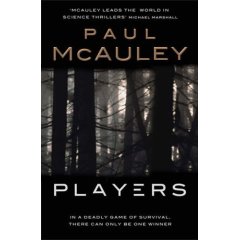
Players is published today. Here’s what it’s about, according to the blurb on the back:

A teenage girl found naked and fatally injured in mountain forest two hundred miles from her home.

The mutilated corpse of a young man in the Nevada desert, his heart and eyes removed.
The post-apocalyptic world of a role-playing computer game - and the murderous spee of a psychopathic killer driven by delusions of superhuman supremancy.


And rookie detective Summer Ziegler, pitched headlong into her first major case. But even as she tries to unpick the killer’s twisted logic, he lures her into a cat-and-mouse game with a spectacular climax of his own devising . . .

Buy a copy or two, and keep my sponsors happy. Why, I might even be able to afford to keep posting stuff here. American readers might like to note that at present there are no plans for a U.S. edition, so amazon.co.uk is your friend.

Sunday, February 04, 2007

Here Come The Suits

One character in Players scrapes a living by winning virtual weapons and treasures in online Massively Multiplayer games and auctioning them off via eBay. Another runs a business that uses teenage labour to set up virtual characters and do all the boring, repetitive labour of providing them with skill-sets and attributes before selling them to cash-rich, time-poor players who can’t be bothered to do the work for themselves. Luckily, I decided to set the novel in the present of its composition, 2006, rather than in the near future; a week before its publication, eBay announced that it is banning the sale of virtual objects, currency, and characters on its site.

This throws a hefty spanner into the burgeoning virtual economy based on trading of objects and money that exist only in digital form, and undercuts the long-established assumption that this real-money trading is an established part of online gaming. In fact, most companies that run online games prohibit RMT in their terms of service, and eBay seems to be not only clamping down on an area where fraud is rampant, but also anticipating legal arguments about intellectual property rights (it’s still allowing auctions of Second Life property, because Second Life’s publisher, Linden Lab, encourages players to trade goods), as well as the interest by some governments in regulating and taxing RMT. With Sony Online setting up its own 'Station Exchange' service and the rise of third-party trading sites like IGE, it looks like the Wild West days of online gaming’s virtual economy may be coming to an end. The cutting edge of the electronic frontier gets civilized faster than Deadwood: one moment it’s all wild-cat prospectors and gun-slingers; the next it’s banks, mining companies and the feds. Any day now, I expect the Mob to move in.

Monday, January 29, 2007

Altered Ego

According to this, I’m really Stanislav Lem (link via boingboing). Which is nice. After all, it’s about the only way I’m ever going to get within punting distance of a Nobel Prize.

Sunday, January 28, 2007

A Little Light Research

I've posted on the website a brief piece about a trip to Oregon to do some background research for Players.

Saturday, January 27, 2007

In the Pines

A couple of the reasons for setting Players in Oregon were the extensive forests along the coast, and the wonderful idiosyncrasy of a significant proportion of the people living there. Where else would you find someone turning an airliner into a home, in the middle of the woods?

Wednesday, January 24, 2007

The Blues

Actually, you'd get a better idea of the cover of Cowboy Angels if Blogger for some reason didn't include red in its palette when reproducing uploaded pictures. Which is a pity, as the dominate tone of the cover is, er, red. Hopefully, this is the last recursive post I make for some time, but if anyone happens to know how to post pictures that end up looking like the originals...

Tuesday, January 23, 2007

First Sighting


This is the cover rough for Cowboy Angels, which is slowly moving into production. I may be biased, but I think it very fine. The discrete open door (which you may have a hard time seeing in this low rez post) is highly significant, by the way.

Saturday, January 20, 2007

The Sorrows of Young Hannibal

Thomas Harris’s Hannibal Rising, which gives us the origin myth of his most famous creation, Hannibal ‘the Cannibal’ Lecter, displays Harris’s flair for concise narration and grand Guignol effects (as well as his weakness for tagging Hannibal’s victims with physically or morally repulsive characters, and his obvious dislike of the human herd), but it never quite lays to rest the feeling that it’s a franchise cash-in. After all, it is no more than an elaboration of a few pages of flashback in its predecessor, Hannibal, and a flashback that itself seemed pretty unnecessary, given that it attempted to explain the motivation of a monster who boasted to Clarice Starling in The Silence of the Lambs, ‘Nothing happened to me, Officer Starling. I happened. You can’t reduce me to a set of influences.’

The movie version of the novel shares this problem of redundancy, but like the novel it’s by no means as bad as it could have been. Apart from some necessary elisions and compressions, it sticks fairly close to the novel - not much of a surprise, given that Harris wrote the screenplay. In 1944, Hannibal Lecter’s family hide in the summer lodge when the Russian advance sweeps through their Lithuanian estate. His mother and father and their servants are killed in a firefight between a Russian tank and a Nazi Stuka; then a band of ragged looters take over the lodge and kill and eat his little sister, Mischa. Hannibal escapes, and after eight years flees a Soviet orphanage, and makes his way across Europe to France and his only surviving relative, the Japanese widow of his uncle. Plagued by nightmare flashbacks, he exacts a horrible revenge on a butcher who insults his aunt, and becomes a medical student and hones the skills he requires to track down the war criminals who murdered his sister.

It’s a handsomely staged period movie, with good direction by Peter Webber (who previously helmed Girl With A Pearl Earring), and despite a variety of Mittle-European accents the actors acquit themselves well. Gong Li brings a watchful stillness and quiet resolve to the part of Lady Murasaki, Hannibal’s aunt (although one wonders why a Japanese actress wasn’t given the role); Rhys Ifans plays Gaspar, the leader of the war criminals, with eye-rolling relish; and Gaspard Ulliel is a striking and devilishly gleeful young Hannibal. What the movie lacks, as does the novel, is a suitable antagonist for Hannibal to measure himself against. In The Silence of the Lambs he played cat-and-mouse games with Clarice Starling and in Hannibal he was chased not only by Starling but also by a venial Italian police inspector and his only surviving victim. In Hannibal Rising, Lady Murasaki does little more than fret over Hannibal’s monstrous descent, the French detective who investigates his trail of murders, Inspector Popil (played by The Wire’s Dominic West), is an incidental nuisance issuing impotent warnings, and until the final reel Gaspar is mostly offstage.

All that’s left is a series of increasingly gruesome set-piece variations on the theme of decapitation as Hannibal slashes through the ranks of the war criminals until he reaches their leader. There’s some small tension when Gaspar kidnaps Lady Murasaka, but it’s too little, too late. And although the movie tries to make something of the possibility that Hannibal can make a Faustian choice between good and evil, there’s little to be wrung from it because we already know what Hannibal will choose, and in any case Inspector Popil, echoing Red Dragon’s Will Graham, tells us that the human part of Hannibal died in the forest during World War Two, giving birth to the monster. And despite Ulliel’s hypnotic performance, it’s hard to muster sympathy for Hannibal’s devil, which makes his revenge all the more unpalatable.

Tuesday, January 16, 2007

Coming Attractions

The paperback was never quite out of print, but I’m pleased to announce that Gollancz will be republishing Fairyland in their new Modern Classics series, along with Stephen Baxter’s Evolution, Greg Bear’s Blood Music, Greg Egan’s Schild’s Ladder, Richard Morgan’s Altered Carbon, Christopher Priest’s The Seperation, Alastair Reynold’s Revelation Space, and Dan Simmons’s Hyperion. All with neat, graphic-design covers, coming to a bookshop or online merchant near you in August.

Meanwhile, I’ve been told that Players will feature in a front-of-store promotion in Waterstone’s next month. This is Good Stuff, as an awful lot of foot traffic (ie potential book purchasers) doesn’t make it past the barricade of front tables with their come-hither special offers, 3 for 2 stickers, and velcro filaments that attach to you while the book squawks buy me or my pet dog will die in the plaintive voice of a big-eyed starving orphan...

Monday, January 15, 2007

My Generation

So I’m listening to the latest Ray Lamontagne CD, Till The Sun Turns Black, and I’m thinking, Oh boy, what a great collection of 1970s albums he must have. And then I realise that it’s probably his father’s collection.

Stuff like this can make a man feel his years.

It’s a great CD, by the way.

Wednesday, January 10, 2007

Lake Deja Vu


The lead article in this week’s Nature, summarised on JPL’s site, confirms previous reports that there are presently lakes of what is presumably liquid methane and ethane on Titan. There are all kinds of lakes in all kinds of places, it seems. Some have been compared to flooded volcanic calderas, like Crater Lake in Oregon, which I visited a couple of years ago while doing research for Players, much of which is set in the forests of the southwest of that state; here’s a low rez photo to prove it. The island in the lake is called Wizard Island, and it’s another, smaller volcano inside the much larger one. With its panoramas of volcanic cones, and pumice fields, it’s a truly alien landscape for the British visitor; how strange and wonderful that it may be replicated in different materials on Titan, where a couple of my characters will shortly be playing a desperate game of hide and seek...

Tuesday, January 09, 2007

Dead Tyrant Storage

Last week, Richard Dawkins gave a refreshingly different reason why Saddam Hussein shouldn’t have been hung. His mention of using a time machine to retrieve Hitler for psychological study rang a very faint bell - didn’t someone write a short story on this theme?

In other news, ‘Dead Men Walking’ has been picked up by David Hartwell for his Best SF anthology. Gosh.

Sunday, January 07, 2007

Elsewhere

As threatened, I’ve posted the first two and a half chapters of Players on my much neglected web site.

Wednesday, January 03, 2007

Out There

From the good people who are swinging Cassini around the Saturn system, some choice images of moons seen previously, but never in such detail, and moons never before seen too. Glorious.

Tuesday, January 02, 2007

The Dreamer Awakes

The day after New Year’s Day, London is almost back to normal. On Christmas Day itself, G. and I walked down through Clerkenwell to the Thames, and at times were quite alone on streets where the only movement was litter blowing in the wind and pigeons pecking after it. All the buildings shuttered, asleep with that peculiar suspended stillness that’s so different to the quiet of the countryside, all except for St Paul’s Cathedral, lighted and open, getting ready for the Eucharist service, the sound of its bells floating after us as we crossed the footbridge to the South Bank. In the week between Christmas and New Year, many parts of the city were still so deserted they might have been sets from a movie depicting the aftermath of some depopulating disaster; but now everyone is back, and the city is awake again.

In the post today, the first of the year, a contract from Gardner Dozois, who wants to include my story ‘Dead Men Walking in his Year’s Best annual collection. Which is as good a start to the year as any.

Sunday, December 31, 2006

End Times

I think the extract above should be the last I’ll post here. By now, if you’ve been reading these snippets, you’ve met all the principal characters in Players, progressing much further will give away too much of the rest of the plot, and in any case the novel will be published in February if you want to find out what happens next (it’s not too early to preorder). I’ll probably put up a couple of complete chapters on my web site, though. Meanwhile, I’ve spent the last day of 2006 reading through and printing out the manuscript for the edited version of Cowboy Angels; it’s sitting by my elbow on the desk, cooling from the laser printer, as I type this. And I have to get back to the new novel, too. Busy, busy, busy . . . I’m not quite up to the standards of Anthony Trollope, who would upon completing the last lines of a novel immediately begin the first lines of the next, so as not to waste a minute of the time he alloted himself each day for composition before going off to his work at the post office (I can’t help wondering how completely he made the switch from novelist to civil servant each day, especially as he insisted that authors must live with their characters ‘in the full reality of established intimacy’). No, I’m a little more indolent. Before I head out to the Moon, and the moons of Saturn, and renew my acquaintance with Macy Minnot, Cash Baker, Sri Hong-Owen and all the rest, I’m taking tomorrow off. Happy New Year.

Players - 22

Although he still hadn’t reached the save point in the ruins of downtown Los Angeles, Daryl was feeling pleased with himself. He’d closed out bids on three items he was selling on eBay, drawn from the store of gadgets, maps, and other valuables he’d acquired during Seeker8's adventures in Trans, and the deals had fattened his PayPal account by just over four hundred dollars. Even better, his partner, Ratking, finally had reached out to him, explaining that he’d had to attend to some urgent business out in the world, but now he could devote his attention to the final stage of the treasure hunt.

> I’ve developed a new strategy. I can’t come with you, but I’ll be watching over you. I’ll be your guardian angel.

> Lay it on me, Daryl typed.

They were instant messaging, East Coast to West Coast and back again. It was one in the morning in Brooklyn, just after Daryl’s latest attempt to get Seeker8 to the save point had failed.

> I purchased a hack that lets me watch anyone in the game. I’ve become a point of view, pilgrim. I’m the eagle that dwells on the rock. Wherever you go, I’ll be right there with you. I’ll be the voice in the burning bush. I’ll speak to you out of the whirlwind.

Daryl, reading this, hunched over the glowing screen in his hot dark cell in Brooklyn’s unsleeping anthill, wondered what had happened to his partner while he’d been out of the loop. Previously, Ratking’s messages had been terse and clipped, pure business and always straight to the point, but now he was on fire with self-importance and a Biblical fervour.

After a moment’s thought, popping gum with machine-gun rapidity, Daryl rattled out his reply:
> I’d rather you were watching my back, helping me knock down the warewolves.

Strictly speaking, Seeker8 had been taken down by tar babies this time, but it had been a pack of warewolves that had driven him into the broken channel of the Los Angeles River, with its smoking cinder cones, fields of congealed lava, and asphalt pits from which dozens of tar babies had clambered, lumbering stiff-legged towards him from every direction like giant teddy bears dipped in sump oil, eyes glowing red, stubby arms spread wide. He’d killed thirty or forty with incendiary bullets and grenades before he’d been caught from behind in an unbreakable embrace and carried off and drowned in a deep pool of oily water. The night before that, warewolves had chased him howling through the ruins, playing with him, nipping at his heels, harrying him with balletic coordination until they’d finally closed in and taken him down.

Each attempt to reach the next save point had been harder than the last. It wasn’t just that the warewolves were making things difficult. The game itself constantly evolved as players roamed across it and interacted with each other, finding treasures, trading secrets and weapons, making alliances, building or destroying fiefdoms. The game learned from players’ moves, adjusted itself to their strategies, messed up their plans by throwing storms and earthquakes, bandits and monsters into their paths. Daryl had been worrying that he had reached a no-win stalemate, reloading time and time again to try to make progress from a hopeless position, but now his partner was back with the promise of fresh information and this weird new mystical slant. Telling Daryl now:

> The eagle dwells and abides on the crag of the rock, and the strong place. That’s me.

Daryl massaged his forehead with one hand, and with the forefinger of the other hit the Caps Lock key and pecked ?

> Read the Book of Job, pilgrim. Meanwhile, you need to reach that save point. Let me make some suggestions.

Ratking might have started to have sound like the preacher at the church Daryl’s mother attended each and every Sunday, but his advice was as detailed and sensible as ever. After some back and forth, he told Daryl to wait until tomorrow evening before he tried to move on.

> I’ll be watching then. And when you reach the next save point, we’ll work out what to do next.

Sunday, December 24, 2006

Players - 21

The blonde waitress, Janice, was a tall and big-boned young woman, with acne in the corners of her mouth and too much blue eyeshadow. She said that she’d heard about what happened to Edie on the TV news, just about everyone was cut up about it, and confirmed that Edie had been at work last Thursday but hadn’t turned up on Friday. ‘It’s a fucking shame what happened to her, excuse my French. She was a real darlin’. Everyone but Sneaky Pete liked her.’

‘Sneaky Pete?’

‘Mr Schopf, the manager? I don’t suppose he was much help to you.’

Janice had an accent from someplace three thousand miles south and east of Portland that lifted every other sentence into a question. She wore a candy-striped cotton dress and a white apron with a scalloped trim. Her dirty blonde hair was pulled back in a ponytail fastened with a rubber band, and there was a ballpoint pen tucked behind her ear.

Summer said, ‘Mr Schopf thought you might be able to help me.’

‘I don’t know how I can, but I can try.’

The girl was shifting from foot to foot in her trodden-down flat-heeled shoes, easing the weight on her ankles. Summer suggested that they sit in an empty booth. When they were settled, she said, ‘Did you know Edie socially, or just here at work?’

‘Just at work. We talked when we snuck cigarettes out back? I know she was on probation, and she wanted to go straight. Her big idea, she wanted to go work in one of those big offices downtown. Excuse me.’ Janice pulled a handkerchief from her sleeve and dabbed at the corners of her eyes and said in a pinched voice, ‘I thought she was sweet, y’know?’

Summer said, ‘Did she have a boyfriend that you knew of?’

Janice blew her nose with surprising delicacy. ‘She sure did. Real nice boy, name of Billy.’

Summer felt a quick flare of hope. ‘Did you ever meet this Billy?’

‘Just the once. He came by on Edie’s first day. I think he wanted to see where she was working?’

Garrulous, sharp-eyed Janice, every cop’s idea of a dream witness, gave Summer a description of Edie Collier’s boyfriend: six foot nothing, brown eyes and cheekbones to die for, shoulder-length black hair, rangy, wearing Hi-Top sneakers, blue jeans out at both knees and a raggedy old T-shirt. ‘And he had a couple of fingers missing from one of his hands.’

‘Which hand?’

‘The right.’

‘Can you remember which fingers were missing?’

‘The little finger, and the one next to it.’ Janice wrinkled her nose, remembering. ‘They were cut off at the knuckle? He kept his hand behind him, or in his pocket, like he was ashamed of it, but I saw it when he lit a cigarette.’

‘Did Edie ever tell you how her boyfriend lost his fingers? Was it some kind of industrial accident, for instance?’

‘Uh-uh.’

‘How about his last name?’

Janice looked up at the ceiling for a moment, thinking. ‘I don’t believe it ever came up. Like I said, I only met him that one time.’

‘Did Edie mention what he did for a living?’

‘I believe it was something to do with computers. He played games in competition, something like that? I know when he came in that time he had one of those laptop cases. But whatever he was into, it can’t have earned him much money -- the two of them were living out of his van.’

Thursday, December 21, 2006

Players - 20

The Black Rock Desert, Nevada. The sun a fiery nail hammered high in the wide blue sky; hot wind blowing threads of alkali dust across the playa towards bare mountains rippling behind glassy layers of heat haze.

Carl Kelley was standing in a thin wedge of shade at the rear of the big RV, wearing a baseball cap, an unbuttoned denim shirt and black combat pants, sipping from a bottle of spring water, and watching with edgy and uncharacteristic impatience as Dirk Merrit’s ultralight stooped and turned and climbed a couple of miles away. The buzz of the ultralight’s rear-mounted prop sounded like a bee at a window, rising and falling as Merrit harried the sacrifice to and fro across the dry lake bed, taking his bloody time about it.

The RV, a Coachman Cross Country SE finished with ten coats of hand-rubbed black lacquer and customized from stem to stern, was an ideal way of transporting sacrifices to remote sites where Dirk Merrit could act out his fantasies. The sacrifice could be kept trussed and gagged on the bed in the main sleeping compartment; Dirk Merrit liked to stretch out his unlikely length on the modified recliner behind the big, comfortable driver’s chair. And because people who own RVs often attach all kinds of leisure equipment to them, no one looked twice at the trail bike hung on the rear rack, or the Cumulus motor glider folded on its twenty-foot trailer.

The volume of the walkie-talkie clipped to Carl’s belt was turned right down because he was tired of listening to Dirk Merrit’s breathless whoops of glee, and he didn’t bother to follow the action with the pair of Bushnell field glasses hung around his neck because he knew from all the other times how it would go. If the sacrifice stood its ground, Dirk Merrit would fire shots around it until it ran; when it ran, he chased it and dive-bombed it and took pot shots until it was too tired to run any more, and then he landed and dispatched it with his crossbow.

All in all, it was an expensive, complicated, and dangerous way to get your rocks off, and Carl had lost all patience with it. Also, he felt a squirt of acid in his blood every time the flimsy little aircraft swooped low. Dirk Merrit took unnecessary risks because he thought he was smarter than anyone else and was going to live for ever. Carl would be glad enough to see the back of him, but it wasn’t quite time for him to die. Soon, but not quite yet.

Actuality

I’ve just received advanced copies of Players, and as usual had the strange feeling holding in my hand a physical representation of something that’s been in my head for the past couple of years. I must say the design and layout is striking and quite handsome. But as yet, I haven’t read any of it, being very aware of the Awful Curse of the About-To-Be-Published: an author, on reading in the first copy of his new book a random sentence on a random page will spot a howler that’s entirely his own fault. Unread, the book remains, like Schrodinger’s cat, uncollapsed into its final quantum state.

Wednesday, December 13, 2006

Players - 19

Summer sat at the back of the wood-panelled courtroom and watched things go down pretty much as Mark Kirkpatrick had predicted. A line of shackled prisoners shuffled in, mostly wife-beaters, petty thieves and hung-over drunks, all of them wearing orange jumpsuits with ‘Macabee County Correctional Facility’ stencilled in black letters across their chests and backs. Randy Farrell was hunched between a wincing teenager and a dignified black man with a shaven head. When he noticed that Summer was looking at him, something hardened in his face and he looked away.

The court officer, a balding man wearing an ancient Colt in a worn leather holster under his paunch, ordered everyone to rise, and the judge appeared from a door behind the bench like a figure in a medieval clock. Randy Farrell’s case was first up. Mark Kirkpatrick said that his client wished to plead guilty, and asked to approach the bench. He had a brief whispered conversation with the judge, stepped back. The judge fixed Randy Farrell with a sharp stare and told him that assault on an officer of the law was a serious matter, but given the circumstances and the recent tragic events she was minded to mitigate the sentence to a fine of five hundred dollars and a suspended sentence of a hundred days. The prosecutor made no objection, and the judge banged her gavel and moved on to the next case.

After that, everything moved with the smooth dispatch of a well-rehearsed execution. Randy Farrell was released into Summer’s custody, and after he had changed into his own clothes in a restroom and paid his fine at the cashier’s desk Summer drove him out of the parking lot and through Cedar Falls’s one-way system to the I-5.

Although no one followed them, Summer had the feeling that a hundred years ago they would have been tarred and feathered and ridden out of town on a rail. She let Randy Farrell sit up front next to her, but he hardly said a word on the long trip back to Portland.

Tuesday, December 05, 2006

Players - 18

Joseph Kronenwetter’s neighbour was a widow by the name of Rhonda Cannon, a sensible, sharp-eyed, garrulous old bird in jeans and a man’s shirt. She had no objection to answering Summer’s questions, telling her that she had known Joe Kronenwetter from birth, it was a darn shame he’d turned out the way he did.

‘He was a nice little boy, tow-haired and cute as apple pie. He got into a few scrapes with the law when he was a teenager, but it wasn’t anything serious, and he straightened up after he joined the army. His father, now, he was a drinking man. That’s how they reckon the house burned down, he passed out one evening with a lit cigarette in his hand. It was just after Christmas, in the middle of a snowstorm. My husband -- he was still alive then -- saw a light flickering through the falling snow, and realized the Kronenwetters’ place was on fire. It took the fire trucks more than an hour to arrive, not that it would have made any difference if they had turned up right away: the house was already alight from top to bottom when my husband spotted it. It was one of the strangest sights I’ve ever seen in my life, that house throwing yellow flame and black smoke into the night and snow coming down all the while.’

‘Joseph Kronenwetter was in the army at the time.’

‘Yes, ma’am, getting ready for the First Iraq War. He was given compassionate leave when his parents died in the fire, came back for the funeral, stood straight and tall in his dress uniform by his parents’ grave, and then he went right back to Kuwait to fight Saddam. He’s the only one of his family left. He had an older brother that died in a traffic accident, and there’s a sister who upped and went to live in Los Angeles, no one knows if she’s alive or dead. Anyhow, either the deaths of his parents hit him hard or something happened to him in Kuwait, but when he quit the army and came back here you could see at once that he was a changed man. He’d never been what you could call talkative, but when he came back he didn’t hardly care to pass the time of day. He was drinking heavily, he grew his hair and shambled about in ragged clothes like he was some kind of hobo, and when he did talk to you it was most often to sound off about how people were out to get him.’

‘What kind of people?’

Rhonda Cannon looked away, shrugged. ‘Oh, it was just nonsense. He said that people were hiding in the woods and watching him, nonsense like that. I paid it no heed.’

Summer said, ‘I know you don’t want to speak ill of your neighbour, ma’am. But anything you know about him could help us understand why this happened. It might even help him.’

‘I can’t see how, seeing as you have him locked up.’

‘It might help get him the right treatment.’
Newer Posts Older Posts